Brands
Aashirvaad Atta’s Ganesh idols on wheat grains set record this Ganpati

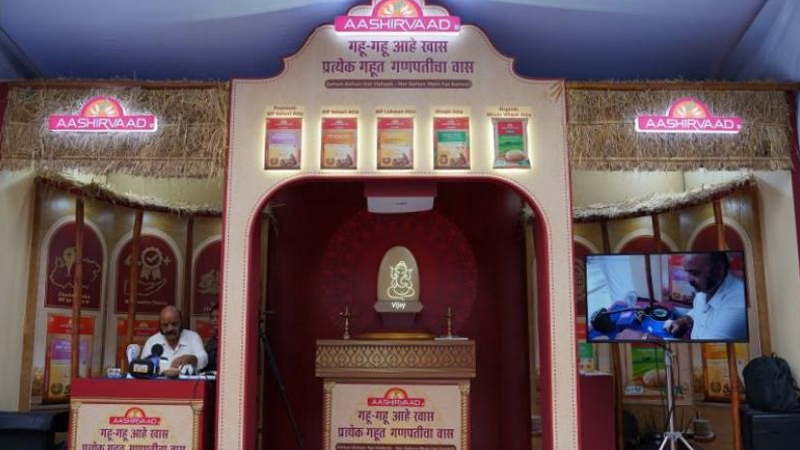
MUMBAI: Holy grain! In a record-breaking festive twist, ITC’s Aashirvaad Atta has proven that devotion need not be larger than life. Sometimes, it fits on a single grain of wheat.
During the 10-day Ganesh Chaturthi celebrations at the iconic ‘Andheri cha raja’ pandal in Mumbai, Aashirvaad pulled off a feat that earned it a place in both the India book of records and the Asia book of records for the ‘biggest distribution of Ganesha idols on wheat grains.’
Yes, you read that right. Lord Ganesha, meticulously engraved onto actual grains of wheat, was at the centre of this unique campaign. Over 2,000 micro-idols were distributed to devotees, each grain carefully enclosed in an acrylic display box with a built-in magnifying lens. Think of it as a divine collectible with a sprinkle of science and a whole lot of soul.

The initiative was part of Aashirvaad’s festive campaign: “Gehu gehu hai vishesh, har gehu mein hai Ganesh,” spotlighting the purity and cultural significance of wheat in Indian homes. Through this punny yet poignant message, the brand wove a connection between the grain that sustains millions and the god who removes obstacles.
Commenting on the milestone, ITC, chief executive, staples & adjacencies, foods division, Anuj Rustagi said, “Ganesh Chaturthi is a festival where devotion meets grandeur, and we wanted to offer something truly unique. By engraving Lord Ganesha on a single grain, we showcased how tradition and innovation can come together to celebrate purity in a memorable way.”
From its trusted ‘chakki MP sehori aata’ to ‘organic aata,’ Aashirvaad continues to win hearts across India by delivering quality flour that meets local tastes and now, sets records too.
Looks like when it comes to devotion and innovation, Aashirvaad truly doesn’t grain and bear it, it goes the extra (milli)metre.






Brands
Dunkin’ Donuts to exit India as Jubilant FoodWorks ends 15-year franchise deal
The quick service restaurant giant is ending a 15-year franchise partnership with the American doughnut chain, even as it renews its Domino’s agreement for another 15 years
NOIDA: Dunkin’ is done in India. Jubilant FoodWorks Ltd, the country’s leading quick service restaurant operator, has decided not to renew its franchise agreement with the American coffee and doughnut chain, and will wind down its Indian stores in a phased manner before December 31, 2026, bringing a 15-year partnership to a quiet, loss-laden close.
The decision, approved by JFL’s board on March 30, 2026, ends a relationship that began with a Multiple Unit Development Franchise Agreement signed on February 24, 2011. JFL will now evaluate and undertake what it described in a regulatory filing as the “rationalisation and/or cessation of certain operations and/or sale, transfer or disposal of assets and/or assignment or transfer of franchise rights,” all in consultation with Dunkin’s brand owners and strictly within the terms of the original agreement.
The numbers tell the story bluntly. In the financial year 2024-25, Dunkin’ India posted a revenue of Rs 37 crore against a loss of Rs 19 crore — a haemorrhage that was always going to test the patience of a parent company recording revenues of Rs 6,104 crore and a profit of Rs 194 crore in the same period. Doughnuts, it turns out, were never going to move the needle.
The contrast with JFL’s handling of its other marquee franchise could hardly be sharper. Even as it walks away from Dunkin’, the company has just doubled down on Domino’s, signing a fresh Master Franchise Agreement on March 31, 2026, granting it exclusive rights to develop and operate Domino’s Pizza stores in India for 15 years, with an option to renew for a further 10.
JFL, incorporated in 1995 and promoted by the Bharatia family, operates a network of more than 3,500 stores across six markets — India, Turkey, Bangladesh, Sri Lanka, Azerbaijan and Georgia. Its portfolio includes Domino’s and Popeyes on the global side, and two home-grown brands: Hong’s Kitchen and COFFY, a café brand in Turkey.
For Dunkin’, India was always a stretch. The brand never quite cracked the cultural code in a market where filter coffee and chai command fierce loyalty and where the doughnut remains, at best, an occasional indulgence rather than a daily habit. Fifteen years, mounting losses and a parent with better things to spend its capital on was always going to be a difficult equation to solve.
The doughnut has had its last day. The pizza, however, is staying.






