iWorld
Kuku Tech wins interim relief against Mohalla Tech in copyright suit
Delhi High Court orders takedown within 36 hours; next hearing May 13.

MUMBAI: Mohalla Tech’s platforms just got another legal speed bump because when short videos keep racking up lawsuits, even the feeds start feeling like evidence. Kuku Technologies Pvt Ltd (formerly Mebigo Labs) has secured interim procedural relief from the Delhi High Court in its copyright infringement suit against Mohalla Tech Pvt Ltd, the company behind Moj and Sharechat. In an order dated 18 March 2026, Justice Jyoti Singh exempted Kuku from pre-institution mediation under Section 12-A of the Commercial Courts Act, 2015, citing urgency and relying on Supreme Court and Delhi High Court precedents.
The dispute centres on alleged unauthorised use and dissemination of Kuku’s copyrighted content on Mohalla Tech’s platforms. The court issued summons, directed Mohalla Tech to file its written statement within 30 days along with an affidavit on documents, and granted Kuku liberty to file replication within 30 days thereafter.
While declining an ex parte ad interim injunction, Justice Singh recorded Mohalla Tech’s assurance that the flagged URLs were removed on 17 March and that no further promotion via push notifications would occur. The company was ordered to provide basic subscriber information for users linked to the disputed content within one week.

For future instances, the court mandated removal of any additional infringing links within 36 hours of notification. The matter is listed for hearing on 13 May 2026.
Kuku’s action joins a growing wave of legal challenges against Mohalla Tech. Zee Entertainment Enterprises Limited earlier sued over alleged violations, while Greenhorn Wellness Pvt Ltd (parent of StoryTV) claimed more than 4,500 instances of infringement. San Francisco-based Dashverse also sent a legal notice and threatened court proceedings after discovering pirated versions of its paywalled content on the platforms, demanding user details including IP addresses.
Mohalla Tech maintains it operates as an intermediary under the IT Act, 2000 and the 2021 Intermediary Guidelines, does not originate user-generated content, and acts promptly on valid complaints through robust grievance mechanisms.
In India’s booming short-video arena, where every clip can spark a copyright storm, the courts are sending a clear signal: platforms may host the content, but the responsibility to keep it clean is non-negotiable and the takedown clock is ticking faster than a viral reel.





Gaming
India’s broadcasters say no to Fifa World Cup 2026
Fifa has slashed its asking price by 65 per cent but India’s broadcasters are still not buying

MUMBAI: The world’s biggest sporting event cannot find a single taker in the world’s most sports-mad nation. Fifa’s television rights for the 2026 World Cup remain unsold in India, and the clock is ticking loudly.
To shift the property, world football’s governing body has already swallowed hard and cut its asking price from $100m to $35m, bundling in the 2030 edition as a sweetener. It has not worked. Indian broadcasters have looked at the offer, done the sums and quietly walked away.
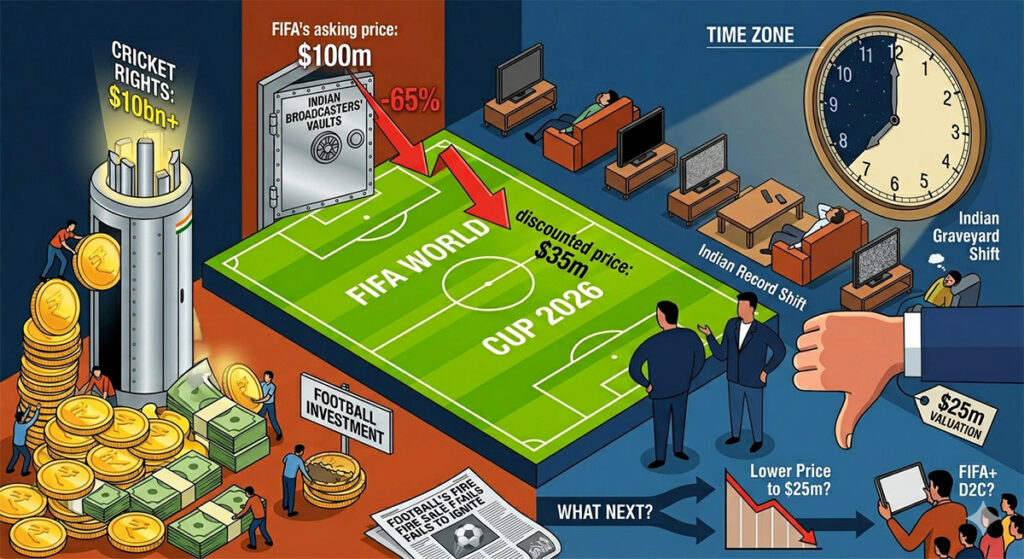
The reasons are brutally simple. The 2026 tournament, co-hosted by the United States, Canada and Mexico, kicks off in a time zone that turns India’s primetime into a graveyard shift. Most matches will air between midnight and 7am IST, a scheduling catastrophe for advertisers chasing mass reach. The 2022 Qatar edition was a gift by comparison, with matches dropping neatly into Indian evenings. North America offers no such luxury.
The market itself has also changed beyond recognition. The merger of Star India and Viacom18 into JioStar has gutted the competitive tension that once sent sports rights prices soaring. Where rival bidders once slugged it out, there is now a single dominant buyer, and it is in no hurry. JioStar has valued the rights at roughly $25m, a full $10m below Fifa’s already-discounted floor price. That gap has so far proved unbridgeable.
Broadcasters are also nursing a ferocious cricket hangover. Between 2022 and 2023, Indian media houses committed well over $10bn to cricket rights alone, covering IPL, ICC events and BCCI domestic fixtures combined. After a binge of that scale, appetite for a football package that delivers a fraction of the ratings, in the dead of night, is close to zero.
The economics of football broadcasting make the maths even harder. Cricket, with its natural breaks every few overs, is an advertiser’s paradise. Football offers a 15-minute halftime and precious little else. Recovering a nine-figure rights fee from a single half-hour ad window is a stretch at the best of times. These are not the best of times: the Indian government’s tightening grip on real-money gaming and gambling advertising has vaporised a category that once underwrote the economics of big sporting events.
Nor is the World Cup an anomaly. Indian Super League valuations have cratered. English Premier League rights have softened across successive cycles. The cooling of football as a broadcast commodity in India is structural, not cyclical.
With the tournament opening on 11th June, Fifa is running out of road. It may yet blink and meet JioStar at $25m. Or it may go direct, streaming the entire tournament on its own platform, Fifa+, or cutting a digital deal with YouTube, and hoping that a generation of Indian football fans finds its way there without a broadcaster to guide them.
Either way, the beautiful game’s Indian chapter is looking decidedly ugly.






