
Brands
India’s D2C sector draws nearly $6 billion as exits gather pace
Tracxn tracks 15 IPOs and 105 acquisitions as early-stage funding takes centre stage


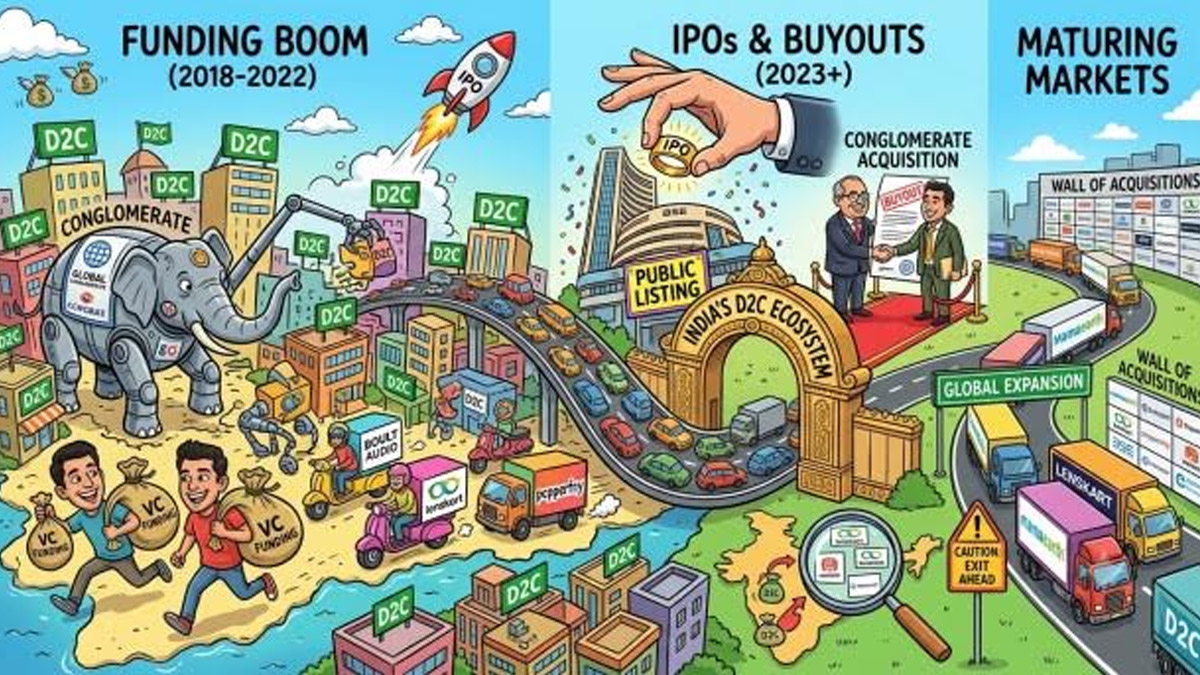
MUMBAI: India’s D2C story is no longer just about going direct, it is now going public and getting bought. Consumer brands have attracted nearly $6 billion across around 2,000 equity funding rounds between 2021 and August 2026, according to Tracxn’s latest India D2C Report.
The money is only half the story. The other half is what happens after the cheques are cashed. During the same period, the sector recorded 15 IPOs and 105 acquisitions, suggesting that India’s D2C ecosystem is gradually moving beyond its venture-funded, hyper-growth phase towards public markets and strategic buyouts.
D2C funding reached a peak of $1.6 billion in 2022, before falling to $824 million in 2024. The market recovered in 2025, with funding rising 9 per cent to $898 million.
Deal volumes, meanwhile, proved relatively resilient. Annual funding rounds remained between 307 and 380, indicating that investor interest continued even as the size and stage of investments changed.
Increasingly, that capital is finding its way to younger businesses. Seed and early-stage funding accounted for 70% of total funding value in 2025, up sharply from 38 per cent in 2021.
Late-stage funding has moved in the opposite direction, falling 69% in value between 2022 and 2025. The shift suggests investors are distributing capital across emerging consumer brands rather than concentrating it on companies already approaching maturity.
Five companies, Lenskart, Licious, FreshToHome, BlueStone and Country Delight have collectively raised around $2.3 billion in lifetime funding, according to Tracxn.
The group spans eyewear, meat and seafood, jewellery and dairy, underlining how far the D2C model has travelled beyond its early concentration in online fashion and beauty.
Lenskart is the clear funding heavyweight, having raised $981 million privately, roughly 43% of the combined funding raised by the top five. Lenskart and Licious together account for around 65% of the group’s funding.
The companies are also taking different routes to scale. Lenskart and BlueStone have entered the public markets, while Licious has indicated that it wants to reach profitability ahead of a planned IPO.
FreshToHome and Country Delight, meanwhile, continued to raise capital in 2026, securing $15 million and $7 million, respectively.
The IPO pipeline is becoming more varied too. Tracxn recorded 15 D2C IPOs between 2021 and 2026 YTD, spanning both heavily venture-backed startups and businesses that reached the market through more traditional routes.
Lenskart, which listed in November 2025, had raised $981 million in private funding from investors including SoftBank Vision Fund, Temasek, KKR and ADIA before its IPO.
Credo Brands, the company behind Mufti, followed a markedly different journey. Founded in 1998, it went public in 2023 after more than two decades of operating without institutional funding.
The contrast points to a broader opening of India’s public markets to consumer businesses with very different funding histories and growth models.
If the stock market is one exit door, acquisitions are becoming another. Tracxn recorded 105 D2C acquisitions between 2021 and August 2026, with established consumer companies increasingly stepping in as buyers.
Hindustan Unilever, Wipro Consumer Care, Reliance Retail, Aditya Birla Group’s TMRW and USV India feature among the prominent acquirers tracked by Tracxn.
The largest disclosed transaction among the highlighted deals was HUL’s $350 million acquisition of Minimalist in January 2025.
Reliance Retail’s acquisition of Clovia in 2022, alongside acquisitions by Wipro Consumer Care and USV India in 2026, shows how large incumbents are using D2C deals to add digital-first brands and enter fast-growing consumer categories.
For startups, meanwhile, being acquired can offer something venture funding cannot always provide: access to established distribution, infrastructure and operational scale.
India’s D2C market, in other words, appears to be entering a new chapter, one where the goal is no longer simply to build a brand and raise the next round, but to build a business that can eventually list, scale or land in a larger consumer empire.






