Comment
DTH, Prospect or Suspect?

Much is made of direct-to-home (DTH) broadcast as the new convergence mantra and conditional access these days, especially after Star TV Asia chairman James Murdoch, and News Corp chairman Rupert Murdoch made whistlestop visits recently to India for meetings with information and broadcasting minister Sushma Swaraj.
Murdoch Jr in fact, in a public address at the recently held Ficci Frames 2002, asserted that the Indian cable market based on its current C&S penetration, is grossly underestimated. Broadcasters only get a meagre slice of the $1 billion cable market as subscriber revenues vis a vis their counterprats in mature economies.
In a post free-to-air regime, the proverbial free loader mentality continues to rule the roost! And in a fragmented (unruly!) and unorganised (disorganised!) cable distribution business it is obvious that this will continue to be the rule rather than the exception for quite some time!

The Technology
In connection with this it is common to hear people talk about DTH and conditional access quite interchangeably, and to some extent as a “final solution” to the twin evils of “underpayment” or “under reporting”, and copyright protection!
Be that as it may, what DTH provides is the ultimate platform for a firm marriage between, what NewsCorp executives would call, “content and distribution”. It is indeed the end game of a natural three stage evolution of broadcasting. The first two stages being free to air, and paid subscriptions without individual addressability respectively!
In a digital (Ku band satellite) regime – CA an integral part of the set top box – takes care of the individual addressability issue. You can therefore pinpoint the total number of viewing homes to the last decimal point, and collect revenues to the last decimal point too! No more “Tu Tu Main Main!”
So what is this magical CA? CA is a proprietary encryption process that unscrambles a digital signal. It is embodied in something called a ‘CA module‘ – a smart card (microchip) which resides in the set top box and uses algorithms to unscramble the broadcast, thereby effectively barring third parties from accessing a service provider‘s subscriber base and programming but ensuring at the same time that the signal can only be viewed by legitimate and paying subscribers.
It is important to understand that whilst encryption is the central feature of any DTH service it represents only one part of its overall functionality. The second part is the SMS – an integral part of the overall platform management, which manages the critical interface between a consumer – prospect or suspect, and the service provider. It manages billings, customer service, subscriber marketing and churn management, and all transactional services across the entire value chain of broadcast and non broadcast services.
 |
The third part is the Electronic Programming Guide (EPG) – which ideally would have four components: the TV guide, PPV Movie guide, Interactive services and Mail service. All these are an inherent part of the set top box that then demodulates and decodes the digital signal for viewing.
The set top box besides offering full MPEG2 DVB decoding, also comes complete with a fast modem for the return path and in many ways the modern day set top box is a stripped down PC, and similar in specifications to the much heralded network computer!
The Value Proposition
My experience in designing & developing an indigenous 3-tier client-server subscriber management system/MDB for the Indian market leads me to believe that it is not as much to prevent copyright infringement, piracy and “under reporting” as much as to monetize, to use an old Internet term, several incremental revenue streams made possible by the marvels of digital technology. Whether that content be “paid” premium content (over and above the regular subscription fare), Pay-Per-View, NVoD, interactive service offerings viz. interactive shopping, music, home betting, home access, video games, travel bookings, and/or Internet/mail & data services. All this (to keep it simple) through a terrestrial return path.
While many of these services may indeed not be available from Day One it is an indication of the expandability of digital systems and concomitant opportunities for attractive additional revenue streams, alliances and cross promotions. Say a return path tie up with Hughes/MTNL, Internet access via Satyam, travel bookings through Travelgenie, home lotto through Playwin Infrawest, etc.
Further, with the market for telecom products getting de-regulated and unbundled there are further opportunities for carrying VoIP on satellite – IP enabled networks along with audio video and data further adding to the overall value proposition of being able to provide interactive value add services.
The Consumers and Markets
So what are the likely factors that will influence the adoption of a digital service? There are several. A consumer survey conducted by J Walter Thompson called ‘Project Titan‘ found that it is indeed not the perceived hardware issues, nor improved picture and audio quality, nor indeed the potential for interactivity that could be the driving factors behind its adoption.
Instead it would be more “consumer choice”, particularly in content such as film Based Programming and cricket. In essence the consumer was likely to regard “content” even above the cost of the set top box in making a decision whether to adopt a “paid” service or not! But yes there is to my mind a “threshold price” below which demand curve will follow its classical downward sloping nature – the lower the price, the higher the demand!
But for the moment let us address the “root”‘ issue of the hardware cost! Who pays for the set top box? Certainly not the broadcaster, as Star India CEO Peter Mukerjea recently and rightly qualified in an interview. The broadcaster will not underwrite the costs in entirety. Much like a PC vendor or your neighborhood ISP does not underwrite the servo-isolation transformer (SIT) – stabiliser (to those not geeky), nor the external modem which often comes along with the home PC.
It will be the customer who will need to factor this into his/her purchase decision.
What the Broadcasters will probably do is facilitate subsidization (directly or indirectly) and in tying up consumer finance to make the box available at fairly attractive terms to the end user. Alternatively, the Government may directly consider subsidization of an “open” set top box and collect a “toll” from various operators who want to have access to the end user on the “fair and timely” principle, as also, own the proverbial “last mile” to the subscriber. This option, while giving the consumer incredible choice, will help in offsetting costs of subsidization, avoiding duplication in efforts and standards, keep economists happy and lead to a high average revenue per set top box!
Ultimately it is the switching costs from the traditional cable operator to a DTH service that would need to be kept in mind and minimised to help drive subscriber base. This would depend on innovative financing schemes and an aggressive subsidization policy.
If the financing cost of the box+dish plus one time installation cost, yearly fees can be kept in the sub Rs 7000 (post subsidization and cash back for fixed sub period) in the first year. Then the economics of such a service should prove favorable.
Once the service picks up, the volumes would lead to a declining set top box cost, affordability and increased offtake. Ample evidence is there in the history of technology adoption to validate this trend. In 1996 the average mobile phone bill and a 1-minute call cost Rs 50,000 and Rs 16 respectively and had a subscriber base of few thousands! Today the handset costs sub-Rs 5000, call charges are Rs 1.49 a minute and has a subscriber base of 6.5 million!
In 1972 Sony introduced its VCR at a price of $2000 (in today‘s money terms). Today it costs less than $100, and has penetrated into 94 per cent of US homes! Initially, even in the US, the one time cost of DTH was $700, but now it is in the $200-300 range.
If indeed DTH has to pick up it has to look at a minimum penetration level of 10 per cent in Year 1. This would comprise of a large percentage of existing “subs” migrating to the new service plus possibly 50 per cent of all new “subs” moving directly to the new service. The entire cable market could grow (net of cannibalization) by about Rs 15000 million in Year 1 itself.
Probir Roy was previously vice-president (technology) for a global media company and was intimately involved in DTH platform management and spearheaded the country‘s first indigenous SMS for DTH operations in 1997.






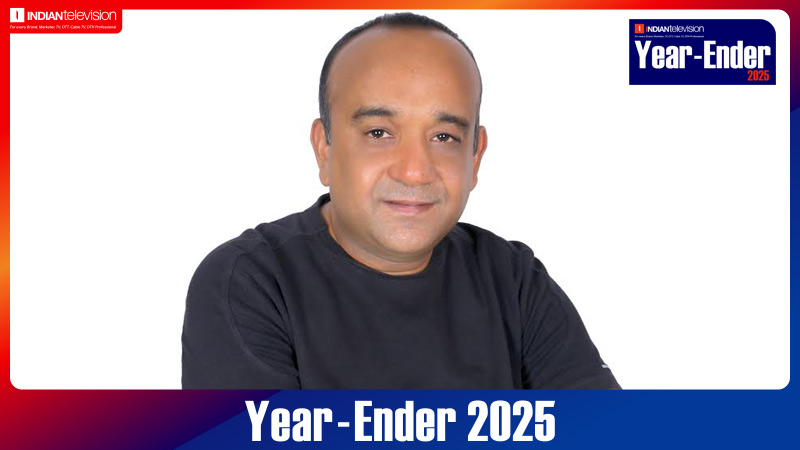
MUMBAI: 2025 will be remembered as the year India’s OTT industry stopped chasing scale for its own sake and began reckoning with how audiences actually consume content. Completion rates fell, patience wore thin and the limits of long-form excess became impossible to ignore. In this guest column, Pratap Jain, founder and CEO of ChanaJor, traces how micro-drama moved from the fringes to the centre of viewing behaviour, why short-form fiction emerged as a retention engine rather than a trend, and how platforms that respected time, habit and emotional payoff were the ones that truly grew up in 2025.
If there is one thing 2025 will be remembered for in the Indian OTT industry, it’s this: the industry finally stopped pretending.
Stopped pretending that bigger automatically meant better.
Stopped pretending that viewers had endless time.
Stopped pretending that scale without retention was success.
What began as a quiet reset in 2023 and a cautious correction in 2024 turned into a very visible shift in 2025. Business models matured. Content strategies tightened. And most importantly, platforms started aligning themselves with how Indians actually watch content, not how the industry wished they would.
At the centre of this shift was micro-drama—not as a trend, but as a behavioural inevitability.
When OTT finally understood the time problem
For years, long episodes were treated as a marker of seriousness. A 45–60 minute runtime was almost a badge of credibility. Shorter formats were pushed to the margins, labelled as “snack content” or “mobile-only.”
That belief quietly collapsed in 2025.
What platform data showed very clearly was not a drop in interest—but a drop in patience. Viewers weren’t rejecting stories. They were rejecting commitment.
Across platforms, the same patterns appeared:
* First-episode drop-offs on long-form shows kept increasing
* Completion rates continued to slide
* Viewers were sampling more titles but finishing fewer
At the same time, shows with episodes in the six to 10 minute range started showing the opposite behaviour: higher completion, higher repeat viewing, and stronger daily habit formation.
Micro-drama didn’t win because it was short. It won because it respected time.
Micro-Drama didn’t arrive loudly. It took over quietly.
There was no single moment when micro-drama “launched” in India. It crept in through dashboards and retention charts.
By mid-2025, it was clear that viewers were happy watching four, five, sometimes six short episodes in one sitting—even when they wouldn’t finish a single long episode. Romance, relationship drama, slice-of-life conflict, and grounded comedy worked especially well.
This wasn’t disposable content. It was compressed storytelling.
In shorter formats, there was no room for indulgence. Every episode had to move the story forward. Weak writing was punished faster. Strong writing was rewarded immediately.
Micro-drama raised the bar instead of lowering it.
Where ChanaJor naturally fit into this shift
ChanaJor didn’t pivot to micro-drama in 2025 because the market demanded it. In many ways, the platform was already built around the same viewing behaviour.
From the beginning, ChanaJor focused on short-to-mid-length fictional stories that felt close to everyday Indian life—hostels, rented flats, office romances, small-town relationships, young people figuring things out. Stories that didn’t need heavy context or cinematic scale to connect.
What worked in ChanaJor’s favour in 2025 was clarity:
* A clearly defined audience
* Tight episode lengths
* Storytelling that prioritised emotion and pace over spectacle
While several platforms rushed to copy global micro-drama formats, ChanaJor stayed rooted in familiar Indian settings and conflicts. That familiarity mattered. Viewers didn’t have to “enter” the world of the show—it already felt like theirs.
Why audiences started responding differently
One of the biggest misconceptions going into 2025 was that audiences wanted shorter content because their attention spans had reduced. That wasn’t entirely true.
What viewers actually wanted was meaningful payoff per minute.
On platforms like ChanaJor, episodes didn’t waste time setting the mood for ten minutes. Conflicts arrived early. Characters were recognisable within moments. Emotional hooks landed fast.
A typical consumption pattern looked like real life:
* One episode during a break
* Two more before sleeping
* A few the next day
This is how viewing habits are built—not through marketing spends, but through comfort and consistency.
Viewers came back not because every show was a blockbuster, but because they knew what kind of experience to expect.
2025 was also the year OTT faced business reality
The other big change in 2025 was on the business side. Subscriber growth slowed. Discounts stopped hiding churn. Customer acquisition costs rose.
Platforms were forced to ask harder questions:
* Are viewers finishing what they start?
* Are they returning without reminders?
* Is this content worth what we’re spending on it?
This is where micro-drama began outperforming expectations. A well-written short series could deliver sustained engagement without massive budgets. It didn’t peak for one weekend and disappear—it stayed alive through repeat viewing.
Platforms like ChanaJor benefited because they weren’t chasing inflated launch numbers. The focus was on consistency and retention, not noise.
Failures Became Visible Faster
2025 also exposed weaknesses brutally.
Several platforms assumed micro-drama was a shortcut—short episodes, quick shoots, instant traction. What they discovered was that bad writing fails faster in short formats than in long ones.
Viewers dropped off within minutes. Episodes were abandoned mid-way. Weak stories had nowhere to hide.
Micro-drama didn’t forgive laziness. It amplified it.
The platforms that survived were the ones that treated short storytelling with the same seriousness as long-form—sometimes more.
OTT Stopped Chasing Prestige and Started Chasing Habit
Perhaps the most important shift in 2025 wasn’t technical or creative—it was psychological.
OTT stopped trying to look like cinema. It stopped chasing validation through scale and awards alone. It began behaving like what it actually is in people’s lives: a daily companion.
Platforms like ChanaJor found their space here because that mindset was already baked in. The goal wasn’t to dominate a weekend launch. It was to quietly become part of someone’s everyday viewing routine.
That shift changed everything—from release strategies to how success was measured.
What 2025 Ultimately Taught the Industry
By the end of the year, three truths were impossible to ignore:
* Time is the most valuable thing a viewer gives you
* Retention matters more than reach
* Format must follow behaviour, not ego
Micro-drama didn’t take over because it was fashionable. It took over because it fit real life.
Looking Ahead
Micro-drama is not replacing long-form storytelling. It is redefining the baseline of engagement.
Longer shows will survive—but only when they earn their length. Short-form fiction will continue to evolve, becoming sharper, more emotionally confident, and better written.
Platforms like ChanaJor have shown that it’s possible to grow without shouting—by understanding the audience, respecting their time, and telling stories that feel real.
2025 wasn’t the year OTT became smaller. It was the year it became smarter.
Note: The views expressed in this article are solely the author’s and do not necessarily reflect our own.






