Comment
2024 The Change makers: Subhash Chandra, the corporate warrior

MUMBAI: Subhash Chandra. No idea if today’s GenZ AND Gen Alpha know who he was. The freedom fighter in the 1940s believed in the use of guns as much as Mahatma Gandhi did in ahimsa. He did his best to trouble the English during their occupation of India. For many he is just a name in the history books.
The modern day Subash Chandra that we know is also a doughty fighter. Excepting that he had a Goyal to his surname which he dropped. Excepting that he is an entrepreneur and a corporate warrior. The pioneer of lamitubes in the country. Now they are common place in this nation of ours but when he launched the tubes in India in the nineties as a replacement for the old aluminium toothpaste packaging, they were unfamiliar. T hey were an immediate success. Soon his Essel group was the largest manufacturer of the tubes in the worldThe pioneer of entertainment pay TV in India.
Then he launched his general entertainment television channel Zee TV, which was again a major runaway hit. It seemed whatever he touched turned to gold, or at least had to have long-term value.


Cut to two years go. In 2022, Zee got into a conversation with Sony – oops we should say Culver Max Entertainment – to merge in readiness for the media gorilla that would be formed with the merger of Reliance-Viacom18 and Disney Star India. Due diligences had been done, valuations had been arrived at, exit clauses and penalties agreed upon.
All seemed to be going well. Until dirt hit the fan and banks started calling in his loans he had taken against his equity holding in Zee to realise his grandiose ambitions to get into the development sector, that is infrastructure. The amounts were large and fingers of suspicions were pointed towards him and his son Punit the CEO of the company. Allegations that the Zee books were not all clean flew, the goateed entrepreneur was forced to step down as a director and chairman from his own company. As was his son as a director.
The banks continued to bay for his blood and some of the FIIs actually cashed in their holdings and the promoters’ equity in a company which he had built from scratch fell to sub-five per cent levels. He was suddenly a minority shareholder, with no control, no say, over the once entertainment power house he ruled with a tight fist.
Through all of this, Sony continued to say it would go ahead and wed Zee. Of course, negotiations were hard as the Zee share price had meanwhile tanked. After much discussion, a peace accord was arrived at that Punit would be MD.
Things seemed to be proceeding when before they could say hello, the proposal to form a joint venture with Sony collapsed with no hope of revival. In January earlier this year, Sony decided to officially call of their discussions with Zee TV. Two years of laborious discussions and getting ready for the merger went down the drain.
The two litigated against each other internationally and within India – Zee to get the NCLT’s order to Sony to go ahead with the joint venture and Sony seeking $90 million as penalties. They finally smoked the peace pipe in August 2024, calling of their disagreements with each other.
But some damage had been done by the banks which name called him, Sony’s backing out, all the bad press, and the impending merger between Disney-Star-Viacom18-Reliance. The Zee Entertainment share lay in the doldrums – a far cry from the Rs 500 zone it once roamed.
Zee would collapse was what many a media observer foretold: after all, from media baron Chandra was now a media fallen. Every company in his media empire – whether Zee Entertainment or Zee Media or Siti Networks or Dish TV – was facing flak from all quarters.

But not Subhash Chandra. He does not believe in giving up easily even if the powers that be in the Centre are not looking upon him kindly. Even if all the naysayers and rivals are ranging against him.
In fact, being down and out gave the 74 year old a new infusion of energy. He had something to prove to himself: that he could turn around the venture he had given birth to, nurtured, until, because of circumstances beyond his control, had gone out of his hands.
He came up with a plan to keep costs under control, let go of the flab that had accumulated in Zee Entertainment, trimmed the workforce and went back to the drawing board to begin almost as if anew. He got the professional Zeel’s board approval to back him and his rescue plan.
Along with his sons Punit and Amit, he went out into the market, calmed jittery nerves of banks, financial institutions, lenders, and the markets as a whole. He also hit the international markets and managed to get international financial institutions to invest in his abilities to get Zee back into fine fettle. He raised Rs 2,000 crore to almost every financial analyst’s disbelief. But that’s Subhash Chandra for you.
These days Subhashji or chairman (as he is called) is back on the shop floor – or should we say studio floor.
He’s rolled up his sleeves and he is back to doing what he did best in the early days of Zee TV: go by his gut and select the right stories and make them into TV shows. His goal: get Zee back to the top of the ratings charts. And be ready for the behemoth JioStar when it starts stomping its way into the marketplace with its large platter of offerings soaking up advertising and subscription revenues.
Will his magic work in today’s D2C world?
Will he win over his lost TV viewers again in an era where streaming is gnawing away at linear TV consumption?
Will he manage to get Zee5 to fire on all cylinders?
He will. That’s what he is betting on.
And we at indiantelevision.com also tend to agree.
For the gent from Hissar, Haryana, carries a name he has to live up to: Subhash Chandra.
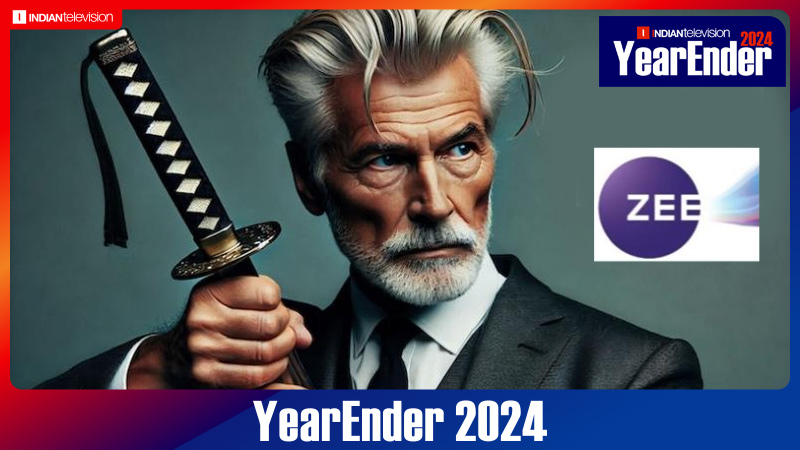
(We asked Microsoft image generator to re-imagine Subhash Chandra as a corporate warrior and the main image of the executive with the sword is one of the images it came up with. No offence is intended to Subhash Chandra nor to anyone at Zee TV nor his family. No copyright infringement is intended either)
Pictures of Shubash Chandra courtesy his X account.




MUMBAI: 2025 will be remembered as the year India’s OTT industry stopped chasing scale for its own sake and began reckoning with how audiences actually consume content. Completion rates fell, patience wore thin and the limits of long-form excess became impossible to ignore. In this guest column, Pratap Jain, founder and CEO of ChanaJor, traces how micro-drama moved from the fringes to the centre of viewing behaviour, why short-form fiction emerged as a retention engine rather than a trend, and how platforms that respected time, habit and emotional payoff were the ones that truly grew up in 2025.
If there is one thing 2025 will be remembered for in the Indian OTT industry, it’s this: the industry finally stopped pretending.
Stopped pretending that bigger automatically meant better.
Stopped pretending that viewers had endless time.
Stopped pretending that scale without retention was success.
What began as a quiet reset in 2023 and a cautious correction in 2024 turned into a very visible shift in 2025. Business models matured. Content strategies tightened. And most importantly, platforms started aligning themselves with how Indians actually watch content, not how the industry wished they would.
At the centre of this shift was micro-drama—not as a trend, but as a behavioural inevitability.
When OTT finally understood the time problem
For years, long episodes were treated as a marker of seriousness. A 45–60 minute runtime was almost a badge of credibility. Shorter formats were pushed to the margins, labelled as “snack content” or “mobile-only.”
That belief quietly collapsed in 2025.
What platform data showed very clearly was not a drop in interest—but a drop in patience. Viewers weren’t rejecting stories. They were rejecting commitment.
Across platforms, the same patterns appeared:
* First-episode drop-offs on long-form shows kept increasing
* Completion rates continued to slide
* Viewers were sampling more titles but finishing fewer
At the same time, shows with episodes in the six to 10 minute range started showing the opposite behaviour: higher completion, higher repeat viewing, and stronger daily habit formation.
Micro-drama didn’t win because it was short. It won because it respected time.
Micro-Drama didn’t arrive loudly. It took over quietly.
There was no single moment when micro-drama “launched” in India. It crept in through dashboards and retention charts.
By mid-2025, it was clear that viewers were happy watching four, five, sometimes six short episodes in one sitting—even when they wouldn’t finish a single long episode. Romance, relationship drama, slice-of-life conflict, and grounded comedy worked especially well.
This wasn’t disposable content. It was compressed storytelling.
In shorter formats, there was no room for indulgence. Every episode had to move the story forward. Weak writing was punished faster. Strong writing was rewarded immediately.
Micro-drama raised the bar instead of lowering it.
Where ChanaJor naturally fit into this shift
ChanaJor didn’t pivot to micro-drama in 2025 because the market demanded it. In many ways, the platform was already built around the same viewing behaviour.
From the beginning, ChanaJor focused on short-to-mid-length fictional stories that felt close to everyday Indian life—hostels, rented flats, office romances, small-town relationships, young people figuring things out. Stories that didn’t need heavy context or cinematic scale to connect.
What worked in ChanaJor’s favour in 2025 was clarity:
* A clearly defined audience
* Tight episode lengths
* Storytelling that prioritised emotion and pace over spectacle
While several platforms rushed to copy global micro-drama formats, ChanaJor stayed rooted in familiar Indian settings and conflicts. That familiarity mattered. Viewers didn’t have to “enter” the world of the show—it already felt like theirs.
Why audiences started responding differently
One of the biggest misconceptions going into 2025 was that audiences wanted shorter content because their attention spans had reduced. That wasn’t entirely true.
What viewers actually wanted was meaningful payoff per minute.
On platforms like ChanaJor, episodes didn’t waste time setting the mood for ten minutes. Conflicts arrived early. Characters were recognisable within moments. Emotional hooks landed fast.
A typical consumption pattern looked like real life:
* One episode during a break
* Two more before sleeping
* A few the next day
This is how viewing habits are built—not through marketing spends, but through comfort and consistency.
Viewers came back not because every show was a blockbuster, but because they knew what kind of experience to expect.
2025 was also the year OTT faced business reality
The other big change in 2025 was on the business side. Subscriber growth slowed. Discounts stopped hiding churn. Customer acquisition costs rose.
Platforms were forced to ask harder questions:
* Are viewers finishing what they start?
* Are they returning without reminders?
* Is this content worth what we’re spending on it?
This is where micro-drama began outperforming expectations. A well-written short series could deliver sustained engagement without massive budgets. It didn’t peak for one weekend and disappear—it stayed alive through repeat viewing.
Platforms like ChanaJor benefited because they weren’t chasing inflated launch numbers. The focus was on consistency and retention, not noise.
Failures Became Visible Faster
2025 also exposed weaknesses brutally.
Several platforms assumed micro-drama was a shortcut—short episodes, quick shoots, instant traction. What they discovered was that bad writing fails faster in short formats than in long ones.
Viewers dropped off within minutes. Episodes were abandoned mid-way. Weak stories had nowhere to hide.
Micro-drama didn’t forgive laziness. It amplified it.
The platforms that survived were the ones that treated short storytelling with the same seriousness as long-form—sometimes more.
OTT Stopped Chasing Prestige and Started Chasing Habit
Perhaps the most important shift in 2025 wasn’t technical or creative—it was psychological.
OTT stopped trying to look like cinema. It stopped chasing validation through scale and awards alone. It began behaving like what it actually is in people’s lives: a daily companion.
Platforms like ChanaJor found their space here because that mindset was already baked in. The goal wasn’t to dominate a weekend launch. It was to quietly become part of someone’s everyday viewing routine.
That shift changed everything—from release strategies to how success was measured.
What 2025 Ultimately Taught the Industry
By the end of the year, three truths were impossible to ignore:
* Time is the most valuable thing a viewer gives you
* Retention matters more than reach
* Format must follow behaviour, not ego
Micro-drama didn’t take over because it was fashionable. It took over because it fit real life.
Looking Ahead
Micro-drama is not replacing long-form storytelling. It is redefining the baseline of engagement.
Longer shows will survive—but only when they earn their length. Short-form fiction will continue to evolve, becoming sharper, more emotionally confident, and better written.
Platforms like ChanaJor have shown that it’s possible to grow without shouting—by understanding the audience, respecting their time, and telling stories that feel real.
2025 wasn’t the year OTT became smaller. It was the year it became smarter.
Note: The views expressed in this article are solely the author’s and do not necessarily reflect our own.








