Cable TV
So who does DAS benefit and what does RIO have to do with it?

When the BJP government was last in power with Ms Swaraj at the helm of the MIB, the digitisation process was first mooted in its original form of CAS. The populist notion was to bring down cable prices with the false concept of pay for what you want, so pay less. But little did the government realise that the customer’s cable bill was so significantly subsidised because of ‘under declaration’ that the ‘spoilt’ consumer in the cheapest cable market in the world would either have to reduce his current offering by half or more or if he wanted the same channel line up, would actually have to pay twice as much!
At that time, the broadcasters were resentful as reduced reach was imminent in an advertising driven market and for DPOs it was definitely not favourable as they would need to reduce the number of analogue channels to piggyback digital cable on some of the frequencies which was otherwise used for analogue channels. (This was because both digital and analogue had to be offered on the same network). And this reduction of analogue channels impacted their carriage potential and hence revenues.
So who won? None of the key stake holders- broadcaster, DPO or consumer.

So who does DAS in its new avatar benefit?
Certainly not the consumer from his cable bill point which was the original populist premise. Sure, the DPOs and broadcasters, once the dust settles down. With the transparency of set top boxes and doing away with ‘under declaration’, the MSO can now collect from the ground higher revenues and hence a bigger chunk eventually to the broadcaster. (Cable revenues were significantly lower than DTH revenues even though cable homes far exceeded DTH homes.) Who else benefits? The government, for sure, by way of higher taxes.
And the losers of course in the value chain would be no doubt the consumer now shelling out higher ARPUs. And of course the LCO who till now reigned king keeping the bigger chunk of collections.
So what’s wrong with DAS?
Fundamentally, the current consumer pricing structure, the RIO rates and the business model. If DAS was to benefit the consumer why is there no B to C model, why are there no retail prices with direct offers from broadcasters to consumers with pipeline commissions to DPOs. Why are RIO rates unrealistic? Why are DPOs free to do retail pricing? The problem is RIO is a regulatory created framework and broadcasters have maxed out after years of price freeze not knowing what to expect.
If DAS has to succeed then this whole pricing scenario has to be re-looked. How can the broadcaster market his product if the DPO controls retail pricing? Or given the RIO pricing (which will now be used as a basis for negotiation) will the broadcaster really allow the DPO to play the role of a wholesaler and buy in bulk and retail at attractive customer offerings significantly lower than RIO.
When regulation hinders market dynamics, it creates more absurdities. Any consumer product needs an MRP. Packages or stand alone. RIO is definitely not helping this process. It’s best the two beneficiaries – the DPOs and the broadcasters finally come together, see eye to eye and work out what is the magical pricing so that packaging and pricing is offered by both and directly to the consumer. If the DPO truly acts as a wholesaler he can surely better any packages the broadcaster directly offers unless of course the broadcaster/channel can go it alone which no doubt will be the true test of content and certainly a success yardstick to measure addressability.
So can the government bury RIO and keep the consumer in mind! TV entertainment is mass and needs to be looked at (retailed) as a service similar to that of consumer products! Let’s have an MRP, let’s also have a distributor pricing better than MRP. There is scope for both models to co-exist- DPOs mixing it up and offering multi-broadcaster packages and broadcasters also retailing with negotiated discounts to DPOs for pipeline usage and payment gateway.
A 100 million plus pay TV homes is a very robust subscription market!
Lastly, with the BJP now back surely we hope they will complete what they chaotically started. With the honourable I&B Minister Arun Jaitley and MoS Rajyavardhan Singh Rathore now at the helm it certainly looks like MIB is priority and our industry will definitely be both in competent hands and in their cross hairs!
(These are purely personal views of consultant Sanjev Hiremath and indiantelevision.com does not necessarily subscribe to these views.)






Cable TV
Hathway Cable appoints Gurjeev Singh Kapoor as CEO
Leadership change comes as cable TV faces shrinking subscriber base and modest earnings pressure
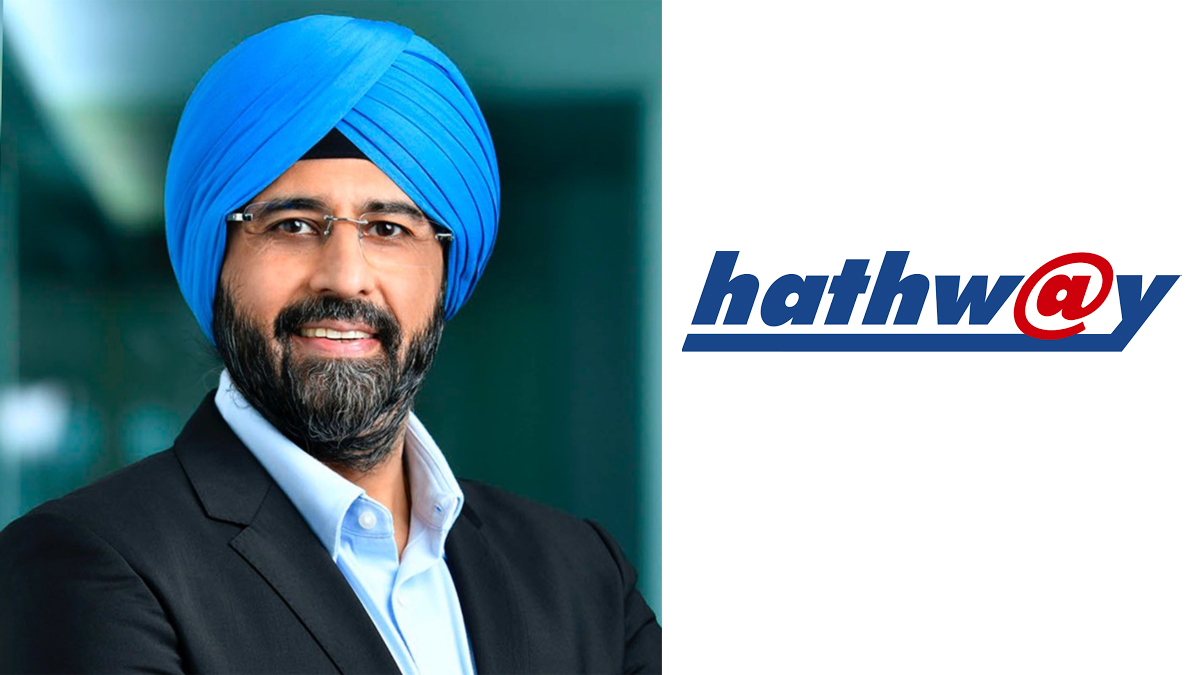
MUMBAI: Hathway Cable and Datacom has tapped industry veteran Gurjeev Singh Kapoor as chief executive officer, marking a leadership pivot at a time when India’s cable television business is under mounting strain.
Kapoor will take over from Tavinderjit Singh Panesar, who is set to retire in August after a long innings with the company. Panesar, chief executive since 2023, has held multiple leadership roles at Hathway, including his latest stint beginning in 2022.
Kapoor brings more than three decades of experience in media and entertainment. He most recently led distribution at The Walt Disney Company’s Star India business, now part of JioStar. His career spans television distribution and affiliate partnerships, with stints at Sony Pictures Networks India, Discovery Communications and Zee Entertainment.
Panesar, with over three decades in the industry, has worked across strategic planning, distribution and business development in media, broadcasting and manufacturing. His past associations include ESPN Star Sports, Star India, Apollo Tyres and JK Industries.
The transition lands as the cable sector grapples with structural disruption. Traditional operators are losing ground to streaming platforms, while telecom and broadband players tighten the squeeze with bundled offerings.
An EY report estimates India’s pay-TV base could shrink by a further 30 to 40 million households by 2030, taking the total down to 71 to 81 million. The slide follows a loss of nearly 40 million homes between 2018 and 2024, a contraction that has already wiped out more than 37,000 jobs in the local cable operator ecosystem.
Hathway’s numbers reflect the strain. The company reported a consolidated net profit of Rs 93 crore for FY25, down from Rs 99 crore a year earlier. Revenue inched up to Rs 2,040 crore from Rs 1,981 crore. As of December 2025, it had about 4.7 million cable TV subscribers and roughly 1.02 million broadband users.
Kapoor steps in with a familiar brief but a shrinking playbook. In a market where viewers are cutting cords faster than companies can reinvent them, the new chief executive inherits a business fighting to stay plugged in.







