iWorld
Bollywood stars go OTT

MUMBAI: Circa 1990: When a big Bollywood star like Amitabh Bachchan descended on the small screen to host a quiz show featuring the common man, it raised a few eyebrows as well as caught the nation’s fancy! The until then inaccessible and elusive star soon became a fixture in every home with a television set as he won fans and admirers with his trademark baritone voice.
Since then, Bollywood stars like Shah Rukh Khan, Salman Khan, Aamir Khan, Akshay Kumar, Hrithik Roshan, Priyanka Chopra and Sonakshi Sinha amongst others have tried their hand at television hosting various non-fiction shows. What’s more, the likes of Bachchan and Anil Kapoor have even gone a step further by featuring in fiction TV series like Yudh and 24 respectively. One of the major reasons for this was that each realised the power and reach of the television medium, which beamed into millions of Indian homes as opposed to the exposure they received via the limited number of theatre screens in India during their sporadic movie releases.
Cut to 2016: With the rise of the digital medium and the growing over-the-top (OTT) platforms, a handful of forward-thinking Bollywood stars now have their digital strategy chalked out in order to get even more closer to their fans not just in India but across the globe. With OTT’s unprecedented reach coupled with their fan following across various social media platforms, the world is literally their oyster!
Stars now want a bite out of the digital pie either by promoting themselves on various social media platforms or by appearing in digital-only content. Internationally, Netflix’s path-breaking original series House of Cards featuring a mainstream Hollywood actor like Kevin Spacey created waves when the first season was launched in 2013. What’s more, actors like Brad Pitt and Angelina Jolie-Pitt have also partnered with the streaming giant for exclusive original movies.
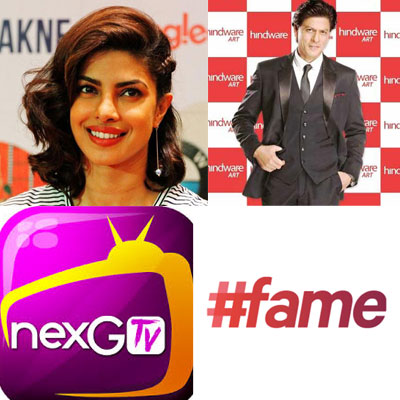
Closer home, Priyanka Chopra, who took a leap into American television last year with the ABC show Quantico, has now trained her eyes on the digital landscape. The avant-garde actress has partnered with OTT platform nexGTV, Fluence and Endemol-Shine India to co-produce and create an original 14-part mobi-series called It’s My City.
What’s more, last year Eros International’s OTT platform ErosNow unveiled ambitious plans to develop six original digital series namely The Clients, Khel, Legacy, Lost, Showtime and Fairytale featuring mainstream Bollywood stars like Ayushmann Khurrana, Anil Kapoor, Bipasha Basu, Chitrangda Singh, Radhika Apte and Nana Patekar.
And it won’t be long before the rest of the brood follows suit.
Speaking on the factors driving the trend of Bollywood stars taking this leap into the bottomless digital landscape in order to expand their visibility, #Fame CEO Saket Saurabh says, “Two things; firstly, stars have woken up to the importance of social media in engaging fans be it through their various social media profiles or through content present on web. The other crucial game changer is the rapid rate at which video content is growing in the digital space. Over the last three to four years, social media has evolved from being text based to video based. What’s more, live video is seeing a huge surge this year.”
However, Saurabh observes that this surge is mostly on Video on Demand (VOD) platforms as the OTT platforms are still feeding off television. “There is a dearth of original content when it comes to the OTTs, who are still showcasing content from movies and television,” he says.
nexGTV COO Abhesh Verma adds, “Digital platforms enable stars to engage and get up close and personal with their fans, followers, and influencers alike, via an alternate, personal, preferred, widely adopted and rapidly growing platform. This also allows them to complement their other update-led social media handles such as Facebook, Twitter, and Instagram etc. Together with its global pervasiveness and with 300 million+ active internet users of which a significant number is via mobiles, stars cannot afford to ignore digital anymore. While most of them are already exploring the medium in one way or another, it is time for them to start creating deeper engagements with not just their communities but the public at large.”
A major reason why stars are now drawn to this medium is also because of the way content is treated on this platform. Several creators are experimenting with different new formats now that they are not restricted by the limitations that the television medium brings. Producers are dabbling with short-form content to test the waters with edgy narrative. This also works in favour of the stars who want to showcase their talent in ways that movies and television don’t let them.
“In television and movies, celebrities are ‘cast’ in a role, while in digital there is scope for partnership,” points out Saurabh. “Digital content creators are partners not clients who have ‘hired’ the artists. Stars own the work they are doing digitally, which can also be weaved around them keeping their image in mind. Since it is a new medium there is a huge scope for artists to make the most of it. This will only increase the number of celebrities coming on the medium, as the audience base keeps increasing,” he adds.
Be it producers, content creators, advertisers, media planners or the OTT players, all unanimously agree that the current trend is a direct result of the sudden opening up of bandwidth in India for internet consumption, with the rollout of 3G and 4G being a key factor.
“If statistics shared by several data aggregators are to be believed, India has a mind blowing 320 internet connections through smart phones and another 160 million will be added by the end of 2016,” shares Rishi Negi from Fluence, who has co-produced the web series It’s My City with Chopra for nexGTV. “The way people are adapting to the second screen is amazing,” he adds.
Concurring with him is Madhouse COO and mobile marketing expert Milind Pathak. “Mobile is already taking upwards of 60 per cent of video consumption in the digital space. Looking at these numbers, it’s a logical move for Bollywood stars to come on to the mobile video platform to increase visibility and create more followers. Apart from YouTube, with apps like Hotstar, Sony Liv, Netflix, Hungama and VuClip, we have large active user base, which will easily reach over 50 million in 2016. So it’s imperative that Bollywood stars follow this platform.”
ErosNow COO Karan Bedi adds, “3G and 4G rollouts are picking up speed and the next 12 – 18 months will see a huge change in how people access content, especially video on their devices. You will see a huge pickup as more and more stars, production companies and producers migrate to OTT platforms. At ErosNow, for example, we are commissioning a whole series of original shows, some with stars, for the platform. It is still very early right now but all the stars will be present in the space.”
What’s interesting is ErosNow’s revenue model for the shows, which is layered between advertising, subscription and viewership based models that comes into play as one spends more and more time with the platform – ‘Pay As You Go.’ This points at how, even with the rapidly growing digital content and video consumption in India, monetisation is still a challenge and has to be carefully strategised. “Monetisation does work in a bit of a lag. Right now, monetised digital content is probably one-seventh or one-eighth of television, and one-sixth of the digital usage,” Saurabh guesstimates. “But that only means it is bound to get better from here on. It’s bound to correct itself, if we go by how businesses work,” he adds.
If one were to go by return on investment (ROI), then do celebrities entering the market increase production cost and thereby also affect the returns for a medium, which is still in its nascent stage? “Celebrities aren’t always looking to be highly compensated for these projects; at least not right now. Often it’s a partnership for them where they look at the outcome as a way to engage with the audience. Plus, their presence makes the discovery of the series easier in the million other videos circulating on the Internet,” says Negi.
Looking at it from an advertiser’s perspective as well, having celebrities onboard only make the IP more credible or preferable to invest in, Negi adds. “Brands are excited with the digital space. The industry is at a time when the platforms are just setting their viewership right. Right now, visibility and peaking the interest of various advertisers is more important than ROI. That will follow,” he states.
“OTT platforms will obviously increase prices if they have a Bollywood star on-board. However, having a star on-board doesn’t mean good viewership, which is more dependent on good and quality content. If premium quality content is available on the VOD, then these platform will attract premium rates from advertisers,” explains Pathak.
This can be a double-edged sword for independent content creators waiting to be discovered because as competition increases, the over all value in the medium will also increase.
What Netflix’s strategy will be in the Indian market in terms of original content featuring celebrated actors will definitely be worth watching. What’s more, with the impending launch of Balaji Telefilms’ OTT platform ALT Digital, it is likely that Ekta Kapoor’s production powerhouse, which has a galaxy of Bollywood stars within an arm’s reach, will also have some original digital aces up its sleeves when it launches.
For now, Bollywood stars are definitely going OTT on digital and by that we don’t mean over the top in the literal sense… at least not as yet!