I&B Ministry
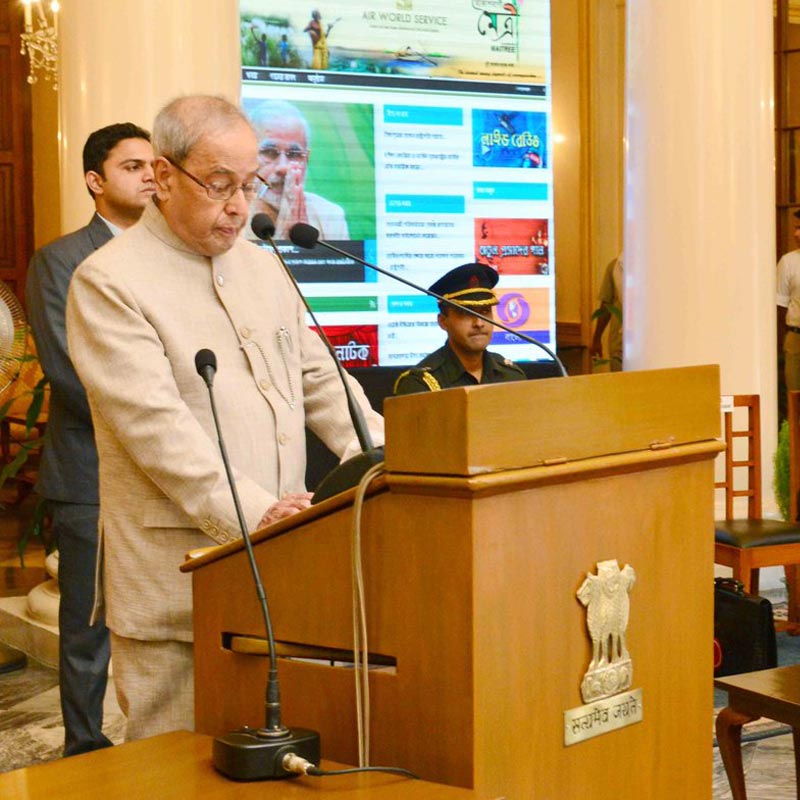
Indo-Bangladesh radio channel Akashvani Maitree launched by President Mukherjee
NEW DELHI: President Pranab Mukherjee today said blending of software content from both India and Bangladesh in the fields of art, culture, literature, music, and sports will help promote and preserve the composite Bengali cultural heritage which is the proud inheritance of all Bengali speaking people.
Launching Akashvani Maitree channel in Kolkata, he said this will make the channel a unique one and establish it in the hearts of millions of radio loving people both in India and Bangladesh as well as outside.
Test trials had begun several months earlier and it was to have been launched in June but waited till the President could go.
The President said India and Bangladesh are not just neighbours but are bound by an umbilical connection of ethnicity and kinship. India always attaches highest importance to bilateral relations with Bangladesh because of our shared history, heritage, culture, language, physical proximity and also the role which the two nations can play together for the development and prosperity of the entire subcontinent and beyond.
The bedrock on which the edifice of this unique relationship stands is the unwavering faith of both the countries in democratic values, principles of liberalism, egalitarianism, secularism and respect for each other’s sovereignty and integrity.
With the launch of Akashvani Maitree, he said a new chapter is being added in the annals of India-Bangladesh relations. He said that Akashvani Maitree and its multimedia website is a unique venture and initiative of All India Radio not only for the Bengali listeners in West Bengal, Bangladesh and the adjoining areas but the entire Bengali speaking Diaspora living in different parts of the globe.
The station is a terrestrial channel beamed from Chinsurah from a state-of-the-art DRM high power transmitter which is capable of reaching out to listeners in both West Bengal and the whole of Bangladesh.
AIR External Services Director Amlan Jyoti Mazumdar had earlier told Indiantelevision.com that the most unique aspect was that the new channel would also beam programmes that are either co-proiductions or produced by producers from Bangladesh. It could also be streamed online on airworldservice.org.

I&B Ministry
India turns up the heat on piracy, orders Telegram to axe 3,142 channels and blocks 800 websites
New legal teeth, nodal officers and notices to intermediaries signal that the government is done playing nice with copyright thieves
NEW DELHI: India’s war on film piracy just got significantly more aggressive. The government has ordered Telegram to remove 3,142 channels distributing pirated content, blocked access to around 800 websites through internet service providers, and put the full weight of freshly sharpened legislation behind the crackdown. The message from New Delhi is unambiguous: the free ride for copyright thieves is over.
Minister of state for information and broadcasting L. Murugan spelled out the legal architecture to the Lok Sabha on Wednesday. The Cinematograph (Amendment) Act, 2023, he said, now contains specific provisions designed to make piracy a genuinely painful proposition. Sections 6AA and 6AB prohibit unauthorised recording and transmission of films, with violations attracting a minimum of three months’ imprisonment and a fine of Rs 3 lakh. At the upper end, offenders face three years behind bars and fines of up to 5 per cent of a film’s audited gross production cost — a figure that, for a big-budget production, could run into crores.
The legislation also gives the government powers to act against intermediaries hosting infringing content, by notifying them under Section 79(3) of the Information Technology Act, 2000, and compelling takedowns and blocking actions. Under Section 79(3)(b), intermediaries are legally required to remove or disable access to unlawful content upon receiving government notice or court orders. The Information Technology (Intermediary Guidelines and Digital Media Ethics Code) Rules, 2021, add a further layer of obligation, requiring platforms to ensure their services are not used to host or distribute content that violates copyright or proprietary rights.
To put enforcement into practice, the Ministry of Information and Broadcasting has established a dedicated institutional mechanism, complete with nodal officers to receive complaints. Copyright holders, authorised representatives or individuals can report piracy through a prescribed format, after which the government issues notices to intermediaries to disable access to infringing links.
The most headline-grabbing action came on 11 March 2026, when Telegram was formally notified under Section 79(3)(b) of the IT Act and directed to remove and disable 3,142 channels found to be distributing unauthorised content belonging to OTT platforms, content owners and producers. The complaints that triggered the action came from OTT platforms including JioCinema and Amazon Prime Video, which alleged that copyrighted films, web series and other material were being shared on the platform on a massive scale. Telegram’s architecture, with its large file-sharing limits and capacity for user anonymity, has made it a favoured vehicle for exactly this kind of large-scale piracy.
The Telegram action sits within a broader pattern of escalating enforcement. Just days before the Lok Sabha statement, the ministry banned five OTT platforms for streaming obscene content: MoodXVIP, Koyal Playpro, Digi Movieplex, Feel and Jugnu. In July 2025, the Centre ordered the blocking of 25 OTT platforms accused of streaming obscene, vulgar or pornographic material, a list that included ALTT, ULLU, Big Shots App, Desiflix, Boomex, Navarasa Lite, Gulab App, Kangan App, Bull App, Jalva App, ShowHit, Wow Entertainment, Look Entertainment, Hitprime, Feneo, ShowX, Sol Talkies, Adda TV, HotX VIP, Hulchul App, MoodX, NeonX VIP, Fugi, Mojflix and Triflicks.
Rule 3(1)(b) of the IT (Intermediary Guidelines and Digital Media Ethics Code) Rules, 2021, provides the regulatory hook for those actions, prohibiting platforms from hosting content that is obscene, pornographic, invasive of privacy, gender-harassing, racially or ethnically objectionable, or that promotes hatred and violence.
For an industry that loses billions of rupees annually to piracy, the direction of travel is welcome. The question, as always, is not whether the laws exist, but whether the enforcement machinery can keep pace with the ingenuity of those determined to circumvent it. Three thousand channels down, and the pirates are already busy opening three thousand more.