Hindi
31st October: Genuine effort wasted
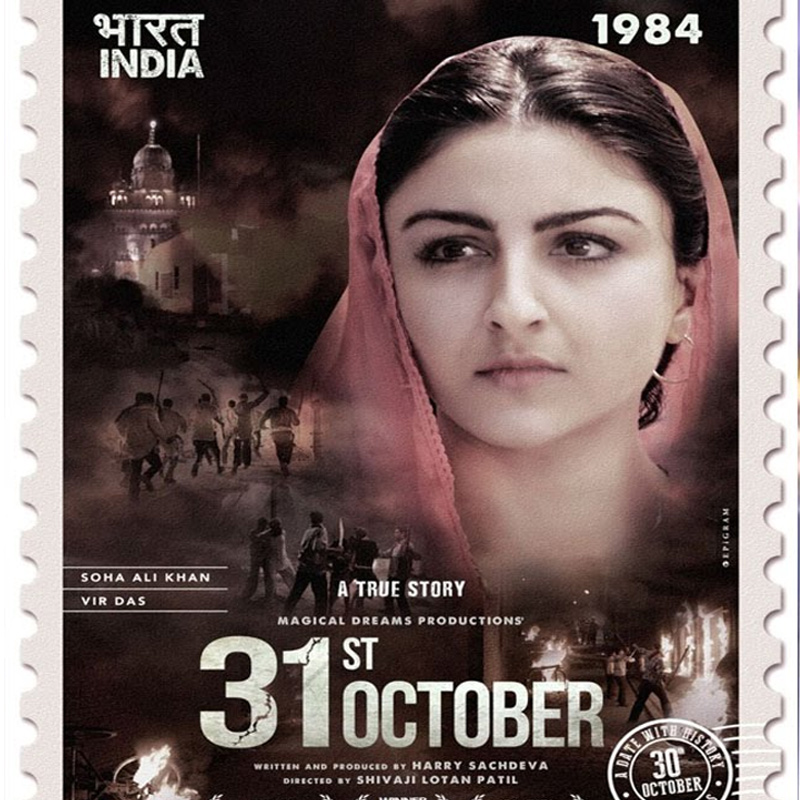
MUMBAI: Rather late in the day, 31stOctober is a film about the Sikh genocide of 1984 in Delhi in the aftermath of assassination of the then prime minister of India Indira Gandhi. She was killed by her security guards, who happened to be Sikh. That assassination, again, is attributed to the anger of the Sikh community following an army operation in the precincts of the Golden Temple in Amritsar. It has been 31 years since the episode and the relevance of this film and, what it wants to convey would make sense to few if any.
It is pre-October 31-1984 Delhi (mainly East Delhi as depicted in the film) where things are normal. People are going about doing their business, there is bonhomie. There never was a feeling of a divide between Hindu and Sikh, neither the issue nor a reason to think of them as different persons or of community was considered.
Vir Das is shown as a simple family-loving Sikh working for a government enterprise and has Soha Ali Khan as his wife and three children making up his family. He is a sincere worker and is much respected by his colleagues as well as friends.
It is another day at work and Vir is on his desk. But, unknown to him, things seem to have changed suddenly as even the office peon fails to respond to his calls, and there is an eerie silence around him. As he soon finds out, the whole office has gathered around a transistor radio; the news is not good. PM Indira Gandhi has been shot.
Suddenly, everybody has turned cold to Vir. He is advised to leave immediately. The offices are closed, shops down shutters and a pall of gloom and fear envelopes the air. Two lookalikes of prominent politicians are seen inciting the crowds (of Hindus) to go out and seek revenge from Sikhs.
What follows is a massacre of Sikhs all around the city reminiscent of Hindu-Muslim clashes of the Partition era. No Sikh seems to be safe, on the road or hidden at home, nor ones in the refuge of Hindu families.
Since this is not a documentary, a hint of a story and to balance things as well as to showcase a semblance of sanity among Hindus, comes in the form of Vir’s Hindu friends coming to his rescue risking their lives and braving police (which sided with the rioters) and the goons killing people indulging in arson mercilessly.
31stOctober is a sketchy, half-hearted effort to depict the genocide. As numerous Sikhs are slaughtered, an operation to save one family has little effect on the viewer. The direction is patchy; few films have succeeded in showing riot scenes convincingly in Hindi films and this film ranks at the bottom. What is bad about the film is the casting of Vir Das as the Sikh in danger. He carries his deadpan standup comedian look to this rather serious role. Add to that his characterization, which is of a Sikh who breaks down instead of standing by his family while his friends take the risk and one of them also sacrifices his life for the cause. Rest of the actors make a sincere effort.
If 31st October has an audience to cater to, it is unlikelyto be found in cinema halls.
Producers: Harry Sachdeva.
Director: Shivaji Lotan Patil.
Cast: Vir Das, Soha Ali Khan.
My Father Iqbal: No drama in Indian Muslim’s honesty
‘My Father Iqbal’ is like recreating the life of an honest man from Jammu & Kashmir. It is unlike any film as it is neither a potboiler nor cinema. There are no twists and turns, no villains nor a drama or a dramatic ending. It is the documentation of the life of a man and his circumstances. It is supposed to be a real-life account.
Iqbal Khan, played by Narendra Jha, is a family loving Muslim in Bani, a township in the state of Jammu & Kashmir, surrounded by Punjab, Himachal Pradesh and close to the Pakistan border. Jha is an engineer in the PWD and is a caring man to his wife, Komal Thacker, and his daughter and son. Jha is also sincere with his work, held in high esteem not only by his bosses and colleagues but also by people of the area for whom he always goes out of his way.
Jha, a man who is devoted to his family, lives like any normal, law-abiding and patriotic citizen despite the circumstances of terrorism and violence surrounding him and his town. He is probably traditional in the local sense because, while he dreams of sending his son to a high school in a bigger city, his daughter stays put in this small place.
Time passes by with Jha and Komal tending to the family, romancing and singing while the son on whom they hang much hope has grown up. He has decided to opt for a career in media and, much against his parents’ hopes, has decided to move to Mumbai. His concern for his family comes in the form of regular remittances of money.
Terrorism, which was lurking on the outskirts, has now invaded the town. The terrorists confer with Jha’s boss, the town police chief and the local MLA, to find a man with a clean image to store a bag full of RDX. The honest man in their sight happens to be Jha. Why do they need an honest man when the cop and the MLA are a party to the plan?
Jha’s refusal to accept the bag is countered by a threat of harm that can be done to his son in Mumbai. With his loyalty at stake, Jha asks his son to return home instantly. He wants to share his dilemma with his now grown-up son. The son is on his way and his train is running late by a couple of hours. But, Jha, who has made his decision not to betray his country, takes the ultimate step of not waiting for those two hours for his son to return.
That is about all as, if one is waiting for a traditional ending to the story, there is none. It is about a patriotic man who was a Muslim and from Jammu & Kashmir, who was neither a terrorist nor a supporter.
Besides the scenic beauty of the area of Bani and its surroundings, My Father Iqbal has some soothing music in a couple of ghazals. Performance-wise, Jha is impressive and Komal supports well.
Producer: Paresh Mehta.
Director: Suzad Iqbal Khan.
Cast: NarendraJha, Komal Thacker, Paresh Mehta, Raj Sharma, Amit Lekhwani, Sudam Iqbal Khan.

Hindi
Singing Better, Writing Deeper, Living Kinder: The Heart of Navjot Ahuja’s Journey
In a music industry that often rewards speed, spectacle, and instant recall, Navjot Ahuja’s journey feels refreshingly different. His story is not built on noise. It is built on patience, discipline, emotional honesty, and a quiet commitment to becoming better with every passing year. After 14 years of struggle, learning, performing, and writing, Navjot stands today as an artist whose success has not changed his centre. If anything, it has only made his purpose clearer.
For Navjot, music has never been about chasing fame alone. It has always been about expression. It is about writing more truthfully, singing more skillfully, understanding himself more deeply, and becoming a kinder human being in the process. That rare clarity is what gives his journey its beauty.
Where It All Began: A Writer Before a Singer
Indian singer and songwriter Navjot Ahuja’s musical journey began in the most familiar of places: school assemblies. But even then, what was growing inside him was not only the desire to sing. It was the need to write.
Long before he saw himself as a performer, he had already discovered the emotional release that writing offered him. For Navjot, words became the first true channel for feeling. Songwriting came before singing because writing was the only way he could let emotions flow through him fully. That inner pull shaped his artistic identity early on.
Like many young musicians, he sharpened his craft by creating renditions of popular songs.
Those experiments became his training ground. But the turning point came in 2012, when he wrote his first original song. That moment did not just mark the beginning of songwriting. It marked the beginning of self-definition.
A Calling He Did Not Chase, But Accepted
What makes the latest Indian singer-songwriter Navjot’s story especially compelling is the way he describes his relationship with music. He does not frame it as a career he aggressively pursued. In his own understanding, music was not something he chose. It was something that chose him.
There was a time when he imagined a very different future for himself. He wanted to become a successful engineer, like many young people shaped by ambition and conventional expectations. But life had a different script waiting for him. During his college years, around 2021, music entered his life professionally and began taking a firmer shape.
That shift was not driven by image-building or industry ambition. It came from acceptance. Navjot embraced the fact that music had claimed him in a way no other path could. That sense of surrender continues to define the artist he is today.
An Artist Guided by Instinct, Not Influence
Unlike many singers who speak openly about idols, icons, and musical role models, Navjot’s creative world is built differently. He does not believe his music comes from imitation or inherited influence. He listens inward.
He has never considered himself shaped by ideals in the traditional sense. In fact, he admits that he does not particularly enjoy listening to songs, especially his own. His decisions as a songwriter and singer come from instinct. He writes what feels right. He trusts what his inner voice tells him. He positions his music according to what he honestly believes in, not what trends demand.
That creative independence gives his work a distinct emotional sincerity. His songs do not feel calculated. They feel alive.
The Long Years of Invisible Struggle

Every artist carries a chapter of struggle, and Navjot’s was long, demanding, and deeply formative. One of the biggest challenges he faced was building continuity as the best new indian singer songwriter in an era where musical collaboration is increasingly fluid.
For emerging singers, especially those trying to build with a band, consistency can be difficult. Instrumentalists today have more opportunities than ever to freelance and perform with multiple artists. While that growth is positive and well deserved, it can make things harder for singers who are still trying to establish a steady team and sound around their work.
For Navjot, one of the most difficult phases came during 2021 and 2022, when he was doing club shows almost every day. It was a period of relentless performance, but not always personal fulfillment. He was largely singing covers because clubs were not open to original songs that audiences did not yet know.
For a new Indian singer and songwriter, that can be a painful compromise. To perform constantly and still not have the freedom to share your own voice requires not just resilience, but restraint.
“Khat” and the Grace of Staying Unchanged
After 14 years of effort, Navjot’s new love song Khat became a defining milestone. Professionally, he acknowledges that the song changed how society viewed him as a musician. It strengthened his place in the public eye and altered his standing in meaningful ways.
Yet personally, he remains unchanged.
That is perhaps the most striking part of his story. Navjot says his routine is still the same. His calm is still the same. His writing process is still the same. He does not want success or failure to interfere with the purity of his art. For him, emotional detachment from public outcomes is essential because the moment an artist becomes too attached to validation, the writing begins to shift.
His joy comes not from numbers, but from the attempt. If he has tried to improve his skill today, if he has written his heart out more honestly than before, then he is at peace.
Growth, Not Glory, Remains the Real Goal
Even now, Navjot is not consumed by labels such as singles artist, performer, or digital success story. His focus remains deeply personal. He wants to sing better. He wants to play instruments better. He wants to understand himself more. And he wants to become a kinder person.
That is what makes Navjot Ahuja’s journey so moving. It is not simply the story of a musician finding recognition. It is the story of an artist who continues to grow inward, even as the world begins to look outward at him. In an age obsessed with applause, Navjot reminds us that the most meaningful success often begins in silence, honesty, and the courage to remain true to oneself.