News Headline
Unethical viewership enhancing has spiralling effect, leads to carriage fee hike, says Chrome DM


MUMBAI: Whether or not a measuring agency or a ratings body approve of members who indulge in unethical means of doing business? Whether or not the business is doing well is only their mandate – however.
MIB has directed BARC India to stop generating ratings of those channels that use landing pages to boost viewership through high sampling and reach for their channels. On earlier occasions, when a broadcasters body had sought BARC to stop measuring a new channel’s ratings, the platform-agnostic measurement agency did not heed the advice.
Going by the past trends, broadcasters have been actively using landing pages to boost viewership. The logic is simple – a landing page ensures higher probability of the channel being watched, much like a supermarket where higher visibility of a product leads to impulse buying. Similarly, the channel with higher availability increases the chances of higher visibility, which eventually increases viewership.

Commenting on MIB’s decision, Chrome Data Analytics & Media CEO Pankaj Krishna said: “We support MIB’s decision of preventing channels using unethical routes to enhance their viewership, for e.g., if a channel opts for dual LCN, the others are compelled to follow it to safeguard their numbers, consequently causing the spiralling effect of increased carriage fees. However, a landing page is purely a promotional exercise. As long as a channel is not running on dual LCN, there is nothing unethical about the concept of channels using landing pages.”
As per the Chrome DM Landing Page Report- Week 36, 2017, there are over 400 landing pages active as on 05-09-2017 and are spread across channels and genres all over cable and DTH platforms.

Dual LCN denotes a channel running on two separate LCN#s within the same cable operator’s/DTH platforms feed.
He further added, “A channel’s presence on the landing page does not denote it being present on Dual LCN. All landing pages do not constitute dual LCN.”
Typically, there are, according to Chrome, three cases of landing pages that can arise:
CASE 1: Channel LCN as a landing page – So for e.g. if a channel is running on LCN #234 – and the set-top box switches on to LCN#234 hosting that Channel, the channel becomes the landing page.
CASE 2: Dual LCN with one LCN being a Landing Page – If a channel is running on LCN#234 – but the set-top box initiates a switches on to another LCN#, e.g. LCN#001, also hosting the same channel (as the landing page), that constitutes to a Dual LCN.
CASE 3: Dual LCN with neither being a Landing Page – When a channel is present on two different LCN#s e.g. LCN#234 & LCN#675 within different genres of the EPG, where neither is a landing page.
Chrome DM believes that there could be a concern in the latter 2 cases – as they constitute to Dual LCNs leading to an unsustainable model of boosting viewership through higher sampling and reach for these channels.
Landing pages are simple marketing exercises – mirroring an FMCG company placing its products at the entry/exit cash counters to boost sales. We believe MSOs have been monetizing landing pages as a source of additional revenue stream by running promos and commercials.
As per the Chrome DM Distribution Investment Index – “The yearly generated revenue ranges from Rs 50 million to as high as Rs 200 million for major MSOs and is all accounted for.
What is more important as an industry endeavour is to focus more on achieving 100 per cent digitisation in India, which missed its 31 March, 2017 deadline. Interestingly, analogue signals continue to be carried out in many parts of the country, indicating a lack of addressability and transparency that only digitisation can solve.
It will be interesting to see how BARC India, armed with software to primarily measure viewership for television channels and programmes in different geographies, will deal with the diktat to detect viewership from a particular distribution platform.





NEW DELHI: Hamdard Laboratories gathered a cross-section of India’s achievers in New Delhi on Friday, handing out the Hakeem Abdul Hameed Excellence Awards to figures who have left their mark across healthcare, education, sport, public service and the arts.
The ceremony, attended by minister of state for defence Sanjay Seth and senior officials from the ministry of Ayush, celebrated individuals whose work blends professional success with a sense of public purpose. It was as much a roll call of achievement as it was a reminder that influence is not measured only in profits or podiums, but in people reached and lives improved.
Among the headline awardees was Alakh Pandey, founder and chief executive of PhysicsWallah, recognised for turning affordable digital learning into a mass movement. On the sporting front, Arjuna Awardee and kabaddi player Sakshi Puniya was honoured for her contribution to the game and for pushing women’s participation onto bigger stages.
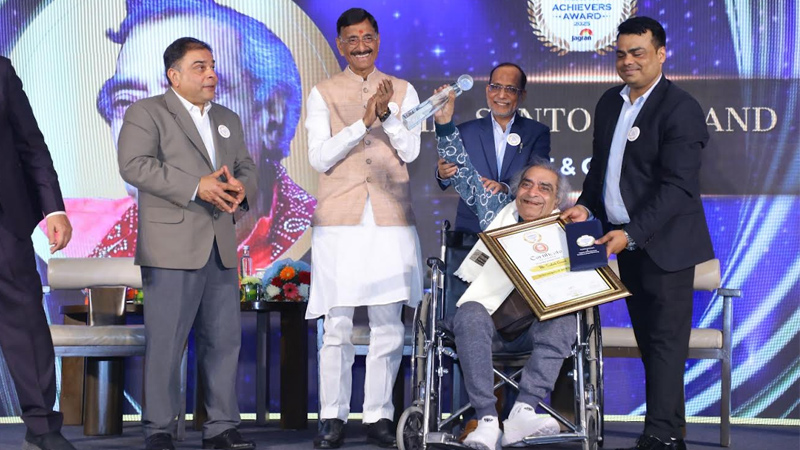
The cultural spotlight fell on veteran lyricist and poet Santosh Anand, whose songs have echoed across generations of Hindi cinema. At 97, Anand accepted the honour with characteristic humility, reflecting on a life shaped by perseverance and hope.
Healthcare honours spanned both modern and traditional systems. Manoj N. Nesari was recognised for strengthening Ayurveda’s place in national and global health frameworks. Padma shri Mohammed Abdul Waheed was honoured for his research-backed work in Unani medicine, while padma shri Mohsin Wali received recognition for his long-standing contribution to patient-centred care.
Education and social development also featured prominently. Padma shri Zahir Ishaq Kazi was honoured for decades of work in education, while former Meghalaya superintendent of Police T. C. Chacko was recognised for public service. Goonj founder Anshu Gupta received an award for his dignity-centred rural development initiatives, and the Hunar Shakti Foundation was honoured for empowering women and young girls through skill development.
The Lifetime Achievement Award went to former IAS officer Shailaja Chandra for her long career in public healthcare and governance, particularly in the traditional systems under Ayush.
Speaking at the event, Hamdard chairman Abdul Majeed said the awards were a tribute to those who combine excellence with empathy. “These awardees reflect Hakeem Sahib’s belief that healthcare, education and public service must ultimately serve humanity,” he said.
Minister Seth struck a forward-looking note, saying India’s young population gives the country a unique opportunity to become a global destination for learning, health and wellness by 2047.
The ceremony also featured the trailer launch of Unani Ki Kahaani, an upcoming documentary starring actor Jim Sarbh, set to premiere on Discovery on 11 February.
Instituted in memory of Unani scholar and educationist Hakeem Abdul Hameed, the awards have grown into a national platform that celebrates those building a more inclusive and resilient India. For one evening at least, the spotlight was not just on success, but on service with substance.