Hindi
Lucknow Central…Script of convenience

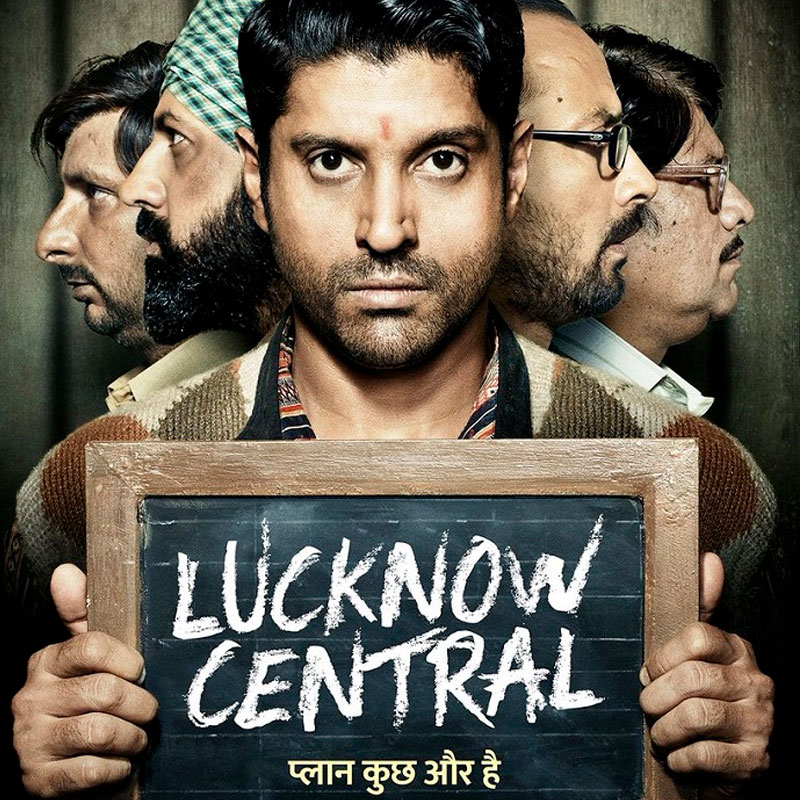
Lucknow Central has its inspiration from some foreign films. The titles acknowledge that it was inspired by Healing Hearts –the story is of a band promoted by a jail superintendent at a Lucknow jail with inmates. Whatever the source, the film has a similar storyline to the recently released film from Yash Raj Films, Qaidi Band, which had its inspiration from the life of Machang Lalung, a man who spent 52 years in jail without facing a trial.
The basic plot in both the films is the same. A few inmates are asked by a politician to form a music band to showcase the good work being done by authorities to rehabilitate prisoners. But, the inmates want to use the opportunity to escape from jail.
Farhan Akhtar is a small town UP lad who loves to sing and aspires to form his own music band someday. He cuts a CD of his music, and, during a public rally, he tries to reach out to the chief guest, Manoj Tiwari, to hand over his CD but is pushed back by a government official. His CD is stepped upon and trampled.
On the way back, Farhan observes that the same official’s car has broken down. He offers to help but makes fun of him and drives off. Unfortunately, for Farhan, this official is found murdered at the same spot.
Farhan is picked up the next morning and, in a speedy trial, consigned to life imprisonment which is later challenged by vested interests seeking capital punishment for him. The latter part is not necessary to carry on the story as such.
Independence Day and the Republic Day are celebrated in jails with active participation of the inmates and a minister uses the occasion to gain some photo-ops. The Chief Minister of the state, Ravi Kissen, wants the jail in Lucknow to have its own band for the forthcoming celebrations and competition between all the jails from the state. The task to put together a band is handed to Diana Penty, a social worker.
Farhan convinces her that only he can make a band in Lucknow Jail. He is transferred from Moradabad Jail to Lucknow Central Jail. Farhan’s plan is to use the celebrations when all jail authorities will be busy to escape from the jail.
Of course, his entry to Lucknow Central has some usual sequences one has been seeing in jail scenes for ages. There are groups and people who call the shots and dominate other inmates. Farhan is invited to join one group, and, when he refuses, he is made to suffer. But, soon his resistance brings the other group, led by Rajesh Sharma, to his side.
Farhan gets down to forming the band and adds Sharma, Deepak Dobriyal, Inaamulhaq and Gippy Grewal to the band. The band uses its practice sessions to plan their escape.While, the band has the blessings of the CM and the IG of Police, the one against it is Ronit Roy, the jailor who thinks that this jail is his personal fiefdom.
The jailed inmates who don’t know M of music are singing in tune and unison when Ronit decides to test them. The IG is impressed.
Lucknow Central is a script of convenience. Anything can happen at the will and whim of the writer. It makes everything look so simple in a heavily guarded jail, especially for those who have the jailor’s evil eyes set on them! For one thing, there are no pleasant moments in the film nor glamour even in passing. Not a presentable face either. Some sequences are unnecessary while some others are stretched. The direction is patchy and predictable. Editing, obviously, is lacking. The cinematography is okay. Production values are average. Music was supposed to be the film’s main theme but it falls short on that count also, with just a couple of its songs being good. But, is a Punjabi song necessary in Hindi films that too in the climax as a bunch of UP jail mates, led by a UPite Farhan, perform a Punjabi number for the UP CM? Choreography, however, is not up to the mark.
Lucknow Central has nothing to lure the viewers to the cinema.
Producers: Nikhil Advani, MonishaAdvani, Madhu G Bhojwani.
Director: Ranjit Tiwari.
Cast: Farhan Akhtar, Diana Penty, Gippy Grewal, Deepak Dobriyal, Rajesh Sharma, Inaamulhaq, RonitRoy, Ravi Kissen, Manoj Tiwari (sp. App).