Brands
Want the Silk jingle to be popular culture: Mondelez’s Prashant Peres

MUMBAI: What comes to your mind when you hear “Kuch meetha ho jaaye”? Chocolate? Cadbury? Dairy Milk? Well, that’s what most people in India associate with ‘meetha’ today. Cadbury India, now known as India, began its operations in India as early as 1948 by importing chocolates. The brand has always been known for its loveable advertisements that make you want to sing along and do a little jig yourself.
The Indian chocolate industry was worth Rs 58 billion at the end of 2014 and is predicted to reach Rs 122 billion with a compounded annual growth rate of 16 per cent by 2019. According to the 2016 Euromonitor International report, the chocolate confectionery market in India is projected to grow at around 8 per cent per annum between 2016 and 2021 to reach Rs 16,200 crore (on constant value) from Rs 11,256 crore in 2016, backed by better retailing across rural areas. Mondelez is the market leader in India’s chocolate space, with over 65 per cent market share and Cadbury Dairy Milk is its highest selling product that has a market share of 41 per cent.
Mondelez India has created some of the most prominent ads in its 69 years of existence in the Indian market, with some of the famous catch-phrases being — ‘kuch khans hai zindagi mein’, ‘shubh aarambh’, ‘pappu paas ho gaya’, ‘aaj pehli tareek hai’, ‘interstellar party’ and ‘kiss me’. All these notable campaigns are attributed to Ogilvy & Mather (O&M), an advertising agency that has been associated with the brand for over 25 years.

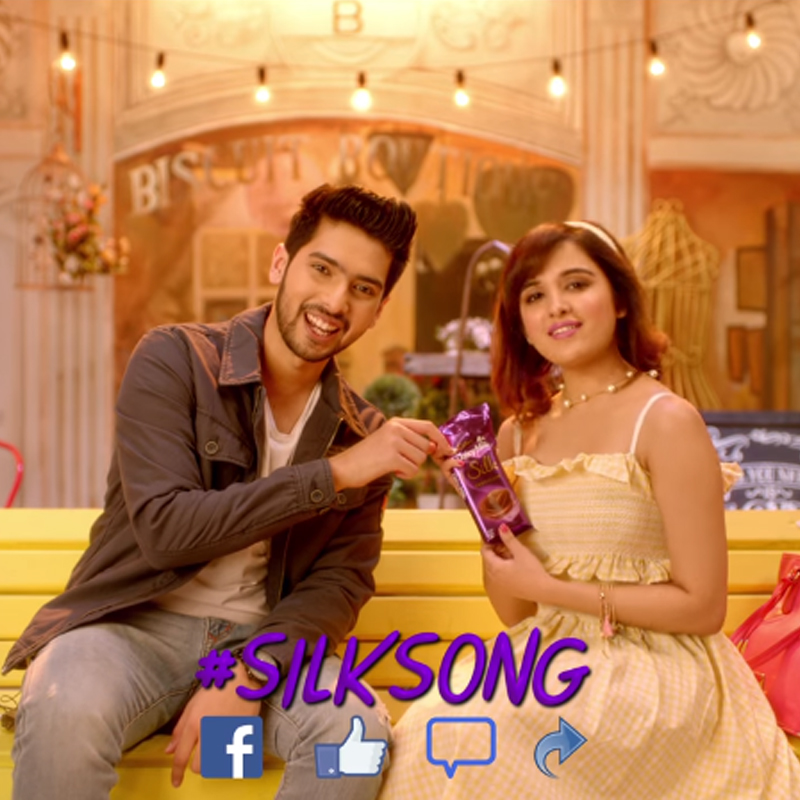
In India, Dairy Milk Silk has been one of the marquee products for the brand, which was launched in early 2010. Ever since then, the Silk jingle has probably been one of the most loved and recognised tunes in advertising and popular culture. Mondelez recently renovated its Cadbury Dairy Milk Silk making it curvier and with a fresh packaging. Now, the company has rolled out a new music video that showcases a refreshing rendition of the jingle by Bollywood singers Armaan Malik and YouTuber Shirley Setia.
O&M wanted to explore the digital medium to showcase the fresh new look of chocolate in an impactful manner. O&M Client services director Smita Padmanabhan says, “For Silk, the jingle is our biggest brand identity and for the first time this year we had a TVC where the protagonists were actually seen singing it on screen and that gave us the idea to get more people to sing the song they love.”
This festive season, it kept a low profile on mainstream media and instead took a risk in the digital medium with the first music video. Mondelez India director of marketing (chocolates) Prashant Peres mentions, “The key objective of this campaign was to try and make the jingle a part of the popular culture through an aspirational yet mainstream portrayal as digital is gradually becoming a lead medium for youth brands.”
Digital has shattered the invisible wall between brands and customers but it questions the optimal usage of advertisements. “While digital provides us with the medium to reach out and engage with consumers on a one-on-one basis, it is always a challenge to stand out in the clutter and grab their attention. As marketers we have to be on top of trends and emerging platforms, which pushes us to constantly innovate and adapt,” he adds.
When it comes to brand recall, some of Mondelez’s campaigns occupy the top shelf in the consumers’ mind. The iconic chocolate manufacturer has managed to pull the rabbit out of the hat every time it has wanted to draw attention to new brands. With digital on top priority to target consumers, we are sure the company will come up with another breakout campaign to call out to those with a sweet tooth.






Brands
UK’s OnlyFans seeks US investor at $3bn valuation after owner’s death
The adult video platform is seeking stability after the death of its billionaire owner
LONDON: OnlyFans is looking for a new partner. The London-based adult video platform is in advanced talks to sell a minority stake of less than 20 per cent to Architect Capital, a San Francisco-based investment firm, in a deal that would value the business at more than $3bn (£2.2bn).
The move is driven by an urgent need for stability. Leonid Radvinsky, the Ukrainian-American billionaire who owned OnlyFans, died of cancer last month at the age of 43, leaving the future of one of Britain’s most profitable privately held businesses suddenly uncertain.
The choice of Architect Capital is not arbitrary. The firm has deep expertise in financial services, which aligns neatly with OnlyFans’ ambitions to offer banking products to its creators, many of whom have long struggled to access basic financial services because of the nature of their work.
The numbers behind OnlyFans are, by any measure, staggering. The platform posted revenues of $1.4bn in the year to 30th November 2024, with a pre-tax profit of $684m, up four per cent on the prior year. Payments to creators totalled $7.2bn over the same period, a rise of nearly ten per cent. Radvinsky personally collected $701m in dividends from the business in 2024 alone, on top of more than $1bn in such payments he had already received. The platform, run through its parent company Felix International, hosts 4.6m creator accounts, with performers keeping 80 per cent of subscription proceeds and the platform pocketing the remaining 20 per cent. It has 377m fan accounts in total.
The current minority stake talks represent a notable scaling back of ambitions. In January, OnlyFans was reported to be in discussions with Architect about selling a majority stake of 60 per cent. Before that, the company had explored a sale to a consortium led by Forest Road Company, a Los Angeles-based investment firm. Neither deal materialised.
OnlyFans has built an enormously lucrative business on content that mainstream finance has long refused to touch. Now, with its owner gone and a $3bn valuation on the table, it is looking for the kind of respectable institutional backing that might finally persuade the banks to take its calls.







