MAM
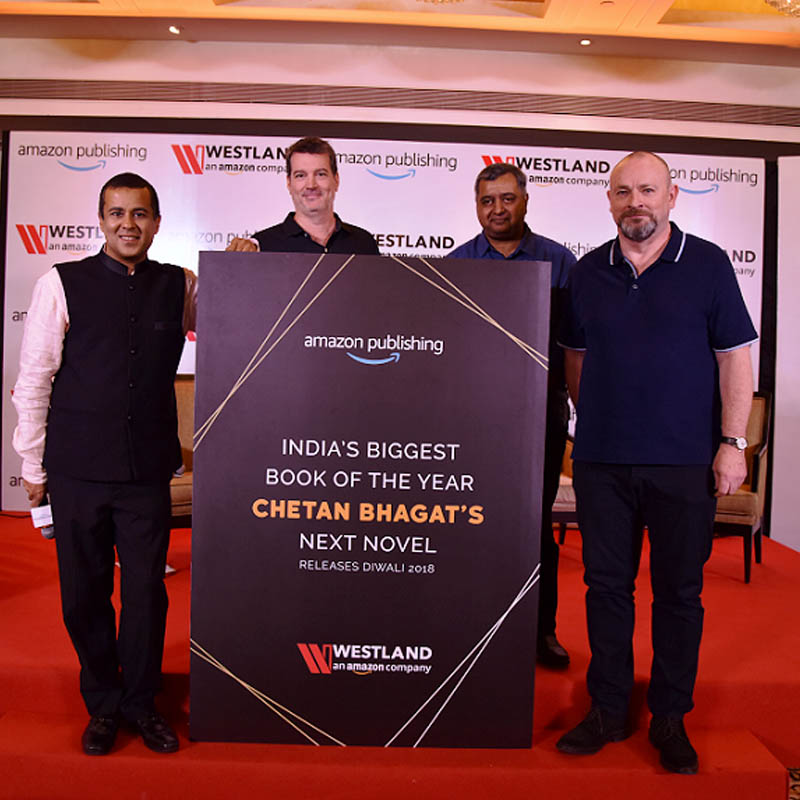
Amazon ties up with Chetan Bhagat for 6 books
MUMBAI: They say that traditional book publishing business is dying a slow death. But many beg to differ and believe it is here to say, although it may change its shape and format. Today’s generation does not want to invest time in sitting down and reading a novel, but they would rather go for an e-book or just listen to an audio book. Amazon was the first e-commerce platform that introduced the world to ebooks at large.
Launched in the United Stated in 2009, Amazon Publishing is the publishing arm of Amazon and publishes literary and commercial fiction and non-fiction. Today, Amazon Publishing is a global publisher working with Amazon editors in Seattle, New York, Grand Haven, Luxembourg, London, Munich, Milan, Madrid, and Paris. In Europe, Amazon Publishing publishes original-language titles in English, French, German, Italian, and Spanish.
In order to reach and target the Indian market and expand its publishing portfolio, Amazon acquired Westland publishing in 2017 which is one of the largest English-language trade publishers in India. Westland’s bestselling authors include Amish Tripathi, Ashwin Sanghi, Devdutt Pattanaik, Ashok Banker, Rujuta Diwekar, Rashmi Bansal, Savi Sharma, Anita and Harsha Bhogle, and Preeti Shenoy.
Adding another feather in the list, Amazon Publishing has now announced a global deal for the next six books by Chetan Bhagat, India’s best-selling author.
The deal includes three fiction and three non-fiction titles by Chetan Bhagat and Amazon Publishing to publish these books globally in print, eBook and audio formats. The first title in fiction genre will be published in October 2018 followed by a non-fiction novel later in the year. The pre-orders for the book will start from August.
It will be Chetan’s first book in both e-book and print formats with Amazon Publishing.
All the books are planned to also be available in multiple Indian language translation versions. Westland, an Amazon company, will distribute the print editions in India. All the books will also be available in multiples book stores and will be distributed in India by Westland.
Westland brings Amazon Publishing’s bestselling international books to the Indian market available in over 1000 outlets.
The company is excited to have Chetan Bhagat on board. Amazon Publishing vice president Jeff Belle says, “Millions of readers have enjoyed Chetan’s work for over a decade. His books deftly weave together the everyday life of youngsters with the prevalent social milieu of our time. He is India’s best-selling author and we both share a common passion that more people reading more books makes the world a better place.”
Delighted to partner with Amazon Publishing, Chetan Bhagat says, “Amazon’s online advantage and their commitment to reach every corner of India ties in well with my goals of inspiring every Indian read books.”
Chetan wants to reach readers in Tier II and Tier III with his books as he believes that the next round of readers are going to come from smaller towns and villages in English and regional languages.
With this deal, Amazon wants to bring Westland’s authors to more customers in India and over the world.
Our aim to bring great content from around to our readers whenever and wherever they are. For this, we are open to partnering with new publishers and authors. With the publishing arm, Amazon wants to reach the audience that is digital savvy and constantly on social media platforms to create reading culture among them.
Amazon Publishing will advertise and market the association with Chetan Bhagat on its online shopping website amazon.in followed by some OOH and digital.
Although Amazon registered a loss of USD 622 million from international operations in the first quarter of 2018, Jeff Belle is optimistic about the Indian market and will continue to invest in India as it sees great potential here with both sellers and customers.

Brands
Champions again: How India’s brands roared after the T20 World Cup win
From food delivery apps to dating platforms, Indian brands wasted no time riding the wave of India’s historic back-to-back T20 World Cup victory over New Zealand
Ahmedabad: On March 8, 2026, which also happened to be International Women’s Day, India scripted history by clinching the ICC Men’s T20 World Cup for the second consecutive time, defeating New Zealand in a thrilling final. As fireworks lit up stadiums and streets across the country, another kind of celebration erupted simultaneously: India’s marketing machine kicked into overdrive.
Within minutes of the final whistle, brands from every sector, tech giants, quick commerce players, streaming platforms, and even a condom brand, were racing to craft the cleverest, most culturally resonant posts. Here’s a breakdown of how India Inc. celebrated the nation’s historic win.
Zomato: The Repeat Order

Zomato, India’s ubiquitous food delivery app, kept things refreshingly simple. Playing on its own product language, the brand posted: “Repeat order delivered 🏆 #INDvsNZ.” It was short, punchy, and perfectly on-brand, a nod to India’s back-to-back title, framed through the lens of what Zomato does best: delivering again and again.
Netflix India: Now Watching History

Netflix India leaned into its streaming identity with a clever checklist format: “2007 ✅ / 2024 ✅ / 2026 ✅ / NOW WATCHING: HISTORY BEING MADE 🇮🇳💪.” By bookending India’s three T20 World Cup victories as a watchlist completed in real-time, Netflix framed the nation’s triumph as unmissable content, the kind of story only live cricket can tell.
Reliance Jio: Typing the Win

Telecom giant Reliance Jio delivered a wordplay masterclass: “India typed ‘WIN’ in Black Caps today. 🏆” The double entendre, referencing both the act of typing in capital letters and the Black Caps (New Zealand’s cricket team), was crisp, witty, and instantly shareable. It was a reminder that in the age of social media, the best brand moments often come in a single sentence.
Google India: Teen Bhai

Google India took a more data-forward approach, posting “Teen bhai… 🔥” alongside a screenshot of Google Search’s AI Mode highlighting India’s three half-centurions in the final, Abhishek Sharma (52 off 21 balls), Sanju Samson (89 off 46 balls), and Ishan Kishan (54 off 25 balls). It was a subtle showcase of its AI search capabilities wrapped in patriotic pride. “Teen bhai” (meaning “three brothers”) referenced the trio of batting heroes who powered India to a massive total of 255/5.
Zepto: The Women’s Day Double Whammy

Quick commerce platform Zepto scored the most culturally savvy moment of the day by merging two celebrations into one. Earlier on Women’s Day, Zepto had posted: “Women’s Day gift idea: World Cup trophy 🏆 #WomensDay2026.” After India’s win, they quote-retweeted their own post with the simple reply: “Gift delivered 🇮🇳💜.” It was meta, timely, and perfectly executed, riding both national pride and the Women’s Day conversation in a single stroke.
CashKaro: They Tasted So Good, India Ate Them Twice

Cashback platform CashKaro went for bold visual storytelling with a striking creative: a tiger sitting over the T20 World Cup trophy with a plate of kiwi fruit, accompanied by the tagline, “They tasted so good, India ate them twice.” The use of the tiger as India’s symbol, paired with a cheeky jab at New Zealand’s kiwi identity, made this one of the most talked-about creatives of the day.
Manforce: Round 2 Always Gives the Best Satisfaction

In perhaps the most audacious play of the lot, condom brand Manforce posted a creative featuring the T20 World Cup trophy against a stadium backdrop with the copy: “Guess Round 2 always gives THE BEST SATISFACTION.” The innuendo-laden post, hashtagged #BackToBackChampions, was quintessential Manforce, a brand well-known for consistently using cricket moments to drive cheeky, double-meaning campaigns that generate massive engagement.
Parle-G: Pehle Dip Se Aakhri Cup Tak

Beloved biscuit brand Parle-G went the emotional, illustrative route with a vibrant artwork showing Indian cricketers lifting the World Cup trophy superimposed onto a giant Parle-G biscuit. The tagline, “Pehle dip se aakhri cup tak / Parle-G humesha saath rahega” (From the first dip to the last cup, Parle-G will always be with you), was a masterstroke of nostalgia marketing, connecting the simple act of dunking a biscuit in tea to an entire nation’s cricket journey.
Domino’s India: No Kiwi on This Pizza

Domino’s India served up a deliciously savage quip: “India mein pineapple on pizza chala nahi, Kiwi toh kya hi chalta 😜🏆 #Champions #India.” By invoking the age-old pineapple-on-pizza debate, Domino’s made a clever statement: if Indians won’t accept pineapple on pizza, there’s certainly no room for the Kiwis (New Zealand) either. It was the kind of post that got fans and foodies alike sharing in equal measure.
JioHotstar: History Repeated, History Defeated

As the official streaming home of the ICC T20 World Cup, JioHotstar had the most at stake and arguably the biggest platform. The brand’s post was thunderous in its simplicity: “HISTORY REPEATED, HISTORY DEFEATED!” A bold, all-caps declaration that served as both a celebration of India’s second consecutive title and a subtle flex for the broadcaster that streamed every ball of it.
Tinder India: It’s a Match Again

Dating app Tinder India proved that no brand is too far removed from cricket fever with a perfectly on-brand line: “India just matched with the world cup again 💙🇮🇳.” By using its own core product concept, a “match”, to describe India’s World Cup triumph, Tinder struck a note that was both clever and effortlessly native to the platform’s voice.
Snabbit: Sabko Dho Diya

Home services startup Snabbit rounded out the celebrations with a pun-driven visual: an Indian jersey hanging out to dry, with the copy “Sabko dho diya, ab champions hawa khayenge,” roughly translating to “Washed everyone clean, now the champions ride the breeze.” The laundry-meets-cricket metaphor (“dho diya” means both “to wash” and “to thrash completely”) was a crowd-pleaser that perfectly captured the irreverent, punchy spirit of Indian moment marketing.
The bigger picture
What these posts collectively demonstrate is the extraordinary maturity of Indian digital marketing. Brands no longer simply congratulate, they connect their core product identity to the cultural moment in ways that feel earned rather than opportunistic. In the space of under an hour, the same victory inspired a food app to talk about repeat orders, a dating app to talk about matches, a laundry startup to talk about washing opponents, and a telecom giant to make a pun about capital letters.
The convergence of India’s World Cup win with International Women’s Day added yet another dimension, as Zepto demonstrated brilliantly, showing that the best brands are always watching for the intersection of multiple cultural conversations.
India’s cricketers gave the country a night to remember. And India’s marketers, it seems, were ready and waiting.