MAM
Vistara’s Robot wins big at ICMG Global Architecture Excellence Awards 2018

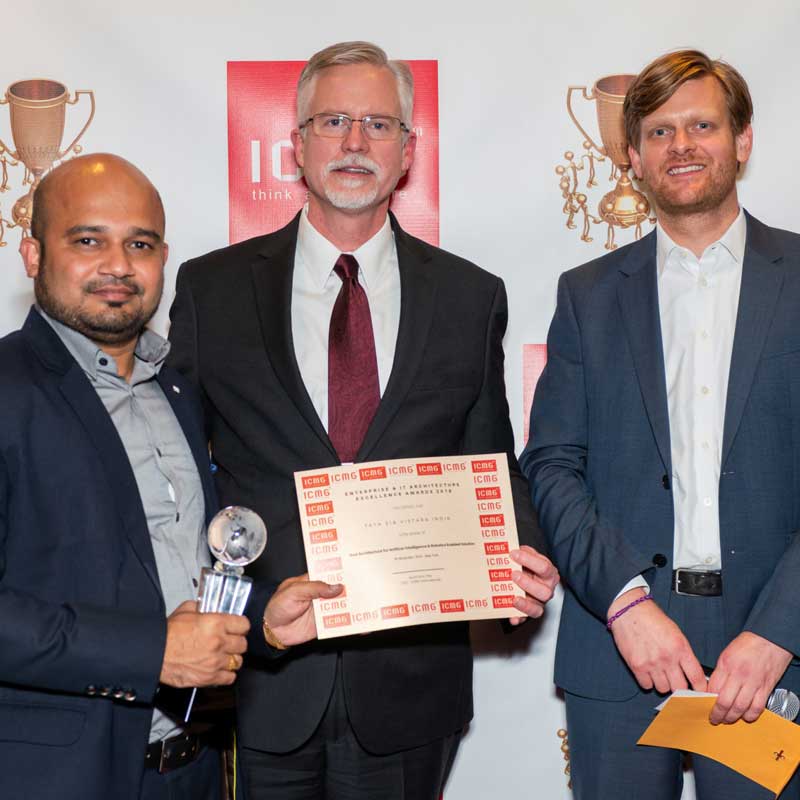
MUMBAI: Vistara, India’s finest full-service carrier, has bagged the prestigious ICMG Global Architecture Excellence Awards 2018 at the Architecture World Summit 2018 recently held in New York, USA. Vistara’s Robotics Program – of which the airline recently introduced India’s first robot designed to assist travellers at airports – was adjudged the winner in two categories – Artificial Intelligence & Robotics Enabled Solution and Customer Centricity & Excellence categories, by an eminent jury panel led by Mr. John Zachman, known as the Father of Enterprise Architecture. Vistara’s robot won against innovations from some of world’s biggest organizations operating in diverse sectors.
Winners of the coveted ICMG Global Architecture Excellence Awards are selected through an elaborate, stringent process of four rounds that requires showcase of technology expertise, deep domain understanding, overall vision for the industry and a case study presentation at Architecture World Summit.
Expressing his delight, Mr. Leslie Thng, Chief Executive Officer, Vistara, said, “We are happy to receive this recognition for an innovation that truly reflects Vistara’s steadfast focus on transforming the experience for air travellers.”
Mr. Ravinder Pal Singh, Chief Information & Innovation Officer, Vistara, said, “For us, Vistara’s robot is a remarkable ‘Make in India’ story, and for it to be recognized at a global platform against world leaders in technology, makes this award so special. At Vistara, we are very upbeat about leveraging AI and other technologies to drive innovation that would make air travel a truly seamless and joyful experience.”
In the last 12 years, ICMG Architecture Awards have become the most prestigious global award program honoring excellence in the Enterprise and IT Architecture, with the leading companies from over 30 countries participating every year.
Vistara’s robot was also recently awarded by ET NOW for ‘Excellence in Leveraging IT for Business Performance. As part of its futuristic technology framework, Vistara introduced the first-of-its-kind robot earlier this year and ushered in a novel innovation in the form of an indigenously built robot that assists travellers in the airline’s lounge at New Delhi’s Terminal 3, Indira Gandhi International Airport, addresses their queries and also entertains them. It is built on a chassis of four wheels, enabling it to rotate 360 degrees, and has three in-built cameras for cognitive interaction. At present, the robot is equipped to perform functions such as scanning boarding passes, providing useful information about the terminal, departure gates, weather conditions of the destination city, real time flight status, play songs, games, etc. The robot’s capabilities are being enhanced and it is being upgraded to perform more complex tasks in the near future, to assist travellers in many more ways.
As the highest-rated Indian airline on Skytrax and TripAdvisor, and winner of several ‘Best in Industry’ awards, Vistara has consistently raised the bar for operations and service delivery in the Indian aviation industry in a short span of less than four years. The airline today serves 22 destinations with over 800 flights a week and a fleet of 22 aircraft, and has flown over 12 million customers since launch.
About Vistara (TATA SIA Airlines Limited): TATA SIA Airlines Limited, known by the brand name Vistara, is a joint venture between Tata Sons Limited and Singapore Airlines Limited (SIA) with Tata Sons holding the majority stake of 51% in the company and SIA holding the remaining 49%. Vistara brings together Tata’s and SIA’s legendary hospitality and renowned service excellence to launch the finest full-service carrier in India aimed at creating memorable and personalized flying experiences for its customers. Vistara commenced its commercial operations on January 9, 2015 with an aim to set new standards in the aviation industry in India.