ces
Consumers Expect to be Riding Hyperloops and Owning Home Robots in 2030 According to Survey by CITE Research/Dassault Systèmes
MUMBAI: Dassault Systèmes (Euronext Paris: #13065, DSY.PA) today revealed that consumers expect that cities in 2030 will be filled with technology that improves overall quality of life, delivers socially-conscious benefits and personalizes experiences. The findings came from a survey of citizens representing the demographics of U.S. adults that was conducted in partnership with independent market research firm CITE Research.
Hyperloop rail, fully connected smart home systems, mobile payments and personalized preventive health plans are just a few of the disruptive technologies underway today that will become the norm in 2030 according to respondents, who were polled on their expectations for future experiences in home, travel, health and retail. While consumers expect personalization as one of the top benefits of technological innovations in 2030 in each of these categories, they also cite security, energy efficiency, convenience, accessibility, savings and prevention as benefits expected from the different technologies.
Findings from the survey include:
· Personalized experiences are seen as the primary benefit of advancing technologies, particularly among millennials. Among 18-34 year olds, technology is expected to deliver experiences that are customized to their own personal needs and tastes; respondents over the age of 35 expect technology advancements to provide primarily a better quality of life.
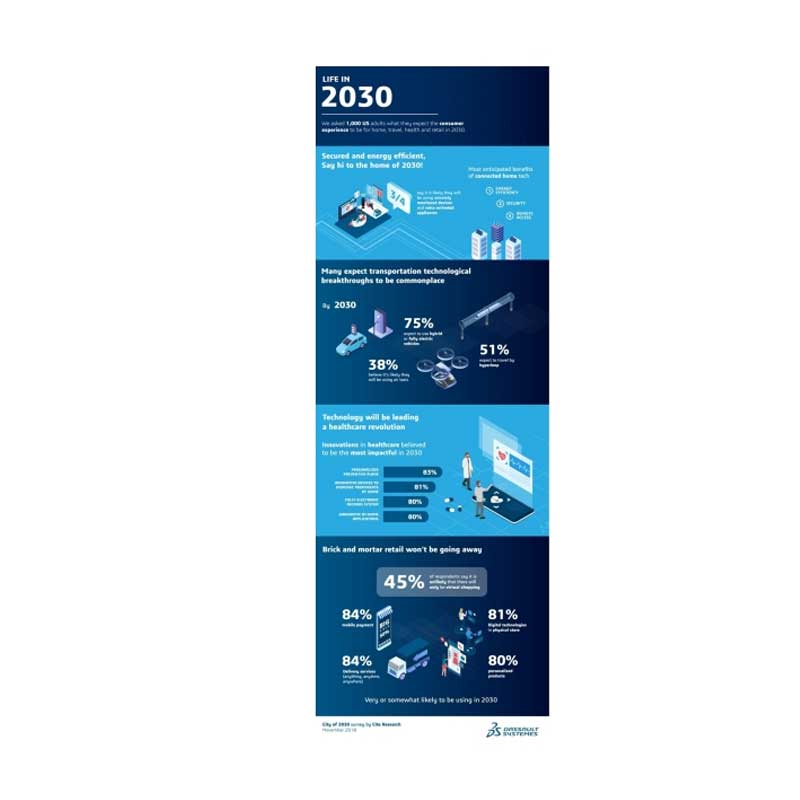
· The home of 2030 will be secure and energy efficient. More than 70 percent of respondents will use remotely monitored devices, voice-activated assistants and fully-connected smart home systems. Forty-nine percent expect to use a virtual personalized home assistant or robot.
· Transportation and mobility is expected to become increasingly electric and connected, improving cost savings, travel time, road safety and quality of life. More than 70 percent of respondents expect to use hybrid or fully electric vehicles, while over half expect to travel by hyperloop. Thirty-eight percent expect to be using air taxis. More than 75 percent expect personalized passenger experiences such as navigation path optimization and city-controlled traffic regulation, however the majority expects not to allow access to personal data in order to improve such services.
· Personalized preventative health and home treatments will become the norm. More than 80 percent of respondents expect to prevent disease and live longer because technology will enable them to manage their personal health more easily and effectively, with 83 percent expecting preventive plans based on behavior or nutrition to be the most impactful, 81 percent devices to dispense treatments at home, and 80 percent fully electronic record systems. Three-quarters of respondents feel that technologies such as diagnostic at-home applications, wearable devices and custom-made prosthesis orthopedics will also be impactful.
· Brick-and-mortar stores are not going away, but the in-store experience will evolve around payments and the use of in-store technologies. In retail, 84 percent of respondents expect to use mobile payments and anytime/anywhere delivery to make shopping more convenient, but 55 percent feel that it is unlikely there will only be virtual shopping in 2030.
“This survey on consumer expectations of the city of 2030 allows us to gauge the hype versus what consumers perceive as realities that are truly coming their way,” said Florence Verzelen, Executive Vice President, Industry Solutions, Field Marketing, Global Affairs, Dassault Systèmes. “Consumers expect massive change in every aspect of their lives. This glimpse into their thinking offers valuable feedback to companies on what to explore, develop and accelerate. It confirms personalized initiatives as the dominating theme behind all innovation. Dassault Systèmes will continue to support industry’s initiatives to meet these consumer expectations with our 3DEXPERIENCE platform.”
CITE Research, on behalf of Dassault Systèmes, conducted an online survey among 1,000 U.S. census-balanced adults. The survey was fielded between November 19-29, 2018. For a full copy of the survey results, please contact Suzanne Moran: suzanne.moran@3ds.com.
Dassault Systèmes will illustrate consumer trends in the city of 2030 with an interactive experience at its booth #4121 at CES January 8-11, 2019 in Las Vegas.

ces
It’s raining new NextGen TV sets & receivers at CES 2025
MUMBAI: There is a lot of excitement in the US about NextGen TV or TV broadcasts based on the ATSC 3.0 standard. With 76 per cent of U.S. households now able to receive the signals, America’s local TV broadcasters are hailing the introduction of new ATSC 3.0 receivers that will first be shown at next week’s Consumer Electronics Show (CES) in Las Vegas. The affordable options will add to consumer choice, from high-end NextGen TV sets to affordable accessories that can transform Android and Fire TV devices already in consumer homes.
“We are very excited about the expanded offerings from accessory device manufacturers for NextGen TV. The new low-cost Atlanta DTH (ADTH) USB receiver, powered by Tolka, is built for existing Android and Fire TV televisions and will, at a very affordable price, expand the reach of NextGen TV into homes who already have those sets. ADTH is also about to introduce a new model that works without an internet connection and will be doing a software update for deployed ADTH devices to give them the same functionality. In addition, Zinwell is adding pause functionality to their accessory device, with an add-on hard disc drive. In 2025, RCA is also coming to market with two new NextGen TV sets that will join TV options already available from Panasonic, Sony, Samsung, Hisense, and TCL,” said Pearl TV managing director Anne Schelle. “We congratulate all of the manufacturers who are selling thousands of receivers each day to consumers looking for the best possible video and audio quality from local stations.”
Pearl TV is a business organisation of US broadcast companies with a shared interest in exploring forward-looking broadcasting opportunities, including innovative ways of promoting local broadcast TV content and developing digital media and wireless platforms for the broadcast industry. Pearl’s membership, comprising more than 820 TV stations, includes eight of the largest broadcast companies in America: Cox Media group, Graham Media group, Gray Television, Hearst Television, Nexstar Media group, Sinclair Broadcast group, the E.W. Scripps, and Tegna.
Broadcasters are loading up new services with new features for NextGen TV viewers, including interactive gaming options that will be launched by GameLoop.
GameLoop TV launches next week in Las Vegas on local NextGen TV channel 3.2 and will bring gaming directly to viewers with no additional hardware or subscriptions required. At the heart of GameLoop’s innovation is the channel’s exciting “play now” feature, which allows NextGen TV viewers to instantly play games showcased on the channel simply using their TV remote or mobile phone.
“We also salute TV broadcasters Gray and Sinclair, who are working to bring fun, interactive gaming to the living room through GameLoop – a service that utilises NextGen TV for web-based family fun that will work seamlessly with millions of installed NextGen TV sets. Easy interactivity is literally going to be a game-changer for viewers,” Schelle predicted.
High Dynamic Range (HDR) functionality is now live on more than 200 local NextGen TV services throughout the US , with more being added to enhance viewing of key sports games and other spectacles. Broadcasters are promoting the advantages of NextGen TV this sports season on stations throughout the country and plan to continue these promotions as they continue to rollout HDR and Dolby Atmos services nationwide.
A holiday promotion effort in NextGen TV markets that began before December continues through early February, with broadcasters now indicating onscreen to viewers when local NextGen TV programming is available in HDR.
“We’re very excited to announce that broadcast stations throughout the country are adding HDR10+ capability in their NextGen TV broadcast services to accommodate a broad array of TV manufacturers. With other flavors of HDR that also may be present in the service, this allows every receiver to present the best picture possible, showing that local television just keeps getting better and better, which is exactly what we promised with the rollout of NextGen TV services,” Schelle said. In addition to providing better video quality through HDR, many markets are adding Dolby Atmos audio coding, which delivers immersive audio capability.
“HDR began for sports with the Kentucky Derby last spring. It really made the Olympic Games pop with brilliant video. We know that sports is a big driver for buying new TV sets as well as for enjoying broadcast services — your favorite games look even better in High Dynamic Range,” Schelle said.
Throughout the country, local stations not already broadcast on over-the-air ATSC 3.0 transmissions are gaining access to NextGen TV viewers through the innovative addition of more channels through broadcast internet protocol – or broadcast IP. These additional channels are available as NextGen TV channels and have added more choices for viewers in a range of markets, from public to commercial broadcasters who now have their programming available for NextGen TV viewers.
Consumers can easily find details of what NextGen TV services are available in their markets by visiting WatchNextGenTV.com, a resource maintained by Pearl that lists individual services by market and a full range of more than 90 NextGen TV receivers and antenna products certified to work seamlessly with the new services.