MAM
Market Research Society of India elects new managing committee

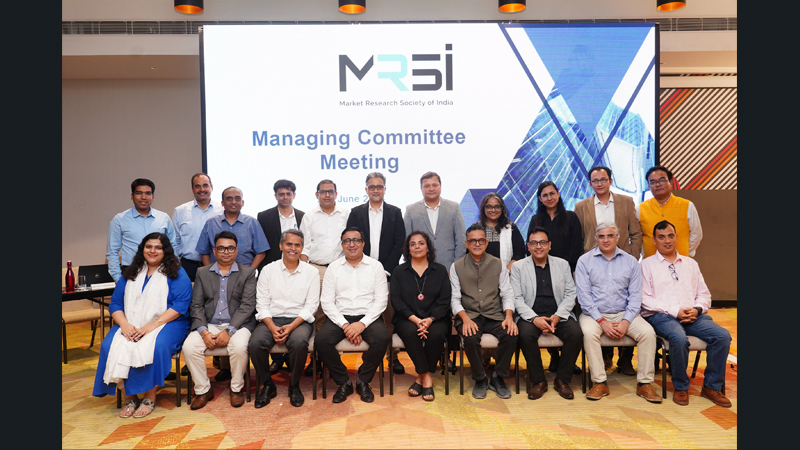
Mumbai: Market Research Society of India (MRSI), India’s foremost industry-led market research body today announces the formation of the Managing Committee for the tenure of 2024-2027. TAM Media Research Pvt. Ltd. chief growth & partnerships officer Nitin Kamat was elected as the new President and takes over from Kantar managing director, South Asia, Insights Division,Pari Minocha. Nitin worked as the treasurer for MRSI’s Managing Committee 2022-2024. He was also part of the MRSI’s ISEC Committee.
Additionally, Puneet Avasthi and Shuvadip Banerjee were elected as vice-presidents, Anila Vinayak as the secretary, and Parijat Chakraborty as the treasurer for MRSI. The new Managing Committee was announced at MRSI’s 36th Annual General Meeting held on 27 June 2024 in Mumbai.
MRSI’s Managing Committee is represented by companies across Research Agencies, Research Users and Service Providers in the market research industry. The newly elected Managing Committee continues to stay committed to promote, protect, improve and propagate the highest quality standards in all branches of market research, thereby establishing India as a dominant force in the global market research industry. For the next couple of years, MRSI aims to capitalize on its recent successes while fostering a more collaborative network for its members, resulting in effective knowledge and resource sharing. Additionally, MRSI will continue to develop the next generation of market research professionals and instil a deep sense of pride in the impactful work being done by the Indian market research industry.
Congratulating the newly elected president, Minocha said, “I am grateful for the unwavering trust MRSI members placed in the current Managing Committee. Key initiatives like the launch of the Socio-economic Classification System, ‘ISEC’, and the Market Sizing report of FY 2022-23, have given a new direction and scale to the vision of the association going forward. As I pass on the baton, I wish the incoming Managing Committee under the leadership of Nitin Kamat all the best.”
Soon after its inception, the former Managing Committee adopted the strategy of focusing on three broad pillars- building Profile, building Pride and building the Network and reach. The committee was responsible for the successful implementation and adoption of the new Socio-economic Classification System, ‘ISEC’. Among the various industry stakeholders that adopted ISEC are The Indian Society of Advertisers (ISA), research users of various organisations such as ITC, HUL, Marico, Dabur India, etc., research agencies including Kantar, IPSOS, as well as key media agencies. Additionally, MRSI also indicated that the market research sector, once again recorded positive growth, and will formally announce The Indian Research & Insights Industry 2024 Update in September 2024.
On being announced as the newly elected president of MRSI, Kamat said, “I am honoured to take forward the role of MRSI President. The market research industry has seen a seismic shift, making it crucial to stay ahead of the curve. My focus will be to engage new minds, to not only maintain existing standards but also implement a new set of ideas and initiatives. In addition to building MRSI’s 3 Pillars – Profile, Pride, and Network, I firmly believe, ‘Building Trust’ is another crucial pillar that we will work upon. I look forward to strengthening global connects, deepening government connects and driving more initiatives for active participation from regional players. I am confident of achieving these goals along with the new elected managing committee members.”
MRSI’s Managing Committee for the term of 2024-2027
|
Sr. No |
Name |
Organization |
|---|---|---|
| 1 |
Abhinav Goel |
Nestle India |
| 2 |
Amitabh Mishra |
Dr. Reddy’s Laboratories |
| 3 |
Anila Vinayak |
Hindustan Unilever Limited |
| 4 |
Ankit Dhanuka |
Robas Research |
| 5 |
Arindam Bhattacharya |
Lucid (A Cint Group Company) |
| 6 |
Dixit Chanana |
Toluna | MetrixLab – India |
| 7 |
Geetika Kambli |
Future Factory |
| 8 |
Girish Upadhyay |
Axis My India |
| 9 |
Nandita Singh |
Purple Audacity |
| 10 |
Nitin Kamat |
TAM Media Research Pvt. Ltd. |
| 11 |
Parijat Chakraborty |
Ipsos Research Pvt. Ltd. |
| 12 |
Paru Minocha |
Kantar |
| 13 |
Prashant Kolleri |
NielsenIQ India Pvt. Ltd |
| 14 |
Preet Doshi |
Amazon India |
| 15 |
Puneet Avasthi |
Kantar |
| 16 |
Sathyamurthy Namakkal |
AIMO Marketing Services LLP (DataPOEM) |
| 17 |
Saurabh Aggarwal |
Knowledge Excel |
| 18 |
Saurin Shah |
Godrej Consumer Products Ltd |
| 19 |
Shuvadip Banerjee |
ITC Limited |
| 20 |
Vishal Anam |
Datamatics |
| 21 |
Vivek Malhotra |
TV Today Network Ltd. |