MAM
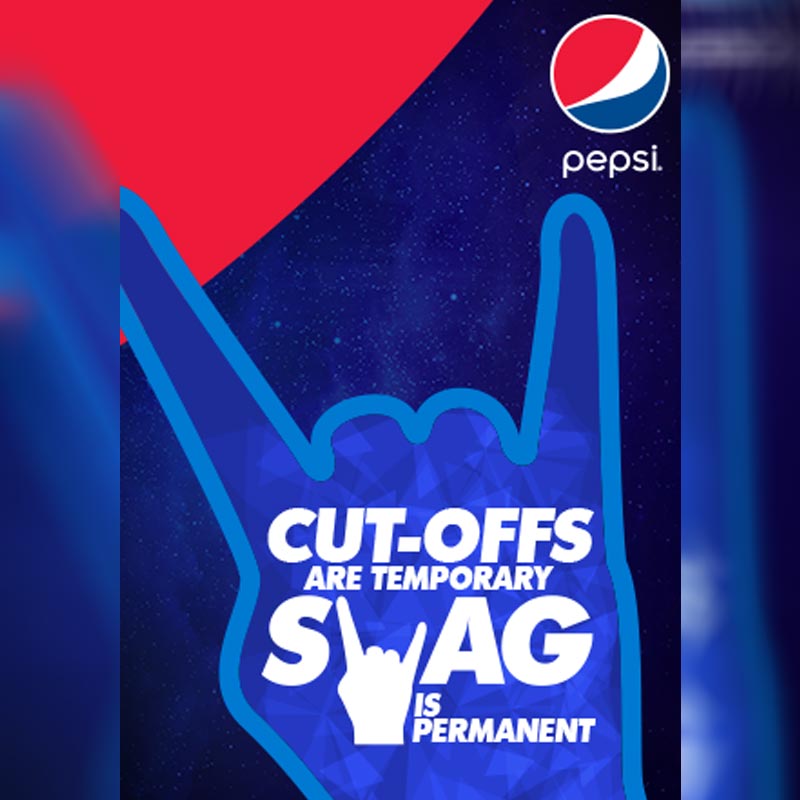
“Swag is permanent” says Pepsi® to college-goers”
MUMBAI: Temperatures are on the rise across North and South Campus as the cutoffs for this year’s academic session are set to be declared.
With over 3 lacs registrations for 62,000 seats across 90 colleges in Delhi University alone, 18 year olds across the country experience a range of emotions as they wait for the cut offs to be announced.
With this in mind, beverage brand Pepsi® is urging college-goers to add a new word to the dictionary this admission season – SWAG. The brand will become a part of their lives with a single, empowering philosophy – CUT OFF IS TEMPORARY AND SWAG IS PERMANENT.
Pepsi has introduced a series of engaging new creatives across digital and on ground, which bring alive this philosophy and reinstate the brand’s proposition of ‘Har Ghoont Mein Swag’.
Talking about the activity, Tarun Bhagat, Director-Marketing, Hydration and Cola, PepsiCo India said, “Every year in India, the most important life event for an 18 year old is college admissions and students across the country are waiting with bated breath the cut-off announcement to see whether they will get the course and college of their choice. Intense competition only adds to the situation. As a brand¸ PEPSI® has always resonated with the voice of today’s generation and we understand that the ongoing admissions season is something that the youth are heavily invested in. At the same time, we want them to know that marks and admissions are only one part of life. If one follows their passion, and puts in their best towards something, they are bound to be successful. With the ‘Har Ghoont Mein Swag’ campaign, PEPSI® will be a part of this important life event of the youth and will enable them to spread their wings by reiterating the empowering message that ‘Cut Off Is Temporary and Swag is Permanent.”
Bollywood’s favorite star of the new generation, Tiger Shroff, and superstar rapper Badshah have also joined the brand as it asks students to follow their passion and let their SWAG do the talking.
Sharing his memories, Tiger Shroff said, “It doesn’t matter what one chooses to do, as long as you give it your 100%. I dropped out of college because I wanted to follow my passion for martial arts and acting. I knew that it was the one thing I was ready to give my 100% to. It took years of hard work to get to where I am today, but it seemed easy all through the way because I was doing what I loved.
I only have one message for all those college aspirants who are eagerly waiting for the cutoffs to be announced – believe in yourself and your passion, carry yourself with swag and success will follow. Don’t let a number write off your dreams!”
Badshah said, “I was an all-rounder at school and loved studying through college as well. In fact, not many people know but I have worked as a civil engineer in the past. But throughout my life there was only one thing that gave me pure joy, and that was music. A lot of people questioned my choices when I wanted to pursue it as a career, but I knew that my passion combined with hard work would take me far. I’m glad I could prove that following your passion can take one places. It’s all about believing in yourself and carrying yourself with ‘swag’. To all the kids who await the cut offs, dream big, be your confident self, work hard and make your dreams come true.”

MAM
India’s experience economy grows as live events market hits Rs 17,000 crore
EY-Parthenon and BookMyShow report finds 78 per cent Indians prefer experiences over products
MUMBAI: India’s live entertainment scene is no longer just about music, comedy or festivals. It is increasingly becoming a powerful stage for brands seeking deeper connections with consumers.
A new report titled Beyond Attention, Into Immersion by EY-Parthenon and BookMyShow suggests that India’s experience economy is entering a strong growth phase, driven by consumers who are choosing memorable moments over material purchases.
According to the study, the country’s live events ecosystem, which includes concerts, comedy tours, festivals and immersive exhibitions, is estimated to reach around Rs 17,000 crore in 2025. The growth reflects a broader cultural shift in how Indians spend their time and money.
The report finds that 78 per cent of Indian consumers now prefer spending on experiences rather than physical products. From attending concerts and festivals to participating in interactive brand installations, audiences are increasingly seeking engagement, community and shareable moments.
This change in consumer behaviour is particularly evident among younger audiences who want to participate rather than simply watch. Instead of passively consuming entertainment, many now look for experiences that allow them to interact, express themselves and connect with like minded communities.
For marketers, this shift has turned experiential marketing into a strategic priority rather than a promotional add on. Brands are moving away from interruption driven advertising and towards immersive formats that allow consumers to discover, test and emotionally connect with products.
The report suggests that experiential marketing now plays a role across the entire consumer journey. It can spark brand discovery, strengthen storytelling, encourage product trials and ultimately influence purchase decisions and loyalty.
The impact is already visible. Post event surveys conducted among 7,450 attendees at major events including Lollapalooza India and concerts by Ed Sheeran and Guns N’ Roses highlight the effectiveness of these experiences.
Around 59 per cent of attendees recalled brands they interacted with during the events, while 55 per cent said those interactions increased their likelihood of purchasing from the brand. A further 63 per cent reported that brand activations actually enhanced their event experience rather than distracting from it. Nearly 29 per cent also said the interaction improved their perception of the brand.
Brands are also changing the way they approach events. Instead of simply putting logos on stages or banners, companies are building experiences into the fabric of the event itself.
Financial services brands, for example, are offering early ticket access, exclusive lounges and curated event experiences for cardholders. Fashion and beauty companies are using festivals to showcase products through pop ups, interactive installations and social media friendly spaces that encourage visitors to share their experiences online.
The scope of experiential marketing now stretches far beyond live entertainment. Retailers are designing experiential stores where customers can explore products in lifelike environments. Entertainment platforms are extending popular intellectual properties into immersive exhibitions and fan events. Technology is also playing a growing role through augmented reality and virtual try on tools that blend digital discovery with physical interaction.
Cultural festivals remain one of the most powerful platforms for such engagement in India. Celebrations such as Navratri and Holi bring together large communities, emotional participation and heightened consumer spending. For brands, these moments offer an opportunity to become part of the celebration rather than simply advertise around it.
Despite the momentum, the report notes that some companies still hesitate to adopt experiential marketing at scale. Budget constraints, limited expertise and uncertainty around measuring return on investment remain common concerns.
However, the growing body of data around consumer engagement and brand impact is gradually addressing these challenges. More marketers are expected to allocate a larger share of their budgets to experiential formats over the coming years.
Taken together, the findings point to a clear trend. As consumers seek meaning, memories and moments worth sharing, live experiences are emerging as one of the most powerful ways for brands to stay relevant in a crowded media landscape.