MAM
COLORS sets new benchmarks with disruptive marketing for its latest offering “Ram Siye Ke Luv Kush”
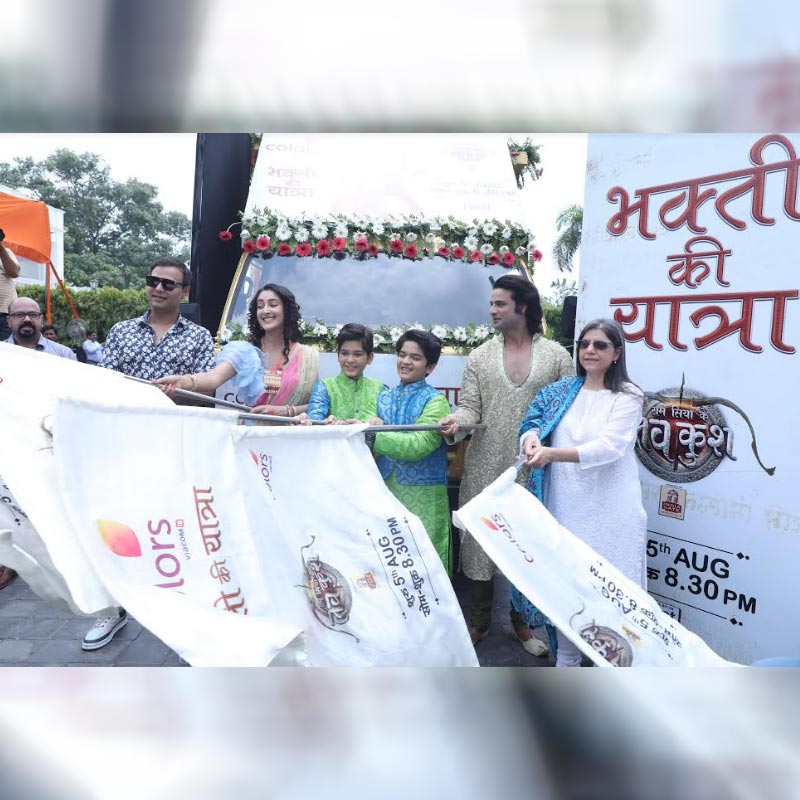
MUMBAI: Starting today, COLORS is all set to present an epic saga that not only reflects India’s deep-rooted culture but blends history and entertainment in the most magnificent way. Ramayan, the eternally universal unifier, a holy scripture that depicts story of Ram-Sita is COLORSupcoming magnum opus show Ram Siya Ke Luv Kush powered byIndia Gate Basmati Rice. The show is an artistic redemption of Lord Ram and Sita’s journeythrough the lens of their warrior sons Luv-Kush. With a thought to bring alive the age-old epic on just on television but also on ground for its audience, COLORS launch a robust on- ground marketing initiative COLORS Bhakti ki Yatra. Flagged off in Lucknow with the lead actors from Ram Siya Ke Luv Kush on 1st Aug 2019, thisholy structure on wheels uses hologram technology to showcase Ramayan’s chapters and give ‘Sakshat Darshan’of Ram, Siya, Luv and Kush to the devotees.
Planned across 5 cities in Uttar Pradesh, this consumer drive has been further promoted by Big FM. The procession was led by devotional performance by highly talented set of dancers and larger than life structure of ‘Luv Kush controlling the Ashwamegh’, Bhakti Ki Yatra has proven to be a major attraction point and continues making the state witness the story-telling proficiency. Adding to the entire experience, a branded Ram Raksha Stotrabooklet were also handed over to everyone present as a memorabilia.
The entire marketing campaign was backed by strong print, outdoor, digital and television plan to create major impact. A 10-day long perception led campaign across key sites in Mumbai displayed the magnum opus imagery of the show along with nostalgic Ram-Siya aarti in metro and local trains. All network channels will have a five minutes roadblock on the launch day. As a part of the print campaign and to create anticipation before the launch, multiple insertions along with a combination of jackets and front-page impact ads across key publications were taken. As a part of on ground activation, COLORS’ popular Intectual Property, COLORS Golden Petal Clubalso hosted events across key cities in Uttar Pradesh to further engage with the viewers.
Shaping an effective media campaign, Sapangeet Rajwant, Head, Marketing and Digital – Hindi Mass Entertainment , Viacom18 commented, “At COLORS our focus has always been to create immersive experience for our audience across all platforms. With Ram Siya Ke Luv Kush we wanted to go a step further to reflect the scale and impact of the show.Mythological shows appeal to audience across all age groups, and with all our initiatives the idea was to creatively bring them closer to the concept and blend modern day technology to the age-old tale. Bringing this thought alive, we launched COLORS Bhakti ki Yatraalong with a robust digital plan to strike the right chord with the audience. While, Bhakti Ki Yatra gave viewers a unique storytelling experience through holograms, our digital association with Google helped us target a new set of audience.”
In partnership with Google, COLORS will create a unique consumer experience on the digital front. It will enable users to engage in an interactive voice session with the lead actors of the show through Google Assistant, who can also share customised GIFs of the show on several platforms such as whatsapp, Instagram and many more.Additionally, first of its kind Twitter Setuwas also created as a digital replica to the famous Ram Setu with 1,523 usersreplying to a single tweet. Providing Darshan on the go is the digital travelogue, Ram Dhaam Yatrawhere televisions favourite Aishwarya Sakhujatakes viewers to places of great significance to Ramayan. In partnership with UC Browser, COLORS will also offer a series of in-app activities for users, helping them to vote and comment on key aspects of the show.

Digital
Content India 2026 opens with a copro pitch, a spice evangelist and a £10,000 prize for Indian storytelling
Dish TV and C21Media’s three-day summit puts seven ambitious projects before an international jury, and two walk away with serious development money
MUMBAI: India’s content industry gathered in Mumbai this March for Content India 2026, a three-day summit organised by Dish TV in partnership with C21Media, and it wasted no time making a statement. The event opened with a Copro Pitch that put seven scripted and unscripted television concepts before an international panel of judges, and by the end of it, two projects had walked away with £10,000 each in marketing prize money from C21Media to support development and international promotion.
The jury, comprising Frank Spotnitz, Fiona Campbell, Rashmi Bajpai, Bal Samra and Rachel Glaister, evaluated a shortlist that ranged from a dark Mumbai comedy-drama about mental health (Dirty Minds, created by Sundar Aaron) to a Delhi coming-of-age mystery (Djinn Patrol, by Neha Sharma and Kilian Irwin), a techno-thriller about a teenage gaming prodigy (Kanpur X Satori, by Suchita Bhatia), an investigative crime drama blending mythology and modern thriller (The Age of Kali, by Shivani Bhatija), a documentary on India’s spice heritage (The Masala Quest, hosted by Sarina Kamini), a documentary on competitive gaming (Respawn: India’s Esports Revolution, by George Mangala Thomas and Sangram Mawari), and a reality-horror competition merging gaming and immersive fear (Scary Goose, by Samar Iqbal).
The session was hosted by Mayank Shekhar.
The two winners were Djinn Patrol, backed by Miura Kite, formerly of Participant Media and known for Chinatown and Keep Sweet: Pray & Obey, with Jaya Entertainment, producers of Real Kashmir Football Club, also attached; and The Masala Quest, created and hosted by Sarina Kamini, an Indian-Australian cook, author and self-described “spice evangelist.”
The summit also unveiled the Content India Trends Report, whose findings made for bracing reading. Daoud Jackson, senior analyst at OMDIA, set the tone: “By 2030, online video in India will nearly double the revenue of traditional TV, becoming the main driver of growth.” He noted that in 2025, India produced a quarter of all YouTube videos globally, overtaking the United States, while Indians collectively spend 117 years daily on YouTube and 72 years on Instagram. Traditional subscription TV is declining as free TV and connected TV gain ground, forcing broadcasters to innovate. “AI-generated content is just 2 per cent of engagement,” Jackson added, “highlighting the dominance of high-quality human content. The key for Indian media companies is scaling while monetising effectively from day one.”
Hannah Walsh, principal analyst at Ampere Analysis, added hard numbers to the picture. India produced over 24,000 titles in January 2026 alone, with 19,000 available internationally. The country now accounts for 12 per cent of Asia-Pacific content spend, up from 8 per cent in 2021, outpacing both Japan and China. Key exporters include JioStar, Zee Entertainment, Sony India, Amazon and Netflix, delivering over 7,500 Indian-produced titles abroad each year. The top importing markets are Saudi Arabia, the UAE, Egypt, the United States and the Philippines. Scripted content dominates globally at 88 per cent, with crime dramas and children’s and family titles performing particularly strongly.
Manoj Dobhal, chief executive and executive director of Dish TV India, framed the summit’s ambition squarely. “Stories don’t need translation. They need a platform, discovery, and reach, local or global,” he said. “India produces more movies than any country, our streaming platforms compete globally, and our tech and creators win international awards. Yet fragmentation slows growth. Producers, platforms, and tech move in different lanes. We need shared spaces, collaboration, and an ecosystem where ideas, technology, and people meet. That is why we built Content India.”
The data, the pitches and the prize money all pointed to the same conclusion: India is not waiting for the world to discover its stories. It is building the infrastructure to sell them.