MAM
Paying tribute to Gandhi Logically AI launches #SwachhPhoneCampaign to curb the growing menace of ‘fake news’
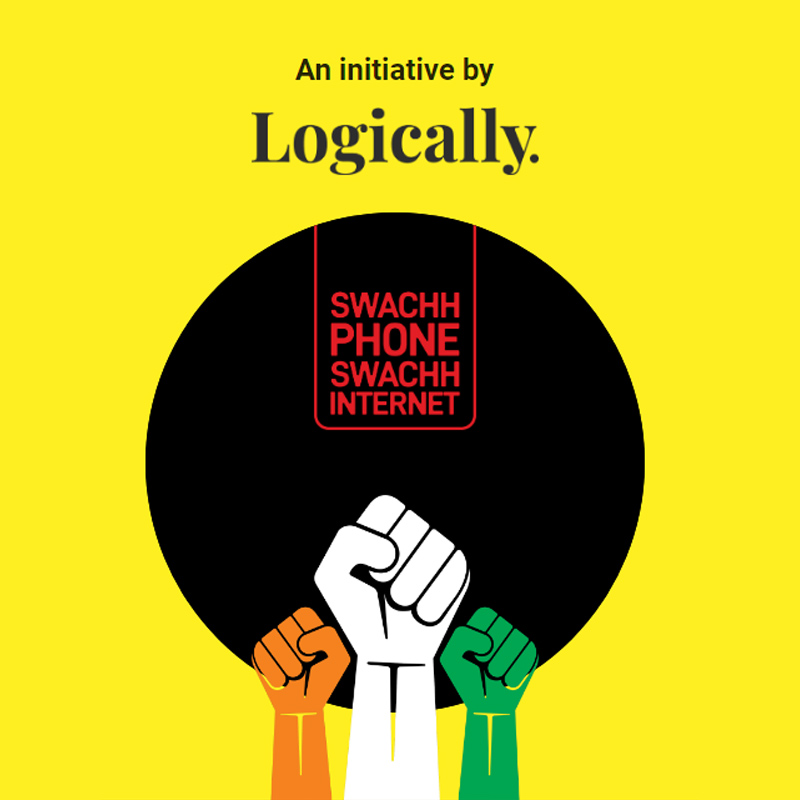
October 2, 2019: Going the Gandhian way, Logically, the artificial intelligence (AI) powered Technology Company that detects ‘fake news’, logical fallacy, inaccuracies, and bias recently launched the #SwacchPhone campaign. The campaign encourages Netizens to #ThinkLogically, clear the 'fake news' on their phones, which pollutes their minds and leads to a divisive society.
The company does not only aim to create awareness about rising ‘fake news’ but will also layout specific proven techniques to mitigate the risks of misinformation and disinformation campaigns.
As a result, Logically AI is organizing workshops for journalists and mass media students across the country.In just three days the company has already trained circa 300 students in St Xaviers College, Wilson College and School of Broadcast and Communication Mumbai. The company aims to vaccinate people against “fake news” by empowering them with tools to combat “fake news”.
Speaking on the occasion, Lyric Jain, Founder, and CEO of Logically said “While there are risks of using technology and AI to combat misinformation, there are greater risks in not doing so. It is equivalent of bringing a knife to a gunfight because bad actors in the current fake information warfare are equipped with extremely sophisticated technologies”
He further added, “Today, fake news on social media platforms is killing hundreds. The same technology that created the problem also has the potential to solve the problem. So Logically believes the most sensible option is to use Extended Intelligence – a combination of HI (Human Interference) and AI (Artificial Intelligence) to solve this issue. By following the human in loop methodology also means building defense teams across the country, who are equipped with the know-how of combatting fake news”.
The on ground campaign gives a digital twist to the Gandhian principle of cleanliness and is encouraging netizens to clean up their phones of the “fake news” junk in order to have a clean and healthy mind.
The company with offices in UK and India recently launched its flagship product, the Logically app. A destination for news consumption, discussion, and verification. The company is also actively expanding its operations in India.
After witnessing the breakdown in civic and political discourse during the Brexit debate and the 2016 presidential election in the US, Logically was conceived by 22-year old Cambridge and MIT graduate Lyric Jain.
Adding a layer of credibility to the internet to battle misinformation, the Logically platform acts as a real-time, user-friendly filter ensuring users can quickly consume information that is fair, authentic, credible and trusted (FACT). For the next few years, Logically aims to generalize AI models and continue to grow its fact-checking team to make sure they’re valid and impactful in broad use cases across geographies such as India, US, and UK.
This will enable Logically, to continue and build on its work to support democracies, build partnerships with government, media and content platforms

MAM
ASCI study uncovers how Gen Alpha navigates ads in endless digital feeds
‘What the Sigma?’ ethnographic report maps blurred boundaries between content and commerce for 7–15-year-olds.
MUMBAI: Gen Alpha isn’t scrolling through the internet, they’re living rent-free inside its never-ending dopamine drip, and the ads have already moved in next door. The Advertising Standards Council of India (ASCI) Academy, partnering with Futurebrands Consulting, has published ‘What the Sigma?’, an immersive ethnographic study that maps how Indian children aged 7–15 (Generation Alpha) consume, interpret and live alongside media and commercial messaging in a hyper-digital environment.
The research draws on in-home interviews, sibling and peer conversations, and discussions with parents, teachers, counsellors, psychologists, marketers and kidfluencers across six cities. It examines not only what children watch but how algorithms, content creators, peers and parents shape their relationship with the constant stream of shorts, vlogs, gameplay, memes, sponsored posts and ‘kid-ified’ adult material.
Five core themes emerged:
- Discontinuous Generation, Gen Alpha is not growing up alongside the internet, they are growing up inside it. Cultural references, humour, aesthetics and language sync globally in real time, often leaving adults functionally illiterate in their children’s world. A reference that lands instantly for a 10-year-old in Mumbai or Visakhapatnam feels opaque or disjointed to most parents.
- Authority Vacuum, Parents and teachers frequently lose cultural fluency in digital spaces. The algorithm responsive, inexhaustible and perfectly attuned to preferences becomes the most attentive presence in many children’s daily lives. Rules around screen time feel increasingly difficult to enforce when adults cannot fully see or understand the content landscape.
- Digital as Society, Online and offline no longer exist as separate realms, they form one continuous reality. The phone is not a tool children pick up; it is the primary social environment they inhabit.
- Great Media Mukbang, Content flows as an ambient, boundary-less, multi-sensorial stream. Entertainment, advertising, commerce, gameplay, memes and vlogs merge into one undifferentiated feed. The line between active choice and passive absorption has largely collapsed.
- Blurred Ad Recognition, Children aged 7–12 typically recognise only the most overt advertising formats. Influencer promotions, gaming integrations and vlog sponsorships often register as organic entertainment. Children aged 13–15 show greater ad literacy but remain highly susceptible to narrative-integrated, passion-driven and emotionally resonant brand messaging. Discernment remains low across the board in a non-stop stream.
ASCI CEO and secretary general Manisha Kapoor said, “ASCI Academy’s study is an investigation into the content life of Generation Alpha not to judge them but to understand them. Their cultural reference points seem disjointed from those of earlier generations. Insights on how they perceive advertising is the first step towards building more responsible engagement frameworks, given that they are the youngest media consumers in our country right now.”
Futurebrands Consulting founder and director Santosh Desai added, “While earlier generations have been exposed to digital media, for this generation it is the world they inhabit. This report explores not only what they watch but how they are being shaped by algorithms, content and advertising.”
The study proposes four adaptive, principles-led pathways:
- Universal signposting of commercial intent using design principles that make advertising recognisable even to young audiences.
- Ecosystem-wide responsibility shared among advertisers, platforms, creators, schools and parents.
- Future-ready safeguards built directly into children’s content experiences rather than as optional background settings.
- Formal media and advertising literacy embedded in school curricula to teach age-appropriate understanding of persuasion and commercial intent.
In a feed that never pauses, Gen Alpha isn’t merely watching content, they’re swimming in an ocean where entertainment, commerce and identity swirl together. The real question isn’t whether they can spot an ad; it’s whether the adults building the ocean can agree on where the lifeguards should stand.