Digital Agencies
Dentsu Webchutney launches Logitech Pebble through one-of-a-kind Rube Goldberg machine
MUMBAI: Logitech has joined hands with Dentsu Webchutney, the creatively-led digital agency from the house of Dentsu Aegis Network, to launch the new Logitech Pebble mouse.
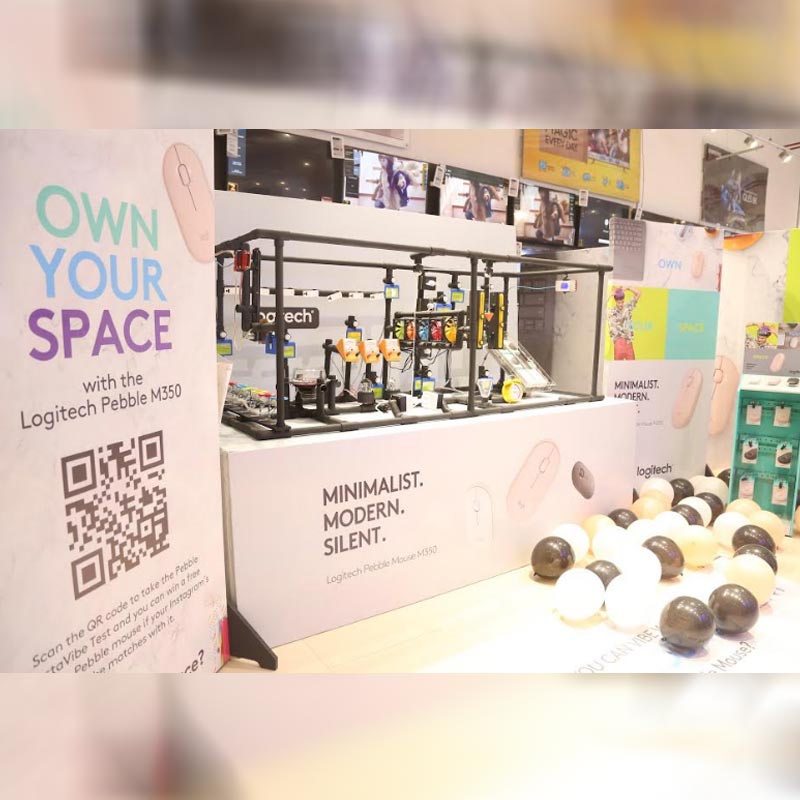
The agency has conceptualised the Pebble InstaVibe Test, an on-ground activation where consumers can win a free Logitech Pebble mouse through a Rube Goldberg machine that analySes their Instagram profiles to check if their “vibe” matches the stylish mouse. Named as the “world’s first auto-reversible dynamic Rube Goldberg machine”, the installation is a personification of Instagram with every stage representing a unique aspect of the popular social media platform.
The Logitech Pebble M350 is positioned as a smart and stylish workspace accessory that caters to millennial professionals with a penchant towards utility as well as aesthetics. This philosophy is reflected in Pebble’s modern design, making it a deserving instagrammable peripheral for the discerning audience that considers ergonomic aesthetics integral to shaping identities, not just in profession but also on social media.
Conventional Rube Goldberg machines have irreversible cause and effect results i.e. they can’t be reset; but the Pebble InstaVibe Test begs to differ. A simple QR code scan lets the user log into their Instagram, which subsequently gets fed into the machine. Once the profile is loaded, the machine breaks down the profile into its various parameters that are native to the platform. From the number of likes and followers to the hashtags and filters – every part of the user’s profile is thoroughly evaluated with a unique result generated in every stage of the machine. This analysis (through the chain of events) eventually leads to a final result that determines your Instagram’s vibe. If it’s stylish and modern like the Pebble, the mouse is unlocked for the user to take.
Commenting on the launch, Gurbaksh Singh, chief creative technologist, Dentsu Webchutney said, “A Rube Goldberg machine is one of the best examples of art and technology coming together. Something that the audience and the product both can relate to. Every stage in the installation is a visual representation of a unique part of your Instagram profile. We scanned through the user’s interests like fashion, travel, music and more to get a cohesive quotient. We hope that the InstaVibe Test really brings consumers closer to the Pebble’s product promise”
Sumera Dewan, Associate Vice President, Dentsu Webchutney added, “Catching the attention of consumers in today’s time and age is more than just making advertisements. With the InstaVibe Test, we made Logitech stand out by giving a larger-than-life treatment to an Instagram profile analysis. Packaged in a contraption that might just be the world’s first auto-reversible dynamic Rube Goldberg machine, we created a unique interaction with the brand that adds a whole new meaning to owning one’s workspace.”

Digital Agencies
GUEST COLUMN: Deepankar Das on the feedback problem slowing creative teams
BENGALURU: For years, creative teams have learned to live with ambiguity. Vague comments, last-minute changes, feedback that arrives without context, clarity, or conviction. It became part of the job – something teams worked around rather than getting it solved.
But as we head into 2026, that tolerance is wearing thin.
Creative work today moves faster, scales wider, and involves more stakeholders than before. Teams are producing more content across more formats, often with distributed collaborators and tighter timelines. In this environment, guesswork is no longer a harmless inconvenience. It’s a cost – to time, to budgets, and to creative mindspace.
The real problem isn’t feedback, it’s how it’s given
Most creative professionals you see today will tell you they’re not against feedback. In fact, they rely on it. Good feedback sharpens ideas, strengthens execution, and pushes work forward. The problem is ‘unclear’ feedback. When someone says “this doesn’t feel right” without context, they aren’t just revising – they’re basically decoding. They’re guessing what the problem might be, trying different directions, and burning time in the process. Multiply that by a few stakeholders and a few rounds, and suddenly days disappear.
In 2026, when teams are expected to deliver faster without compromising quality, interpretation is a luxury most can’t afford.
Scale has changed rverything
Creative projects used to be smaller and simpler. A designer, a manager, maybe one client contact. Feedback loops were short, even if they weren’t perfect.
Today, the same project might involve internal marketing teams, agencies, freelancers, brand reviewers, and regional teams. Everyone has a say. Everyone leaves comments. And often, those comments don’t agree. More people reviewing work means alignment matters more than ever. Clear feedback isn’t just about being nice to creative teams, it’s about keeping projects moving when complexity increases.
Guesswork quietly wears teams down
One of the less talked-about impacts of unclear feedback is what it does to people.
When feedback is vague or contradictory, creatives second-guess their decisions. They hesitate. They overwork. They keep extra time buffers “just in case.” Over time, confidence drops. Ownership fades. Work becomes safer, not stronger. Creative energy gets spent on managing uncertainty instead of pushing ideas forward. And in an industry already grappling with burnout, unclear feedback adds unnecessary mental load.
Actionable feedback is a shared skill
Clear feedback doesn’t mean controlling creative decisions or dictating every detail. It means being specific enough that someone knows what to do next.
Actionable feedback answers three basic questions:
What exactly needs attention?
Why does it matter?
What outcome are we aiming for?
This applies whether you’re reviewing a video frame, a design layout, or a copy draft. The clearer the feedback, the fewer follow-ups it creates. In 2026, teams that treat feedback as a skill and not an afterthought, will move faster with less friction.
Tools shape behaviour (whether we admit it or not)
The way feedback is delivered is often dictated by the tools teams use. Comments buried in long email threads, messages split across chat apps, or notes detached from the actual work all contribute to confusion.
When feedback lives outside the work, context often gets lost. When it’s disconnected from versions and timelines, decisions get questioned. When it’s scattered, accountability disappears. More teams are starting to realise that feedback problems aren’t just communication issues, they’re workflow issues. How work moves between people matters just as much as the work itself.
From Opinions To Alignment
One of the biggest shifts happening in creative teams is a move away from purely opinion-driven feedback. Instead of “I like this” or “I don’t,” teams are asking better questions:
● Does this meet the brief?
● Does this solve the problem?
● Does this align with the goal?
This change reduces unnecessary back-and-forth and helps feedback feel less personal and more productive. It also makes decisions easier to explain and defend. As creative work becomes more strategic, feedback has to support that shift.
2026 Is About Fewer Loops, Not Faster Loops
There’s a misconception that speed means moving through feedback cycles faster. In reality, the most creative teams aren’t just accelerating loops, they’re reducing them. Clear, actionable feedback upfront leads to fewer revisions later. Clear approval stages prevent last-minute surprises. Clear decisions stop work from circling endlessly.
In 2026, efficiency won’t come from working harder or longer. It will come from designing workflows that respect creative time and attention.
Ending guesswork is a mindset change
Ultimately, ending creative guesswork isn’t just about better tools or processes. It’s about mindset. It’s about recognising that clarity is an act of respect – for the work, for the people doing it, for the time invested and for the mindspace used. It’s about moving from “figure it out” to “here’s what we’re aiming for.”
Creative teams that embrace this shift will find themselves not only delivering faster, but also enjoying the process more. And in an industry built on imagination, that might be the most valuable outcome of all.