Cable TV
MSOs on distribution challenges post NTO

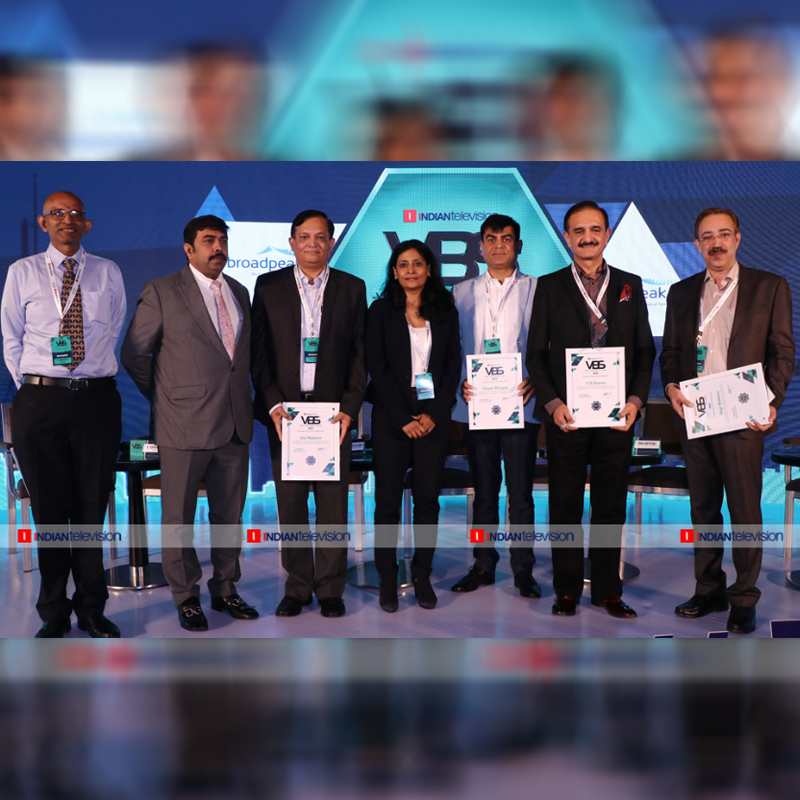
MUMBAI: The internet has given choice to consumers to select packages and watch content of their choice. A rapid increase in the viewership on mobile and OTT platforms on a daily basis has become a threat to the DTH and cable distribution ecosystem. Apart from the internet, competing with broadband services and OTT is another challenge post NTO. The experts from the broadband and cable industry gathered at Video and Broadband Summit (VBS) 2019 in December, organised by Indiantelevision.com to discuss innovative measures taken by companies to stay ahead of the curve.
The Remediation Company founder & partner Shyamala Venkatachalam, moderated the panel discussion on 'The Distribution Challenge' at VBS 2019. The panelists Den Networks Ltd CEO SN Sharma, Kerala Communicators Cable Ltd. (KCCL) ex-CEO and SCTE India GC member Shaji Mathews, Metro Cast Network India Pvt Ltd promoter Nagesh Narayandas Chhabria, Tata Sky Ltd chief financial officer G Sambasivan, SITI Networks Ltd chief executive officer Anil Malhotra and Fastway Transmissions Pvt Ltd consultant (strategic planning) Peeush Mahajan shared their views on how distribution companies are innovating to stay ahead of the curve. They also briefed the audiences on the measures adopted to counter relentless disruption.
"Technology is unstoppable and customer is the king. As lot of innovations keep on happening, the business has to adapt the changes and has to focus on two things – customer viewing experience and customer service. For making viewing experience the best, we are investing very heavily on our backend and the distribution pipeline and will be increasing the bandwidth capacity manifold,” said Sharma.
He further continued, “In India, after a lot of HD channels were launched, still only 20 per cent of subscribers are using the HD platform. As we have taken a conscious decision to only deal with HD boxes from the new year, we will ensure that HD content will be available for every subscriber. Even if consumers are not willing to subscribe for HD channels because of the higher subscription amount, we will ensure that the consumer gets the SD service which will be as good as HD experience.”
"The movement from SD to HD has been much below the consumer’s expectations. The movement to OTT and hybrid boxes has happened over a period of time. As today the content is produced in HD or even higher than that in 4K, lot of MSOs are setting up HEVC transmission and they will also be introducing boxes with capacity of higher than higher definition. The process has to be gradual, which also depends on the willingness of the players to invest in the business," said Mathews.
On the issue of interoperability of STB, he said that the concept of comparing the STP with a mobile phone is not right, as the STB is a sim card and not the mobile phone. So, the whole concept needs to be overlooked.
The challenge for MSOs is that it is not viable for them to go to village areas and give connections to around 200 – 300 houses. “The main concern now is that 15 – 20 per cent of our existing customers are not coming back to us post NTO. This is because of the communication gap between the LCO and the customers. To bridge this gap we have to educate the LCO by training them. Also communicating through social media, direct marketing or door to door marketing is an option to convince customers," said Chhabria.
He also said, “MSOs should get their existing customer base back, which is around 15 – 20 per cent. The NTO model has been stabilised and people can now invest. Two years ago it was a non-viable business, but now we can show the investors that it is a viable business and ask them to invest as there is an opportunity to earn money.”
Sambasivan shared his view on distribution challenges. He said that as per the India projection report, OTT is growing very fast and the number of hours of video consumption is going up. DTH and cable industry need to be worried as 90 per cent consumption is on mobile. But OTT is not an immediate threat to the DTH and the cable industry because along with OTT, consumers are also watching television. The viewership on television in the last five years has not decreased. OTT may be a threat after around ten years.
Throwing some light on the post NTO challenges faced by the industry, Malhotra said that we are facing two challenges, first is two competitions. The first competition we are facing from broadband services, which is a linear way of giving signals compared to STBs. To provide SD, HD or 4K content we need to provide STBs which will decode the signal and provide content in the respective definitions. The second competition from OTT is device agnostic because in the broadband, whether it’s 4K, HD or SD, all signals are distributed similarly. The quality bandwidth decides what kind of viewership experience a customer has.
“The second challenge is that suddenly there are internet users in the country. As per TRAI’s published data, 64 crore is half of the population of India. This population buys smartphones and we do not know how much of this population has moved away from linear TV to internet. From a content perspective, the kind of content which is popular is the adult site and is popular on OTT platform and not allowed to be beamed on the linear TV. The unfair competition will be that if the customer demands a personalised content, which is viewable on the OTT platform, but not viewable on the linear video platform despite having user enabled features on the device. Also the password sharing piracy is a challenge as more than one person can view the same content on different devices. So, overall technological aspects have to be considered,” he said.
Sharma added that the message for MIB is that piracy is one of the issues which need to be addressed as lot of investments have been done at the state level for implementing NTO. DOT, few years back had addressed the issue by appointing state level cells. The other issue is the linkage of a la carte price with the bouquet price.
Mahajan thanked TRAI for implementing a la carte and said that TRAI has given a choice to the customers. In 2018, 98-99 per cent of the customers were on suggestive bouquets offered MSOs and DPOs. In last 8-9 months, a big migration has happened from 2-22 per cent from bouquet to a la carte and it keeps on happening on a daily basis. We have to put in more efforts to educate the subscribers and train the LCOs, as LCOs are the key people who can generate a need for a la carte. DPOs have put in a lot of effort and will continue in future also. By the end of 2020, 35-40 per cent consumers should move on a la carte.
Malhotra said that as per the regulations, TRAI has done a perfect thing by giving a choice to the customers. Unfortunately, the customer needs a la carte along with a package of their suitability. It is very difficult for a customer to choose between 800 channels and make a package of its own. But packaging is important and there are three ways of doing it. Packaging happens at a broadcaster level and if the customer wants the broadcaster package, then the distributor cannot dismantle the package.