Connect with us

MAM

Pair of Men Wins VMate’s #HappyValentinesDay challenge

Published

on

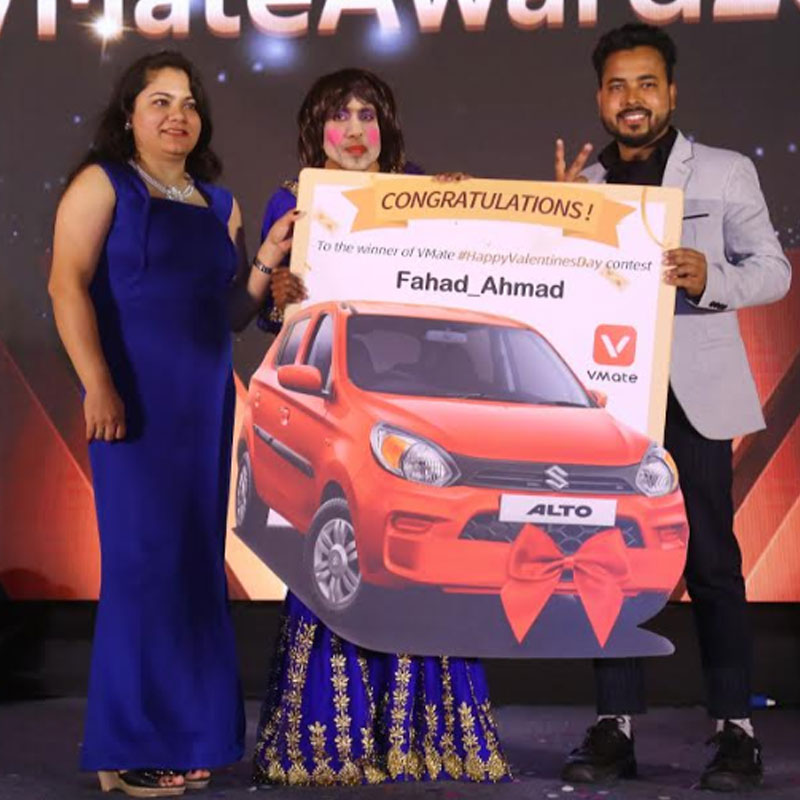
MUMBAI: In a pleasantly surprising turn of events, trending short video platform VMate has announced a male duo as the winner of the recently concluded #HappyValentinesDay challenge, which witnessed a massive participation and creation of more than 8.5 million videos. These two men would be awarded a brand new Maruti Suzuki Alto car. They were adjudged the winner of the contest primarily because of their couple concept videos.

When the duo came across the contest, the first decision they made was that their creation wouldn’t be a usual drill, and they drew their inspiration from males playing female characters famous on Indian television. To come on top of millions of videos, they broke away from the usual norm of a boy and a girl celebrating Valentine’s Day. Instead, they tried role play wherein one of the males dressed up and performed as a woman. This way it worked with the audience and their Valentine’s Day videos got more than 1 million views.

Fahad and his partner created multiple videos as part of the contest. In one of the videos, Fahad’s partner played his wife and they smartly used the exclusive video sticker featuring actress Sunny Leone. Sunny could be seen getting a cup of morning tea for Fahad and asking him to get ready for Valentine’s Day celebration. That is when the performer playing Fahad’s wife shuts him up and stops him from daydreaming. The funny videos pleased several VMate users.

Advertisement

After being honoured at the award function organised by VMate in New Delhi, Fahad owed his success to his mother, who supported him through thick and thin. He further acknowledged the support of his siblings. “My brothers, sister and friends help me in making videos. I wish to bring smiles to my audience, and I want to be known for my comedy. VMate is helping me a lot in my journey,” he said.

He added, “I know mine as well as VMate’s potential. I am giving my 200%, making 15-20 videos daily and participating in all the contests. I am extremely happy to win a car.”

Lauding the duo, VMate Associate Director Nisha Pokhriyal said, “Valentine’s Day is a festival mainly for couples, but on VMate, two male creators won the top prize – a Maruti Suzuki Alto car – by joining the #HappyValentinesDay campaign. The differentiator in their videos was a man playing a woman. It is tough to perform but the concept has often clicked with the Indian audience. I am sure they would be loved by the audience just like Gutthi or Sapna are adored by the Indian viewers.”

Advertisement

VMate has become a rage among youth across the country, thanks to some exciting social media campaigns. These campaigns have enabled them to win bumper prizes such as car, scooty, latest smartphones etc. Recently, VMate concluded its #VMateFilmistan campaign with more than 7.8 lakh people winning prizes worth Rs. 2.65 crore. Prior to that, VMate gained popularity by introducing unique campaigns such as its association with Nach Baliye Season 9. Many VMate creators, who are common people, are earning money with the help of videos and transforming their lives.


Click to comment

Leave a Reply

Your email address will not be published. Required fields are marked *

Digital

Content India 2026 opens with a copro pitch, a spice evangelist and a £10,000 prize for Indian storytelling

Dish TV and C21Media’s three-day summit puts seven ambitious projects before an international jury, and two walk away with serious development money

Published

on

MUMBAI: India’s content industry gathered in Mumbai this March for Content India 2026, a three-day summit organised by Dish TV in partnership with C21Media, and it wasted no time making a statement. The event opened with a Copro Pitch that put seven scripted and unscripted television concepts before an international panel of judges, and by the end of it, two projects had walked away with £10,000 each in marketing prize money from C21Media to support development and international promotion.

The jury, comprising Frank Spotnitz, Fiona Campbell, Rashmi Bajpai, Bal Samra and Rachel Glaister, evaluated a shortlist that ranged from a dark Mumbai comedy-drama about mental health (Dirty Minds, created by Sundar Aaron) to a Delhi coming-of-age mystery (Djinn Patrol, by Neha Sharma and Kilian Irwin), a techno-thriller about a teenage gaming prodigy (Kanpur X Satori, by Suchita Bhatia), an investigative crime drama blending mythology and modern thriller (The Age of Kali, by Shivani Bhatija), a documentary on India’s spice heritage (The Masala Quest, hosted by Sarina Kamini), a documentary on competitive gaming (Respawn: India’s Esports Revolution, by George Mangala Thomas and Sangram Mawari), and a reality-horror competition merging gaming and immersive fear (Scary Goose, by Samar Iqbal).

The session was hosted by Mayank Shekhar.

Advertisement

The two winners were Djinn Patrol, backed by Miura Kite, formerly of Participant Media and known for Chinatown and Keep Sweet: Pray & Obey, with Jaya Entertainment, producers of Real Kashmir Football Club, also attached; and The Masala Quest, created and hosted by Sarina Kamini, an Indian-Australian cook, author and self-described “spice evangelist.”

The summit also unveiled the Content India Trends Report, whose findings made for bracing reading. Daoud Jackson, senior analyst at OMDIA, set the tone: “By 2030, online video in India will nearly double the revenue of traditional TV, becoming the main driver of growth.” He noted that in 2025, India produced a quarter of all YouTube videos globally, overtaking the United States, while Indians collectively spend 117 years daily on YouTube and 72 years on Instagram. Traditional subscription TV is declining as free TV and connected TV gain ground, forcing broadcasters to innovate. “AI-generated content is just 2 per cent of engagement,” Jackson added, “highlighting the dominance of high-quality human content. The key for Indian media companies is scaling while monetising effectively from day one.”

Hannah Walsh, principal analyst at Ampere Analysis, added hard numbers to the picture. India produced over 24,000 titles in January 2026 alone, with 19,000 available internationally. The country now accounts for 12 per cent of Asia-Pacific content spend, up from 8 per cent in 2021, outpacing both Japan and China. Key exporters include JioStar, Zee Entertainment, Sony India, Amazon and Netflix, delivering over 7,500 Indian-produced titles abroad each year. The top importing markets are Saudi Arabia, the UAE, Egypt, the United States and the Philippines. Scripted content dominates globally at 88 per cent, with crime dramas and children’s and family titles performing particularly strongly.

Advertisement

Manoj Dobhal, chief executive and executive director of Dish TV India, framed the summit’s ambition squarely. “Stories don’t need translation. They need a platform, discovery, and reach, local or global,” he said. “India produces more movies than any country, our streaming platforms compete globally, and our tech and creators win international awards. Yet fragmentation slows growth. Producers, platforms, and tech move in different lanes. We need shared spaces, collaboration, and an ecosystem where ideas, technology, and people meet. That is why we built Content India.”

The data, the pitches and the prize money all pointed to the same conclusion: India is not waiting for the world to discover its stories. It is building the infrastructure to sell them.

Advertisement
Continue Reading

Advertisement News18
Advertisement All three Media
Advertisement Whtasapp
Advertisement Year Enders

Copyright © 2026 Indian Television Dot Com PVT LTD

This will close in 10 seconds