English Entertainment
Discovery premieres Wild Karnataka, brings stars to celebrate wildlife

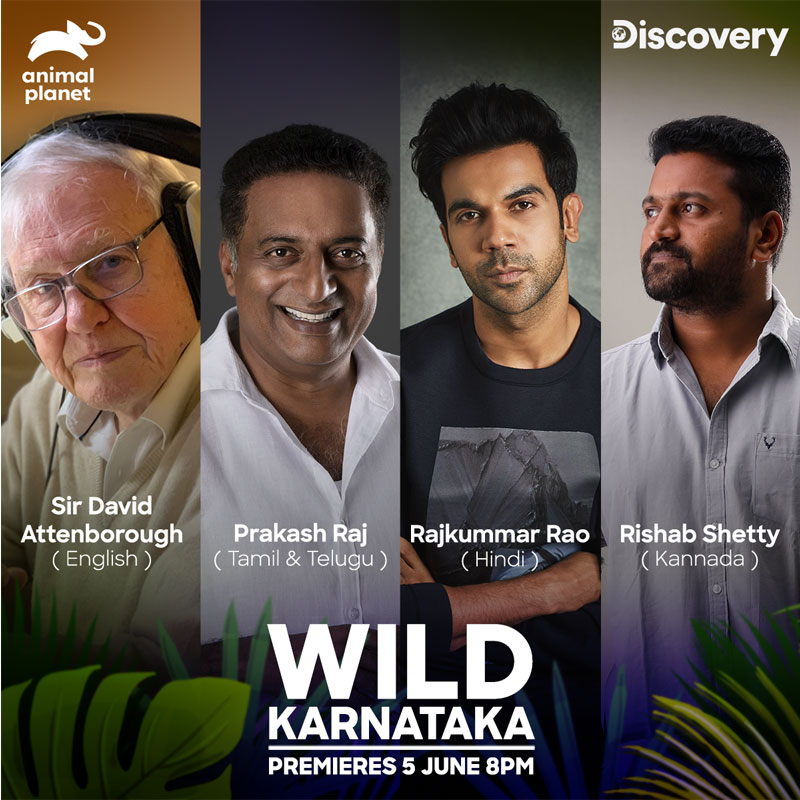
MUMBAI: Discovery in a unique initiative aimed at raising awareness about the rich biodiversity of India and the need for wild-life conservation has pulled in celebrated actors to provide voice-overs for the premiere of documentary ‘Wild Karnataka’ on June 05, the World Environment Day. Produced by award-winning filmmakers Amoghavarsha JS and Kalyan Varma in collaboration with Karnataka Forest Department, Wild Karnataka focuses on the biodiversity that flourishes in the wild, as Karnataka now has some of the best forests in the world.
The film, shot using 4K Ultra HD technology, by a team of 20 camera persons using drones and 15 stationed cameras across Karnataka over a period of four years, is a visual spectacle which is to be enjoyed on the big screen. The premiere of Wild Karnataka will get a never-seen-before reception as leading movie stars come forward to narrate it in different languages. Sir David Attenborough will take the lead in English while Indian actors such as Rajkumar Rao (in Hindi), Prakash Raj (in Telugu & Tamil), and Rishab Shetty (in Kannada) will ensure that Indians across the country join hands and celebrate nature’s gift to this beautiful country.
The documentary will be released on Discovery Plus App at 6:00 am on June 05 on Android, iOS and on the desktop / mobile web on www.discoveryplus.in. The TV premiere will happen at 8:00 pm on Discovery, Discovery HD, DTamil and Animal Planet. The documentary has received huge interest from advertisers with Policy Bazaar, Mi 10 and Unacademy coming on-board as associate sponsors while Wildcraft is co-powered by sponsor.

“The premiere of Wild Karnataka is part of our long-term vision of promoting and elevating Indian filmmakers and storytellers who are making exceptional content,” said, Sai Abishek, director – content, factual & lifestyle entertainment – south Asia, Discovery. “We continue to innovate with an aim to engage audiences with thrilling, power-packed, entertaining and yet purpose driven content. I am indebted to the celebrities who came forward and supported this film readily and brought forward their unique sense of storytelling.”
Co-filmmaker Amoghavarsha JS said, “Following the theatrical release of our film, it gives immense pleasure to be associated with a platform like Discovery Channel which is known for the brilliant work they’re doing towards helping raise awareness about wildlife conservation. We could not have found a better platform for us to showcase our film in which we have tried to bring to the screen the wondrous wildlife of Karnataka.”
Noted celebrities coming together for a special cause: –
Lending his voice to the film in Hindi, the Indian Actor Rajkummar Rao said, “As an actor you’re always looking for interesting stories to tell. However, to be able to narrate the story of our country’s wildlife was an extremely enriching experience for me. Discovery has always been my go to channel whenever I’ve wanted to explore something new. Now to be a part of the channel through a film that so beautifully portrays the natural heritage of our country, it is definitely a proud moment for me. Wild Karnataka celebrates the spectacular diversity of the Indian state, Karnataka and brings us closer to the wildlife that thrives in the state. It serves as a good reminder for all of us to truly celebrate our country’s rich natural treasures and work towards preserving them for generations to come.”
Actor Prakash Raj has lent his voice for the Tamil and Telugu version of the film. He said, “I connect with the ethos of the show – celebrating the rich bio-diversity that is prevalent in India. The magnitude of this wild based magnum opus can be gauged from the fact that this hour-long documentary is sieved from four hundred hours of shot footage. To use one’s craft for raising awareness about the beauty and the diversity of our natural heritage is a beautiful thing and now it is up to us, the viewers and the citizens of India to not only celebrate this beauty but also work towards taking care of it.”
“This film, Wild Karnataka, is close to my heart as I am from Karnataka and I feel grateful to be a part of this project for Discovery India. Lending my voice to the film in a way helps bring it closer to the people of Karnataka so they can witness the beautiful wildlife that thrives in this state, with a personal touch. It is extremely important for us to save our wildlife and the government and Forest Department of Karnataka are taking great efforts despite the pressures of development and vast human populations. It is time we learn more about this and understand how we can be a part of the solution,” said actor Rishab Shetty, who has dubbed for the film in Kannada.
Karnataka is the home to some of the richest wild places on the planet and boasts of a rich biodiversity, most of which is still unknown to the public. Interestingly, one quarter of India’s plant and animal species are found here, many of which are still unknown to the people of India. The film appreciates the efforts of the people, government and the Forest Department of Karnataka, who are committed towards saving some of the greatest natural history for the future generations. Further, the movie spotlights the efforts of the government of Karnataka to save tigers and elephants as the state is a home to these majestic animals than anywhere else in the world. The money raised by this launch is being donated to the Tiger Foundation of Karnataka forest Department. WILD KARNATAKA sends a message of hope not just across India but across the whole world.






English Entertainment
Warner Bros. Discovery shareholders approve Paramount deal
Investors wave through a $111 billion megamerger but deliver a stinging, if toothless, rebuke over half-a-billion-dollar goodbye packages
NEW YORK: The shareholders said yes to the deal. They said no to the cheque. At a virtual special meeting on Thursday that lasted barely ten minutes, Warner Bros. Discovery investors voted overwhelmingly to approve Paramount Skydance’s $111 billion acquisition of the company — and then turned around and voted against the lavish exit pay packages lined up for chief executive David Zaslav and his fellow outgoing executives.
Not that it will make much difference. The compensation vote is purely advisory and non-binding. The Warner Bros. Discovery board can, and almost certainly will, pay out as planned.
But the symbolism stings. It is the second consecutive year that WBD shareholders have voted against the executive compensation packages, and this time they had good reason. Zaslav’s exit deal is, by any measure, extraordinary. Under the terms filed with the Securities and Exchange Commission, he is set to receive $34.2 million in cash severance, $517.2 million in equity in the combined company, and $44,195 in continued health coverage — a total of at least $550 million. On top of that, Warner Bros. Discovery has agreed to reimburse Zaslav up to $335 million for taxes assessed by the Internal Revenue Service on his accelerated stock vesting, though the company says that figure will decline depending on when the deal closes. As of March 11, Zaslav also held $115.85 million in vested WBD stock awards — and last month sold a further $114 million worth of WBD shares.
Shareholder advisory firm ISS recommended voting against the compensation measure, citing “problematic” tax reimbursements to Zaslav and the full vesting of his stock awards.
Zaslav will be bound by a two-year non-competition covenant and a two-year non-solicitation of customers and employees after the deal closes.
His lieutenants are not walking away empty-handed either. J.B. Perrette, chief executive and president of global streaming and games, is in line for $142 million, comprising $18.2 million in cash severance and $123.9 million in equity. Bruce Campbell, chief revenue and strategy officer, will receive an estimated $121.5 million, including $18.8 million in severance and $102.7 million in equity. Chief financial officer Gunnar Wiedenfels is set for $120 million, made up of $6.6 million in cash severance and $113.1 million in equity. Gerhard Zeiler, president of international, will get $82.6 million, including $11.9 million in severance and $70.7 million in equity.
The deal itself, clinched in February after Netflix declined to raise its bid for Warner Bros., still needs regulatory clearance from the Justice Department and European authorities. Several state attorneys general are also weighing legal action to block it.
Senator Elizabeth Warren, Democrat of Massachusetts, was unsparing. “The Paramount-Warner Bros. merger isn’t a done deal,” she said after the shareholder vote. “State attorneys general across the country are stepping up to stop this antitrust disaster. We need to keep up this fight.”
If it does go through, the combined entity would be a formidable beast, bringing together Paramount Skydance’s stable — CBS, CBS News, Paramount Pictures, Paramount+, BET, MTV and Nickelodeon — with WBD’s portfolio of HBO, Max, Warner Bros. film and TV studios, DC, CNN, TBS, TNT, HGTV and Discovery+. Paramount has said it expects $6 billion in cost savings from the merger, which is Wall Street shorthand for mass layoffs on a significant scale.
The ten-minute meeting was presided over by chairman Samuel Di Piazza Jr., with Zaslav, Campbell, Wiedenfels and chief communications officer Robert Gibbs in virtual attendance. Di Piazza was bullish. “We appreciate the support and confidence our stockholders have placed in us to unlock the full value of our world-class entertainment portfolio,” he said. “With Paramount, we look forward to creating an exceptional combined company that will expand consumer choice and benefit the global creative talent community.”
Zaslav echoed the sentiment. “Over the past four years, our teams have transformed Warner Bros. Discovery and returned the company to industry leadership,” he said. “Today’s stockholder approval is another key milestone toward completing this historic transaction that will deliver exceptional value to our stockholders.”
Paramount Skydance struck a similar note. “Shareholder approval marks another important milestone towards completing our acquisition of Warner Bros. Discovery,” it said in a statement, adding that it looked forward to “closing the transaction in the coming months.”
The shareholders have spoken on the merger. On the pay, they were ignored before the vote was even counted.