Brands
P&G pledges to go carbon-neutral by end of decade
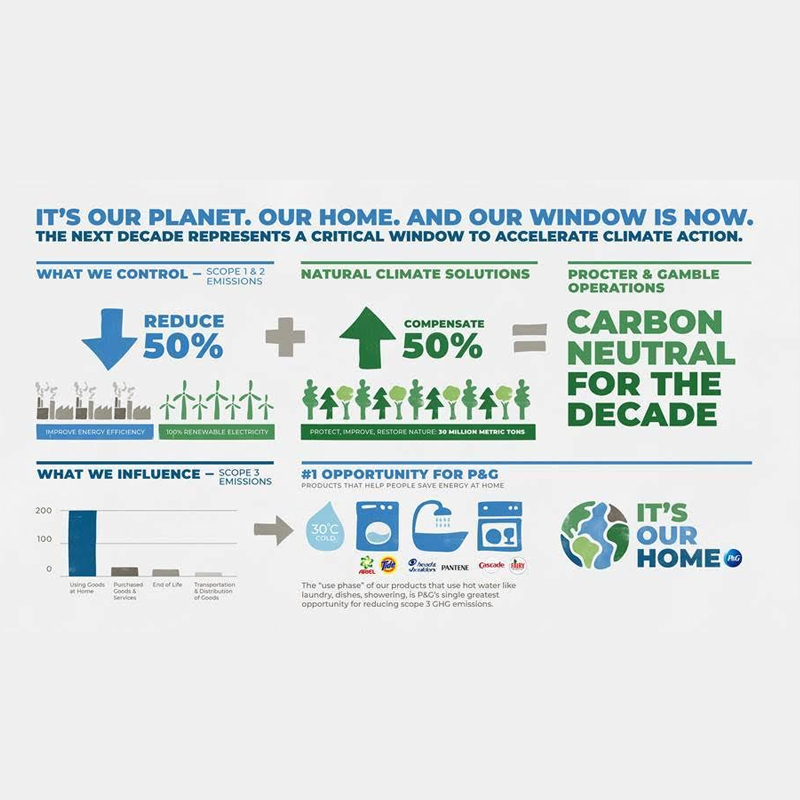
NEW DELHI: Announcing a series of interventions that protect, improve, and restore nature, P&G has committed to going carbon-neutral by the end of this decade, it shared in a press statement. The company will need to balance ~30 million metric tons of carbon from 2020 to 2030.
“Recognising the next decade represents a critical window for the world to accelerate progress on climate change, P&G will go beyond its existing Science Based Target of reducing greenhouse gas emissions by 50 per cent by additionally advancing a portfolio of natural climate solutions. These efforts will deliver a carbon benefit that balances any remaining emissions over the next 10 years, allowing P&G operations to be carbon neutral for the decade,” read the release.
P&G chief sustainability officer Virginie Helias said, “Our role as leaders is to make a lower-emission economy and lifestyle possible, affordable and desirable for everyone. It is our responsibility to protect critical carbon reserves and invest in solutions that regenerate our planet. Consumers also want to do more to address climate change. As a company, we touch five billion people with our brands; we are striving to make a difference every day by encouraging responsible consumption with products that are effective and intuitive to enable adoption of new lower emission habits.”
Its brands have been active in marketing their products in a way that engages consumers to involve in healthy environment-friendly habits. As per the global giant, more than 60 per cent of a laundry detergent’s footprint is in the consumer use phase due to the energy used to heat the water. Its brands, Ariel and Tide, have adopted brand messaging encouraging users to "turn to 30" and "cold water wash" their clothes, reducing roughly 15 million metric tons of carbon dioxide since 2015 as a result.
Likewise, dishwasher detergent brands Cascade and Fairy are encouraging consumers to skip pre-washing in order to reduce water usage and cut up to half of the total carbon footprint of every wash cycle.
Helias noted, "As a company, we touch five billion people with our brands; we are striving to make a difference every day by encouraging responsible consumption with products that are effective and intuitive to enable adoption of new lower-emission habits."
P&G has also partnered with Conservation International and World Wildlife Fund (WWF) to identify and fund a range of projects to achieve the goal. The already identified a slew of international projects including Atlantic Forest Restoration Planning with WWF and Evergreen Alliance with Arbor Day Foundation.
Follow Tellychakkar for the consumer facing news & entertainment

Brands
Trump announces $300bn Texas oil refinery with Reliance, calls it the biggest in US history
First new US refinery in 50 years planned at Brownsville port with Reliance
WASHINGTON: The United States may soon see the first brand-new oil refinery built on its soil in half a century.
Donald Trump announced a proposed $300 billion refinery project in Texas, calling it a landmark moment for American energy production and jobs.
Posting on Truth Social on 10 March, Trump said the facility would be built at the Port of Brownsville and developed by a company called America First Refining, with major investment from India’s Reliance Industries.
The announcement frames the project as a centrepiece of the administration’s push for “energy dominance”, with Trump claiming it would deliver thousands of jobs and billions of dollars in economic activity to South Texas.
If realised, the plant would mark the first all-new major refinery constructed in the United States since the 1970s. In recent decades, oil companies have largely chosen to expand existing facilities rather than build new ones, citing high costs, regulatory hurdles and environmental scrutiny.
Trump described the proposed investment as the “biggest in US history”, positioning it as proof that policy changes such as streamlined permits and lower taxes are drawing large-scale energy investments back into the country.
The refinery is planned for the Port of Brownsville, a strategic Gulf Coast location that provides easy access to shipping routes and export markets.
A key partner in the project is Reliance Industries, controlled by billionaire industrialist Mukesh Ambani. The company already runs the world’s largest refining complex in Jamnagar, India, making it one of the most experienced operators in large-scale petroleum processing.
The Texas venture would mark a significant step for the group into America’s domestic refining sector, potentially strengthening industrial ties between the US and India.
The proposed refinery is being promoted as a next-generation facility capable of processing American shale oil while maintaining high environmental standards. Trump said it would be “the cleanest refinery in the world”, although the specific technologies behind that claim have not yet been detailed.
Industry observers also note that the $300 billion figure is unusually large for a refinery project, and analysts are waiting for more clarity on whether the number reflects total construction costs, long-term infrastructure investment, or broader economic impact estimates.
As of 11 March, Reliance Industries had not publicly confirmed the investment size or the structure of its involvement.
For now, the announcement has sparked equal parts excitement and curiosity in energy markets. If the plan moves from promise to pouring concrete, the refinery could reshape the Gulf Coast energy landscape, and reopen a chapter in American refining that has been quiet for nearly fifty years.