I&B Ministry
93% TV households do not watch news channels; media degenerated into becoming pet performing poodle of govt” former I&B minister, Manish Tewari to Kailashnath Adhikari, MD,Governance Now

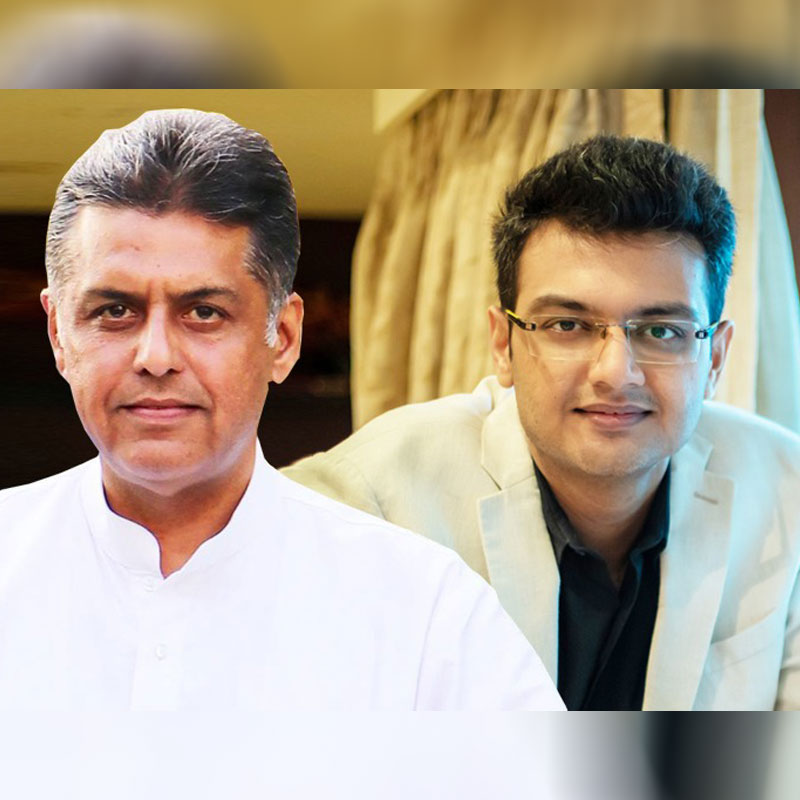
“93% TV households do not watch news channels; media degenerated into becoming pet performing poodle of govt” former I&B minister, Manish Tewari to Kailashnath Adhikari, MD, Governance Now.
Former Information and Broadcasting Minister and MP, Lok Sabha, Manish Tewari has said that with only 7percent of 950 million people in India with TV sets at home watching news and current affairs channels and with 391 news and current affairs channels digging around in that 7% space to earn money, it has become a dog eat dog market.
While speaking to Kailashnath Adhikari, MD, Governance Now at the webinar during the Visionary Talk series, organized by the public policy and analysis platform, Tewari while giving out numbers said that there are 950 million people with television set at home in India. 93% do not watch news channels. Only 7% watch news and current affairs channels and the 391 existing news and current affairs channels are digging around in that 7% space trying to earn money. “It has become a dog eat dog market.”
Tewari also said that that media needs to relook its revenue models and cannot have model which is totally advertisement driven.
While responding to a question if the revenue model could be regulated with a policy, Tewari recalled that when he was the I&B minister he cleaned out the TRP paradigm with a policy framework on how companies which generate TRP’s need to be regulated when a leading newspaper at that time decided to get out of business.
“If you want to correct your revenue model and charge subscribers a higher rate for the newspaper they buy or a TV channel they want to see, you will be able to then offer them better content. You have to start pricing your products properly and get people into the habit for paying.. But since you remain advertising dependent it is measured by fake currency called TRP’’ said Tewari.
The former MP added that like print and electronic media, social media is equally worst and said the biggest difficulty today is that what used to plague the print media and electronic media now plagues the social media which is also completely advertisement driven model. He said that the advertisement driven model does not allow you to curate quality content and be independent as bulk of small and medium people in the business depend on handouts which are given by the BOC (bureau of outreach and communication). “There is a fundamental problem they are not willing to look at” he said.
Coming down heavily on media Tewari said that media is not philanthropic. “Over a period of time media has degenerated into becoming the pet performing poodle of the government. Freedom of press in India is a myth. It is a chimera. Huge corporate interest dictates the direction and trajectory of media depending upon what their business interest currently are. Except for print media, unfortunately I can’t say that for substantive section of electronic media”
Speaking on paid news the former minister said that when he was trying to amend the Press and Registration of Books Act, 1867 and specifically tried to insert the section on paid news and penal provisions, ‘‘the push back from biggies in the media industry was so enormous that the bill has not seen the light of day till date.”
“The news and current affairs media is about educating people, presenting facts in perspective and bringing seriousness to public discourse. That’s the responsibility you need to discharge rather than looking at bottom lines and spin off cheap entertainment as news which does not require news licence” said Tewari in a scathing attack on the news.