MAM
Golden Key Awards 2024: MRSI to celebrate market research pioneers
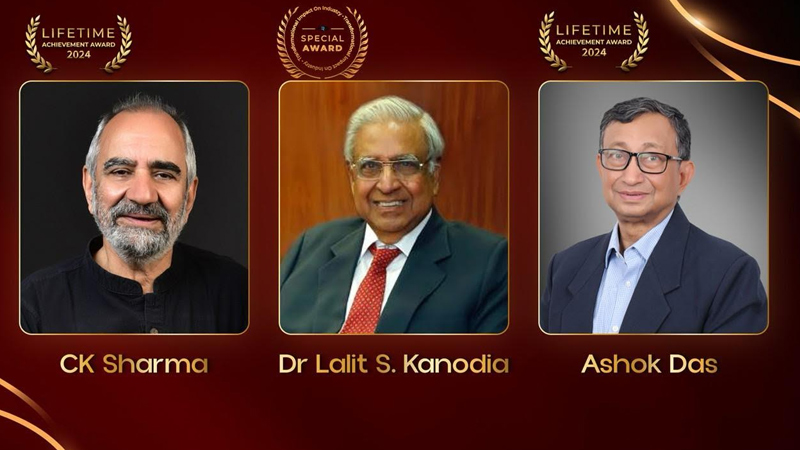
MUMBAI : The Market Research Society of India (MRSI) is all set to honour three trailblazers at the Golden Key Awards 2024, happening on 20 February in Mumbai. This year, Ashok Das, C. K. Sharma, and Lalit S. Kanodia will be celebrated for their exceptional contributions that have shaped and elevated India’s market research and insights industry. Their groundbreaking work continues to inspire and influence the sector, making this year’s awards truly special.
Das will receive the Lifetime Achievement Award for his exceptional work over more than four decades, including his leadership at Hansa Research and his groundbreaking initiatives like the Indian Readership Survey and INTAM, India’s first television meter service. Marketing & Business Associates co-founder Sharma will also be honoured with a Lifetime Achievement Award for his pioneering work in customer and employee engagement, as well as his contributions to global research frameworks.
Kanodia will be presented with a special award for his transformational impact on the market research sector. Known for digitising offline research and integrating data analytics, Kanodia’s leadership at Tata Consultancy Services and Datamatics has revolutionised global research operations.
MRSI president Nitin Kamat, expressed profound gratitude for the recipients’ visionary leadership and mentorship, which continues to influence the industry.

MAM
Madison World to launch AI platform M BrAIn for media planning
Agency group invests about $1 million as it shifts to AI driven growth planning.
MUMBAI: If media planning once ran on spreadsheets and gut instinct, the next chapter may run on algorithms and curiosity. Madison World is preparing to roll out the first version of its proprietary artificial intelligence platform Madison M BrAIn in early April, as the independent agency group accelerates its transition toward AI driven planning and product led media services.
The platform, expected to involve an investment of around $1 million, is designed to reshape how the agency approaches strategy by combining internal knowledge, external data sources and advanced AI models into a single intelligence ecosystem.
According to Madison Media, OOH and Hiveminds partner and group CEO Ajit Varghese the initiative forms part of a larger structural rethink within the organisation. “Traditionally agencies built frameworks around media planning and allocation. We are redesigning that structure into what we call a Growth Planning System (GPS),” Varghese said.
The shift reflects a growing belief that effective media strategy must begin earlier in the decision making process. Instead of jumping directly to channel allocation, planners must first decode the market itself identifying consumer barriers, purchase triggers and the core challenges facing a brand.
Once those insights are mapped, agencies can build clearer growth agendas for clients and design media strategies that connect more closely with business outcomes.
To support that approach, Madison has built Madison M BrAIn as what it describes as a human AI cognitive ecosystem. Acting as a central intelligence hub, the platform aggregates proprietary insights alongside external data sources and large language models, enabling planners to access deeper market intelligence before building campaign strategies.
Varghese said one of the core objectives is to democratise knowledge across the organisation. “In the past, this level of understanding was largely available to senior leaders or experienced strategists. With Madison M BrAIn, even a junior planner should be able to access the same intelligence and approach clients with a far more informed perspective,” he said.
The agency has already implemented the new planning philosophy internally and completed three months of testing for the AI platform, with early trials showing encouraging results in terms of learning capability and system performance.
While the first version relied on global large language models, Madison is now developing its own proprietary Small Language Model (SLM) to serve as the core of the M BrAIn ecosystem.
“The SLM will be able to read global LLMs, but the LLMs cannot read the SLM,” Varghese explained. “That ensures all the intelligence we build remains within the Madison ecosystem and strengthens our proprietary knowledge base.”
The first version of Madison M BrAIn is expected to go live in early April, with a more refined version targeted by the end of June. Over time, the platform will integrate additional external data streams and APIs including consumer insight platforms, social listening tools and client datasets.
These integrations are expected to enhance the system’s learning capability and enable it to generate increasingly sophisticated strategic recommendations.
Although the platform is currently being deployed for internal use, Madison sees potential for it to evolve into a licensable product in the future.
“At the moment, our focus is to stabilise and strengthen M BrAIn internally. But over time there is potential for this to become a product that could be licensed externally,” Varghese said.
The AI platform is also part of a wider technology transformation underway at the agency group. Alongside M BrAIn, Madison is building a broader digital infrastructure called the Catalyst operating system, which aims to integrate operational processes, data and product platforms into a unified ecosystem.
This broader technology stack could require an additional $1 million to $1.5 million investment over time, though spending will be phased and reviewed regularly.
“We are evaluating progress every three months and prioritising the most critical capabilities first,” Varghese said.
Madison expects the full AI and operating ecosystem to be fully functional within 12 to 18 months, positioning the agency to combine human strategy with machine intelligence as the advertising industry enters its next data driven phase.