AD Agencies
CCOs are shepherds, not showmen, say ad veterans in spirited Goafest debate
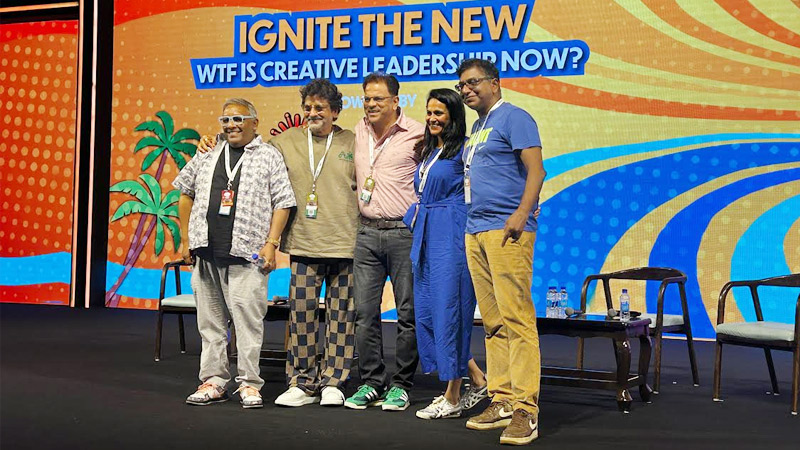
MUMBAI: At Goafest 2025’s high-energy panel “WTF is Creative Leadership Now?”—powered by Sun NEO and Amar Ujala—the crowd wasn’t just fed insight, it was served a full-course debate. The motion on the table: “The chief creative officer (CCO) is no longer the heart of the creative agency”. What followed was part philosophy, part punchlines, and all-out passion.
Moderated by Ohriginal founder Rohit Ohri, the session featured industry legends and present-day captains: Bobby Pawar, Sonal Dabral, Senthil Kumar (VML India), and Lulu Raghavan (Landor APAC). The format was unconventional—a structured debate—and emotions ran high as both sides made their case.
Pawar, speaking for the motion, fired the opening salvo: “The CCO has become a generalist, not a specialist”. He lamented the erosion of focus, saying creatives today juggle too many hats—part spreadsheet warrior, part HR liaison, part plumber of broken processes. “The CCO is supposed to make people better, not just the work”.
Dabral echoed the sentiment. “The role’s been marginalised”, he said. “Once upon a time, creative work brought in the revenue. Now, we’ve surrendered that ground to consultants and growth officers”.
On the other side, Raghavan mounted a spirited defence. “The CCO is the custodian of the brand’s unified creative vision”, she said. “They’re culture magnets and client counsellors. Yes, the role has evolved, but that doesn’t mean it has weakened—it has amplified”.
Kumar brought the flair, calling today’s CCO a “playing captain”, not a bench-bound boss. “They’re curators of talent and makers of movement. They must know when to step up and when to step back.”
The debate heated up as rebuttals flew. Pawar quipped, “If the client only wants to speak to one person, why do they need the rest of us?” Raghavan countered, “Then make that person the one who inspires, not just manages”.
What united both camps, despite the sparring, was a shared reverence for creativity’s core purpose. All agreed that CCOs must move beyond ego, protect originality, and build cultures that nurture bold thinking. In Ohri’s closing words, “It’s not about idea ownership anymore—it’s about creating open spaces where ideas can roam freely and return home safe”.
The rapid-fire round that followed was peak Goafest theatre. The panelists defined today’s CCO in their own punchy terms: “instigator”, “playing captain”, “creative curator”, “versatile”. When asked to choose between a Cannes Lion or a lifetime client, most cheekily opted for both.
As the session wrapped, the takeaway was clear: the CCO isn’t dead. They’re just shape-shifting—and perhaps learning to lead not from the podium, but from the pasture.

AD Agencies
AdTrust Summit 2026 to examine trust, AI and Gen Alpha in advertising
Two-day summit in Mumbai to explore ethics, regulation and the future of advertising trust
MUMBAI: At a time when advertising is navigating a delicate trust deficit, the Advertising Standards Council of India is preparing to bring the industry to the table. On 17 and 18 March, the body will host the inaugural AdTrust Summit 2026 in Mumbai, a two-day gathering designed to spark conversation around responsibility, regulation and credibility in modern advertising.
The summit, to be held at the Jio World Convention Centre in Bandra Kurla Complex, will bring together leaders from advertising, media, technology and policy to examine how brands can build trust in a marketplace increasingly shaped by algorithms, influencers and artificial intelligence.
In an age of deepfakes, dark patterns and blurred lines between content and commerce, the question is no longer just how brands capture attention, but whether audiences believe what they see. The AdTrust Summit aims to unpack that challenge.
Day one will turn its attention to the youngest digital natives. Titled Decoding Gen Alpha, the session will unveil ‘What the Sigma?’, a study by ASCI and Futurebrands Consulting that explores how children growing up in a hyper-digital environment encounter advertising and commercial messaging.
The report presentation will be delivered by Santosh Desai, founder and director at Think9 Consumer Technologies and a social commentator known for his insights into consumer behaviour. The discussion that follows will attempt to decode how Gen Alpha consumes media, interacts with brands and navigates the growing overlap between entertainment and marketing.
In a move that mirrors the subject itself, two Gen Alpha students will also join the conversation, offering a rare perspective from the generation advertisers are trying to understand.
The second panel of the day will shift the focus from observation to implication, asking what the report’s findings mean for brands, agencies and society. Speakers include Karthik Srinivasan, communications strategy consultant; Preeti Vyas, president at Mythik; and Abigail Dias, associate president planning at Ogilvy. The session will be moderated by Sonali Krishna, editor at ET Brand Equity.
Day two moves from insight to regulation. Under the theme From Compliance to Trust, ASCI will release its Ad Law Compendium, a comprehensive guide to India’s advertising regulations.
The day will open with a keynote by Sudhanshu Vats, chairman at ASCI and managing director at Pidilite Industries, followed by a chief guest address by Sanjay Jaju, secretary at the Ministry of Information and Broadcasting.
Legal experts from Khaitan & Co., including Haigreve Khaitan, senior partner, and Tanu Banerjee, partner, will present an overview of the current advertising law landscape in India and examine whether existing frameworks are equipped to deal with emerging technologies and formats.
Subsequent panels will explore issues increasingly shaping the industry’s ethical compass. Conversations will range from the limits of persuasive design and the rise of dark patterns, to the growing scrutiny brands face from digital creators and consumer watchdogs.
One session will also feature Revant Himatsingka, widely known online as the Food Pharmer, whose critiques of packaged food brands have sparked debate around transparency and corporate accountability.
Later discussions will turn toward media literacy among Gen Alpha, asking how children can be equipped to navigate a digital world where gaming, content and commerce are becoming indistinguishable.
The summit will conclude with a final panel on the future of advertising, bringing together voices from agencies, legal circles and technology platforms to discuss how innovation, intelligence and integrity can coexist.
For an industry built on persuasion, trust has always been its quiet currency. But as audiences grow more sceptical and digital ecosystems more complex, that currency is under pressure.
Events like the AdTrust Summit suggest the advertising world knows it cannot afford to take credibility for granted. The real challenge now is turning conversation into commitment.