News Broadcasting
Aap Ki Adalat: Delhi CM Rekha Gupta on skipping Sheesh Mahal – “Neend nahin aati”

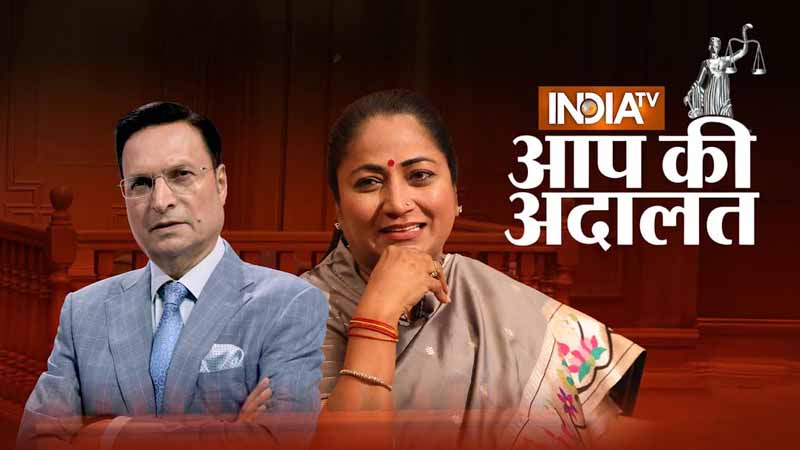
MUMBAI: Delhi chief minister Rekha Gupta has, for the first time, explained why she decided not to shift to the multi-crore ‘Sheesh Mahal’ built by Arvind Kejriwal, and opted to go to a renovated bungalow on Raj Niwas Marg.
Appearing in Rajat Sharma’s iconic show ‘Aap Ki Adalat’, to be telecast tonight at 10 pm on India TV, the chief minister was asked what the harm was in shifting to ‘Sheesh Mahal’, “Neend Nahin Aati (I can’t sleep). I see how the people of Delhi are suffering, and Kejriwal Saheb was enjoying while staying there. He even did not open his curtains (Woh Pardey Bhi Nahin Kholte They). The voice of people did not reach his ears (Janata Ki Awaaz Unke Kaanon Me Nahin Aati Thi). He used to stay within the confines of his home. Even today, his party MLAs come and tell me, they never saw the Sachivalaya (secretariat). Today that secretariat has been opened to thousands of people. Earlier entry to the corridors was restricted.”
Gupta is expected to move into her new bungalow during the Navratri festival this year, as renovation work is going on. On Friday, a special havan and pooja were performed at the bungalow.
When Rajat Sharma referred to a PWD tender notice issued on 28 June for the CM’s bungalow, which will have 24 ACs, 5 smart TVs, three chandeliers, 115 lights, 23 ceiling fans, six geysers, 10 flood lights, advanced cctv cameras and top class internet connection, Rekha Gupta replied: “The man (Kejriwal) who had claimed he would never take a bungalow and car, spent Rs 80 crore of hard-earned money of the people for his personal use. His curtains cost several crores of rupees, and when people raised questions, he closed the gates to his Sheesh Mahal. Today, after being CM for four months, I do not have an official residence. I use tables and chairs on my street to listen to public grievances. Never in history was a residence given to a CM, where a fourth-grade employee of the LG used to sit. Since there was no official CM residence in Delhi, it was easy for me to go there and stay. I refused to go and stay in Sheesh Mahal. I can only go to a residence where thousands of people can come and meet me, otherwise I will not opt. Today my home is open to all. Nobody could go and meet Kejriwal Saheb when he was CM.”
“But my home and residence are open to all who want to meet me. I am your CM, my time is yours and my home is yours….Today my residence is being renovated at a cost for which he had bought doormats and curtains for his home…… My work is transparent. I do not conduct secret meetings like him, nor do I have a fleet of 100 cellphones, which can be broken, when caught. I will stay wherever people will tell me, I want to live in their hearts. I am ready to live in the streets.”
Asked what will now happen to the Sheesh Mahal, Gupta replied, ”Hamari Yojana Hai Ki Janata Ka Paisa Jo Wahan Barbaad Kiya, Hamari Koshish Rahegi Ki Hum Aisa Nirnay Len Ki JO Paisa Laga, Woh Phir Se Khazaane Me Aaye Aur Usse Janata Ka Laabh Ho, Kaam Ho.” (Our plan is, the money that was squandered on it comes back to our exchequer and it is used for the betterment of the people)
The chief minister spoke on several topics ranging from cleaning of Yamuna, Mohalla clinics, education, stray cows and slum dwellers.
On cleaning of Yamuna, she said, “our government is fighting on all fronts. Right from our prime minister to the common man, everybody is worried about Yamuna…. All fresh water that comes to Delhi through Yamuna is used for drinking purpose. Nearly 200 drains including Najafgarh and Shahdara drains fall in Yamuna. We first decided to trap the drains to improve BOD (biochemical oxygen demand) level. It was found 22 out of 38 STP plants were not working as per DPCC guidelines. Old STPs are being updated and upgraded. We are trying to trap all effluents coming from industrial areas. We have also spoken to the Haryana government to trap its effluents. We have prepared Rs 9,000 budget for Yamuna action plan this year and this work cannot be completed in one day. We involved experts during the last four months, acquired technology and did not waste a moment. There are 1,700 colonies which do not have sewer lines. We have started laying sewer lines and pipelines. We are working with Haryana and UP to increase the e-flow of Yamuna.”
On Kejriwal threatening “Naani Yaad Aa Jayegi” if 40 lakh slum dwellers come out on the streets, the Chief Minister replied: “Why should I remember my Naani? Kejriwal complicated matters and he wants Delhi must not develop. Neither he worked on reducing pollution, nor did he remove the garbage hills or created any infrastructure. He only gave away freebies for water and electricity, but did not build new flyovers and infrastructure. Does he want dwellers to continue staying in slums. Let Kejriwal try and see if 40 lakh slum dwellers come out on his call…For 27 years out of which Congress ruled for 15 years and Kejriwal ruled for 12 years, no house was built for the poor. The Centre built 50,000 flats for distribution, but they became dilapidated. It was Modiji who gave homes in places of jhuggis. Let people say, should the government agency not clear the places for which people were given flats? If the court orders removal of those who built slums close to rail tracks, created security threat, will those slums not be demolished? He (Kejriwal) is misguiding and creating fear in the minds of slum dwellers by saying their homes will be demolished. It was the AAP government that created a parameter that those who settled in Delhi before 2015 should be given flats. Those who were left out and are demanding flats, we have two paths left: One, either their old policy was wrong and we should change that policy or say that even those who came to Delhi two months ago should also get flats. Naturally, taxpayers will ask what is the cut-off period,15 years or 40 years or yesterday? Our policy will be transparent. All those who live in jhuggis should get better homes, better amenities.”
Rekha Gupta said, “There are 675 jhuggi clusters in Delhi, out of which demolition was done in only four. Out of these, there were court cases in three and in the fourth, the land owning agency had already given them flats. No demolition action has taken place anywhere else in Delhi. Kejriwal is like Kumbhakaran, who does politics in Punjab for six months and then comes here. He does not know how Delhi progressed in the last four months. He was in power in Delhi for 12 years, did he give a single flat to a slum dweller? You won’t find a single jhuggiwallah who can say that he was given a flat by Kejriwal. Today, our government is making plans to give flats to lakhs of poor people and we are seriously working on it.”
Describing Kerjiwal’s Mohalla Clinic scheme as a “big fraud”, Rekha Gupta said, “It was a big fraud based on fake propaganda. They set up a porta cabin on a drain, named it Mohalla clinic, asked a doctor to sit there, he was paid Rs 40 per patient. Do you think the doctor will cure the patient, or he will ensure there is a long queue of patients. One doctor claimed he attended 500 patients on a single day and demanded payment. There was no medicine, no vaccination. Our Aarogya Mandir is a full-fledged primary hospital or a dispensary, equipped with medical and paramedic staff and nursing staff. We give medicines and vaccination. One can get firstaid and treatment. There are also provisions for medical tests. Nearly 100Aarogya Mandirs are functioning in Delhi today. Mohalla Clinics were a fraud. They were misusing money by cheating people.”
The chief minister alleged that the AAP government used to squander money by appointing people on contract in civil defence. “There was a requirement for 500 staff, but he appointed 25,000 people. They were given jobs like ensuring “odd-even” rule, standing at traffic lights asking car drivers to switch off their engines. Lakhs of rupees were squandered. One person carrying a placard was paid Rs 1,000 daily, which comes to Rs 30,000 per month. Even an engineer does not get this salary. When the court ordered to cancel this scheme, these 20-25,000 people were rendered unemployed. Similarly, bus marshals were appointed. Now we have electric buses having cameras and panic buttons and marshals are not needed. These marshals are now unemployed. They were all on contract. For the first time in the last 15-20 years, our government is going to give permanent appointment letters to 1,500 nurses on July 6. This is how the previous government complicated things.”
On the recent controversy over refusal of fuel to old vehicles in Delhi, the Chief Minister said, “It is our misfortune that Delhi has been declared one of the worst polluted cities in the world. The previous government did not take any serious steps to stop air pollution and the capital, instead of becoming a green city, became a gas chamber. It was then that the courts, National Green Tribunal and CAQM stepped in. The order to deny fuel to petrol and diesel vehicles that are 10 to 15 years old was issued by CAQM. I think this order is not justified.’
She explained: “I would like to assure the people of Delhi that our government would ensure no injustice is done to the people. We will place this view before the courts, NGT and CAQM. There are thousands of middle class families, including my father, who use their vehicles occasionally… The previous Kejriwal government had been scrapping old vehicles for the last one and a half years. ..In the past, the government did not do its duty and the people had to face the music ….. Our government will not allow people to face injustice for keeping old vehicles. There is no logic behind refusing fuel to old vehicles in Delhi, and allowing neighbouring states in NCR to sell fuel.”
Aap Ki Adalat with Delhi chief minister Rekha Gupta telecasted tonight at 10 pm on India TV. Repeat telecasts of this show will take place on Sunday at 10 am and 10 pm.
(If you are an Anime fan and love Anime like Demon Slayer, Spy X Family, Hunter X Hunter, Tokyo Revengers, Dan Da Dan and Slime, Buy your favourite Anime merchandise on AnimeOriginals.com.)