News Broadcasting
Bihar call as India News Manch 2025 puts politics centre stage in Patna
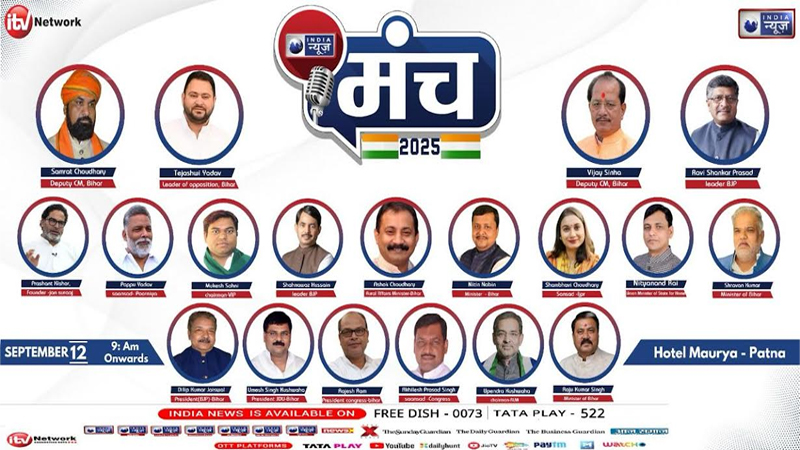
MUMBAI: When Bihar speaks, India listens and this September, the microphone will be turned up to full volume. India News Manch 2025, the flagship political conclave from Itv Network’s India News, is set to storm into Patna’s Hotel Maurya on 12 September 2025, bringing together the who’s who of Indian politics just months ahead of the state’s high-stakes election.
Now in its legacy-making run, the Manch has built a reputation as one of the nation’s most influential forums. This year’s edition is particularly charged, with Bihar’s verdict expected to ripple far beyond its borders, shaping alliances, governance strategies and even the national democratic roadmap.
The conclave will see a powerhouse line-up of more than 20 leaders, including deputy CMs Samrat Chaudhary and Vijay Kumar Sinha, BJP stalwarts Ravi Shankar Prasad and Syed Shahnawaz Hussain, Congress MPs Akhilesh Prasad Singh and Rajesh Ram, RJD’s Tejashwi Prasad Yadav, VIP’s Mukesh Sahani, Jansuraaj’s Prashant Kishor, RLM’s Upendra Kushwaha, and LJPR MP Shambhavi Choudhary. From Pappu Yadav to Dilip Kumar Jaiswal, the conclave ensures every major party and ideology has a voice on stage.
Beyond the political star power, the agenda is just as weighty: governance, economy, youth aspirations, equity, policy reform, and India’s global standing. With Patna as its stage, the forum will drill into how Bihar’s decisions could once again alter the balance of power across India.
“The future of Bihar is inseparable from the future of India,” said India News managing editor for Input Rakesh Singh. “This Manch will bring those voices to the national stage.” Echoing him, ITV Foundation founder Aishwarya Pandit Sharma noted: “By putting leaders and citizens on one platform, we bridge the gap between governance and grassroots voices.”
As anticipation builds, one thing is clear: this isn’t just another conclave. With Bihar at the crossroads of history, India News Manch 2025 promises fireworks, frank talk, and a front-row seat to democracy in action.

News Broadcasting
Induction cooktop demand spikes 30× amid LPG supply concerns
Supply worries linked to West Asia tensions push households and restaurants to turn to electric cooking alternatives
MUMBAI: As geopolitical tensions in West Asia ripple through global energy supply chains, the familiar blue flame in Indian kitchens is facing an unexpected challenger: electricity.
What began as concerns over the availability of liquefied petroleum gas (LPG) has quickly evolved into a technology-driven shift in cooking habits. Households across India are increasingly turning to induction cooktops and other electric appliances, initially as a backup but now, for many, a necessity.
A sudden surge in demand
Recent data from quick-commerce and grocery platform BigBasket highlights the scale of the shift. According to Seshu Kumar Tirumala, the company’s chief buying and merchandising officer, demand for induction cooktops has risen dramatically.
“Induction cooktops have seen a significant surge in demand, recording a fivefold jump on 10 March and a thirtyfold spike on 11 March,” Tirumala said.
The increase stands out sharply when compared with broader kitchen appliance trends. Most appliance categories are growing within 10 per cent of their typical demand levels, while induction cooktops have witnessed explosive growth as households rush to secure an alternative cooking option.
Major e-commerce platforms including Amazon and Flipkart have reported rising searches and orders for induction stoves. Quick-commerce apps such as Blinkit and Zepto have also witnessed stock shortages in major metropolitan areas including Delhi, Mumbai and Bengaluru.
What was once considered a convenient appliance for hostels, small kitchens or occasional use has suddenly become an essential addition in many homes.
A crisis thousands of miles away
The trigger for this shift lies far beyond India’s kitchens.
Escalating conflict in the Middle East has disrupted shipping routes through the Strait of Hormuz, one of the world’s most critical energy corridors. Nearly 85 to 90 per cent of India’s LPG imports pass through this narrow waterway, making the country particularly vulnerable to supply disruptions.
The ripple effects have been swift.
India currently meets roughly 60 per cent of its LPG demand through imports, and tightening global supply has already begun to affect domestic availability and prices.
Earlier this month, the price of domestic LPG cylinders increased by Rs 60, while commercial cylinders rose by more than Rs 114.
To discourage panic buying and hoarding, the government has also extended the mandatory waiting period between domestic refill bookings from 21 days to 25 days.
Restaurants feel the pressure
The strain is not limited to households. Restaurants, hotels and roadside eateries are also grappling with supply constraints as commercial LPG availability tightens under restrictions imposed through the Essential Commodities Act.
In cities such as Bengaluru and Chennai, restaurant associations report that commercial LPG availability has dropped by as much as 75 per cent, forcing many establishments to rethink their kitchen operations.
Some restaurants have reduced menu offerings, while others are rapidly installing high-efficiency induction systems, creating hybrid kitchens where electricity now shares the workload with gas.
For smaller eateries and roadside dhabas, the shift is less about sustainability and more about survival.
A potential structural shift
The government has maintained that there is no nationwide LPG crisis and has directed refineries to increase production to stabilise supply.
Nevertheless, the developments of March 2026 may already be triggering a longer-term behavioural shift.
For decades, LPG has been the backbone of cooking in Indian households. However, recent disruptions have highlighted the risks of relying on a single fuel source.
Increasingly, households appear to be hedging against uncertainty by adopting electric cooking options to guard against price volatility and delivery delays.
If the current trend continues, the induction cooktop, once viewed as a niche appliance, could emerge as a quiet symbol of India’s evolving kitchen economy.