Content Hub
“The idea whose time had come”: Hansal Mehta on making financial thriller ‘Scam 1992’


New Delhi: When the ten-part series Scam 1992 hit SonyLIV platform last October, it captured the imaginations of millions of young Indians in no time. The financial thriller chronicling the life of Gujarat-based stock broker Harshad Mehta, and his involvement in the 1992 Indian Stock Market Scam soon became the most-viewed series on the platform.
On the last day of fifth edition of the Content Hub 2021 -TV, Film, Digital Video, and Beyond’ – the makers and writers of ‘Scam 1992: The Harshad Mehta Story’ got into a freewheeling conversation with Indiantelevision.com founder and CEO Anil Wanvari and showrunner-writer Alok Sharma to discuss the making of one of the most successful digital series on an Indian platform during the pandemic.
“Harshal Mehta’s meteoric rise and sudden downfall had captured the imagination of millions, especially Gujaratis in the 90s. I was fascinated by his journey ever since I read Sucheta Dalal’s book in 2003-04, and wanted to tell the story. But that was the era of six-pack abs and shirtless songs, and I couldn’t even consider making it, until years later, when Samir Nair (Applause Entertainment) pitched the story to me and I jumped at it,” recalls director-producer Hansal Mehta, “It was the idea whose time had come.”
The series went LIVE on the SonyLIV platform in October, 2020 when the first wave of the pandemic had begun to ebb away. The show was lauded for its tight screenplay and sparse writing by a team led by Sumit Purohit, Saurabh Dey, Vaibhav Vishal and Karan Vyas.
The protagonist played by Pratik Gandhi hit it off with the audience with his one-liners, so whether it was ‘Risk hai to, Ishq hai’ which went on to become the tag-line of the series, or ‘Success kya hai, failure ke baad ka chapter’. These were also some of the lines that Hansal Mehta wanted to scrap out of the script believing them to be too filmy.
“I found these lines to be too naïve and filmy at first. Par writers ka kamaal hai, wo kaise dikhate hain. Pratik (Gandhi) delivered those dialogues with such conviction and belief, that the audience connected with them. Wo daur filmi bhi tha,” smiles Mehta. Such one-liners were also used by stock brokers then, he adds.
“It was also a casting feat,” quips co-director Jai Mehta. “Pratik (Gandhi) lent authenticity to the dialogues. Both of us had met several brokers on Dalal Street to get those nuances, and gestures right. It was unreal. Also, most actors in the series, including Gandhi understood finer nuances of the language, as they had done Gujarati theatre or stage plays early in their career.”
Harshad Mehta’ character in the series represented the angry young man, the writers say, drawing inspiration from Amitabh Bachchan of the 70s. All through the series, he is seen, relying on his family for support.
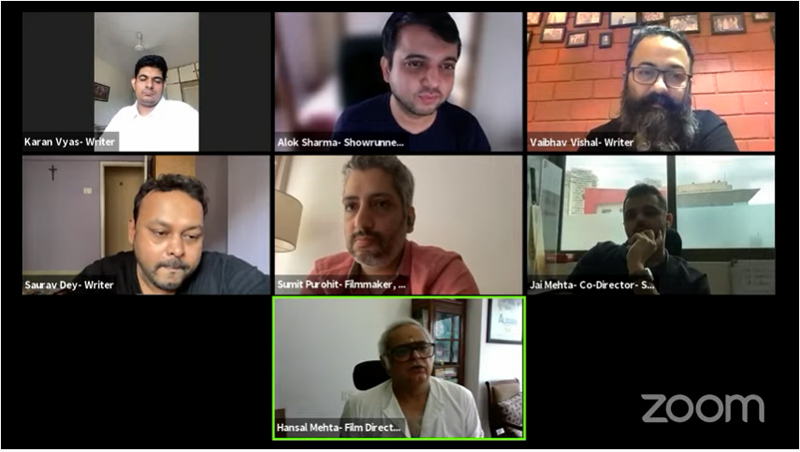
Delving into the writing process for a financial thriller, replete with several technical terms, filmmaker-writer Sumit Purohit says, the team made a conscious attempt not to dumb down the script to make it look simple. “We wanted to ensure that it looks authentic- whether it was the way the stock brokers were talking, or bankers discussing the financial transactions. It’s like science fiction. It’s not necessary that people understand the terms, for as long as they are emotionally invested with the characters,” he elaborates.
Saurav Dey concurs, “That’s exactly the brief we got. We could tell the story as it is, and don’t have to spoon-feed the audience. They can use their judgment and draw inferences.”
The story also carried a deep political undercurrent, with several scenes raising questions over alleged involvement of political leaders during that time. When asked about treading the fine line, Dey says, “We wanted to be responsible about what we show on screen. So, we retained only those parts, which we could substantiate with evidence. Rest was speculation, and we steered clear of that, or it would have irresponsible filmmaking.”
The team began with the simple idea of telling a human story. “It was a volatile time, and we showed as much as we could do within the limits of the current time. We focussed on the bigger picture, and did not want that it should get impacted by any kind of outrage,” shares the ace director, who won the National Film Award for directing 2013 movie Shahid.
However, for this series, Mehta says, he acted more like a motivator, than a writer. “I see my job as that of a motivator, who brings a pool of talent together, and ensures they move in a single direction. The biggest thing in long-form writing is patience and discipline, and the team had that,” he shares.
Also, like his previous movies – Shahid or Omerta, the series Scam 1992 also did not have a lead actor who shared physical resemblance with the lead character in real-life. “My approach is driven by instincts and trust. That’s how I get writers and actors on-board. The physical likeness is not as important as it is to convey the spirit of the character on screen,” he opines.
The ace-director also credits his association with Applause Entertainment, CEO Sameer Nair, who he says, ‘gave him the freedom to choose and trusted his choices.”
Among those choices, were also several famed actors from the 90s, including Mamik Singh aka ‘Rattan’ from the iconic movie – Jo Jeeta Wahi Sikandar who played the Citibank chief Rao in the series. The series also had Anant Mahadevan, playing RBI Governor, S Venkitaramanan and Satish Kaushik as the foul-mouthed stock market kingpin Manu Mundra. “It was a masterstroke,” says Mehta emphatically.
Another crucial element was planning the locations for the series, set in the 90s – ‘Bombay’ that most members of the team had not seen. “We went through books, pictures and did our research to recreate that era. We even got the original CBI office opened for a few scenes we shot there. It has been lying closed for over two decades,” recalls Jai Mehta.
After the success of Scam:1992, Hansal Mehta is now back on the sets for his next – a crime thriller based on a true incident.
The fifth edition of the Content Hub 2021 was co-presented by IN10 Media Network and ZEE5, and co-powered by Applause Entertainment and Tipping Point, the digital content unit of Viacom18 Studios. PTC Network was the supporting partner.






