MAM
56% of families report increase in overall household spending in Aug ‘21: Survey

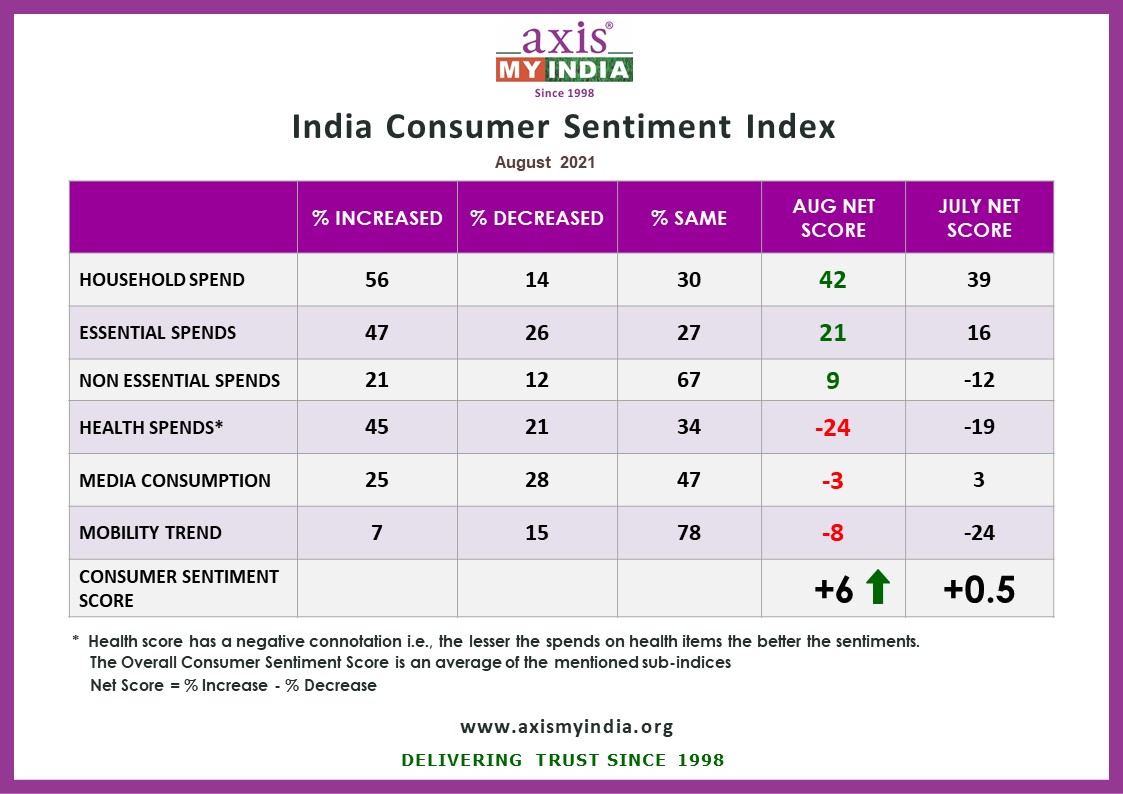
Mumbai: Over 56 per cent of families across the country reported an increase in household spending in August, with North India leading the chart, according to consumer data intelligence company Axis My India’s latest monthly report. The ‘India Consumer Sentiment Index’ is a monthly analysis of consumer perception on a wide range of issues.
The industry has pinned hopes on the upcoming festive season to push growth across sectors with rise in consumer spending. According to the survey done via Computer-Aided Telephonic Interviews, the consumers have reported an increase in spends on essentials like personal & household care. The spends on non-essential & discretionary products are still cautious with only 21 per cent of families reporting an increase. “This shows the festive spirit slowing building up with the net score having increased to +9 from -12 last month. Interestingly, the sentiment increase is highest in rural India,” said Axis My India.
The survey covered as many as 10,482 respondents across the country of which 72 per cent were male and 28 per cent were female.
Health still remains an important consideration and consumption of health-related items has increased or remained the same for 79 per cent of families and decreased only for 21 per cent of families. The health score which has a negative connotation i.e. the lesser the spends on health items the better the sentiments has a net score value of -24.
When respondents were asked if they would shop more or less this festive season, 42 per cent of families said they would shop more or the same as compared to last year. “This gives an indication that there is a sense of cautious optimism and the pent-up demand or degree of revenge shopping which happened last year might not be the same this year. This expected increase in spends is higher among private & government service employees,” according to the survey.
Among other findings, consumption of media has increased for 25 per cent families & remained same for 47 per cent. The corresponding increase figure was 28 per cent last month, net score being at -3. The media consumption increase was found to be highest in the 18-25-year age group at 32 per cent.
Tourism, however, continues to be a concern as 83 per cent of the respondents are still averse to travelling, and 15 per cent mentioned they would only travel domestically. Showing a sign of self-maturity, 96 per cent of people said they will implement Covid appropriate behaviour this festive and hopefully this will reduce the level of cases in case the third wave strikes.
“As the festive season approaches, consumers are slowly stepping out – as proven by increased numbers for non-essential spending and mobility. This should have a positive effect on the hospitality industry which has been severely affected due to the pandemic,” said Axis My India CMD Pradeep Gupta said. “A positive score of an additional 5.5 points over the last month indicates steady progress towards social and economic normalcy, with this trend expected to improve further in the next few months. Overall, we hold a cautious but optimistic outlook on consumer sentiments.”