Cable TV
Den Networks struggles with profitability amid revenue declines in Q3 FY25


MUMBAI: Once a linchpin of India’s cable and broadband revolution, Den Networks now finds itself grappling with the seismic shifts of the digital era.
As 5G continues its relentless march across urban India, the cable giant-helmed by CEO S.N. Sharma and co-founded by Sameer Manchandana-reported lukewarm financial results for Q3 FY25, highlighting the mounting pressures of an evolving market.
While operational focus remains intact, Den’s revenue growth and profitability paint a picture of an industry at a crossroads, battling the twin challenges of rising competition and technological disruption.

Will Den Networks hold its ground, or is this the beginning of the end for traditional cable dominance in India’s digital ecosystem?
For Q3 FY25, Den Networks’ standalone revenue from operations decreased by 3.1 per cent year-on-year (YoY), dropping to Rs 2,582.96 million from Rs 2,666.69 million in Q3 FY24. The nine-month revenue also declined by 8.0 per cent to Rs 7,455.83 million compared to Rs 8,105.98 million during the same period last year. On a consolidated basis, the quarterly revenue from operations stood at Rs 2,607.04 million, marking a 4.5 per cent dip YoY.
The decline in revenue is primarily attributed to lower cable distribution revenues and intensified competition in the broadband sector. The cable distribution network generated Rs 2,495.73 million in Q3 FY25, compared to Rs 2,648.03 million in Q3 FY24, reflecting a 5.7 per cent YoY drop. The broadband segment, however, posted a notable improvement, contributing Rs 111.31 million in Q3 FY25, up 36.8 per cent from Rs 81.34 million in the prior year.
Den Networks reported a standalone profit after tax (PAT) of Rs 231.17 million for Q3 FY25, a significant 43.6 per cent decline from Rs 409.96 million in Q3 FY24. The consolidated PAT showed a similar downward trend, standing at Rs 419.29 million for Q3 FY25, down 12.4 per cent from Rs 478.58 million a year earlier.
Increased operational expenses compounded profitability challenges. Content costs for the quarter rose to Rs 1,577.03 million, accounting for 61.1 per cent of revenue from operations, compared to 57.3 per cent in Q3 FY24. Depreciation and amortisation expenses remained elevated at Rs 179.95 million, reflecting sustained investments in infrastructure.
For the nine months ended 31 December 2024, standalone PAT stood at Rs 934.07 million, a sharp decline of 30.3 per cent from Rs 1,340.25 million during the same period last year. Consolidated nine-month PAT came in at Rs 1,368.69 million, showing a marginal 0.8 per cent increase compared to Rs 1,357.43 million in the previous year.
Den Networks faces an uphill task in reviving its growth trajectory. The cable business, contributing the bulk of revenues, continues to face pricing pressures and subscriber churn due to the growing shift towards over-the-top (OTT) platforms. Broadband, while exhibiting growth, remains a small portion of the overall revenue.
The company’s operational margins also face challenges. The EBITDA margin compressed as placement fees and employee benefits expenses rose YoY, reflecting increased competitive and operational demands.
While Den Networks’ focus on broadband growth is commendable, the overall decline in revenue and profitability highlights the pressing need for strategic adjustments. Addressing challenges in the cable segment, optimising operational efficiencies, and capitalising on digital opportunities will be critical for long-term sustainability.




Cable TV
Hathway Cable appoints Gurjeev Singh Kapoor as CEO
Leadership change comes as cable TV faces shrinking subscriber base and modest earnings pressure
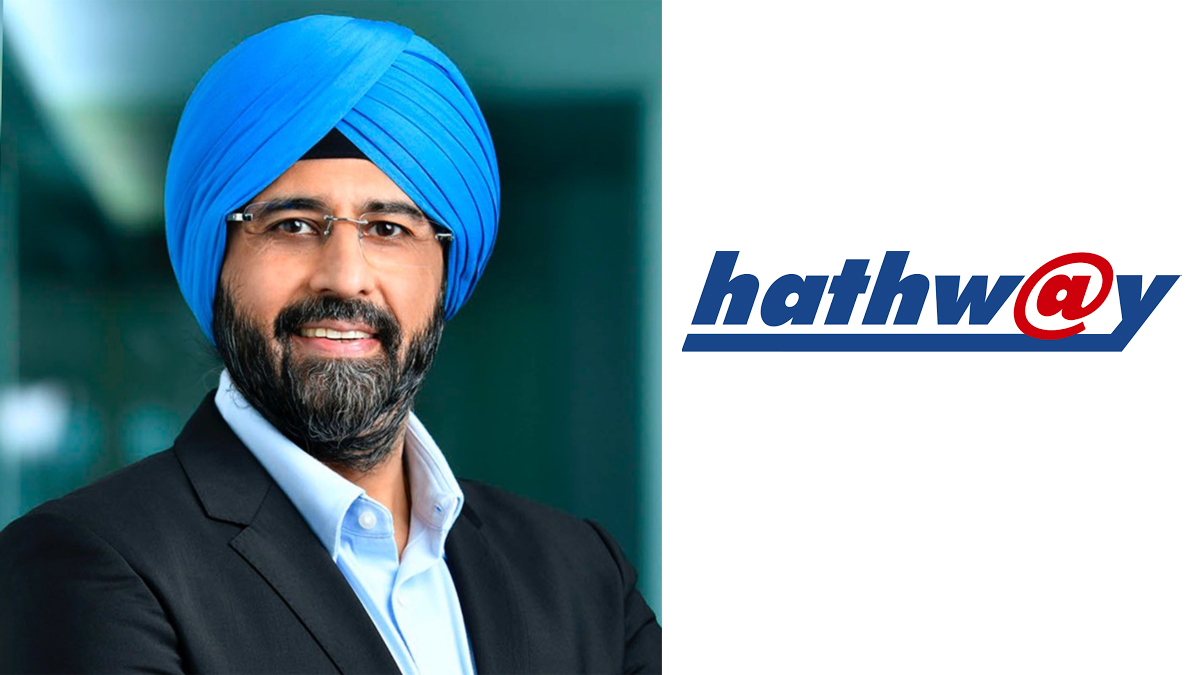
MUMBAI: Hathway Cable and Datacom has tapped industry veteran Gurjeev Singh Kapoor as chief executive officer, marking a leadership pivot at a time when India’s cable television business is under mounting strain.
Kapoor will take over from Tavinderjit Singh Panesar, who is set to retire in August after a long innings with the company. Panesar, chief executive since 2023, has held multiple leadership roles at Hathway, including his latest stint beginning in 2022.
Kapoor brings more than three decades of experience in media and entertainment. He most recently led distribution at The Walt Disney Company’s Star India business, now part of JioStar. His career spans television distribution and affiliate partnerships, with stints at Sony Pictures Networks India, Discovery Communications and Zee Entertainment.
Panesar, with over three decades in the industry, has worked across strategic planning, distribution and business development in media, broadcasting and manufacturing. His past associations include ESPN Star Sports, Star India, Apollo Tyres and JK Industries.
The transition lands as the cable sector grapples with structural disruption. Traditional operators are losing ground to streaming platforms, while telecom and broadband players tighten the squeeze with bundled offerings.
An EY report estimates India’s pay-TV base could shrink by a further 30 to 40 million households by 2030, taking the total down to 71 to 81 million. The slide follows a loss of nearly 40 million homes between 2018 and 2024, a contraction that has already wiped out more than 37,000 jobs in the local cable operator ecosystem.
Hathway’s numbers reflect the strain. The company reported a consolidated net profit of Rs 93 crore for FY25, down from Rs 99 crore a year earlier. Revenue inched up to Rs 2,040 crore from Rs 1,981 crore. As of December 2025, it had about 4.7 million cable TV subscribers and roughly 1.02 million broadband users.
Kapoor steps in with a familiar brief but a shrinking playbook. In a market where viewers are cutting cords faster than companies can reinvent them, the new chief executive inherits a business fighting to stay plugged in.