Hollywood
Doctor Strange and the Multiverse of Madness creating magic at box office

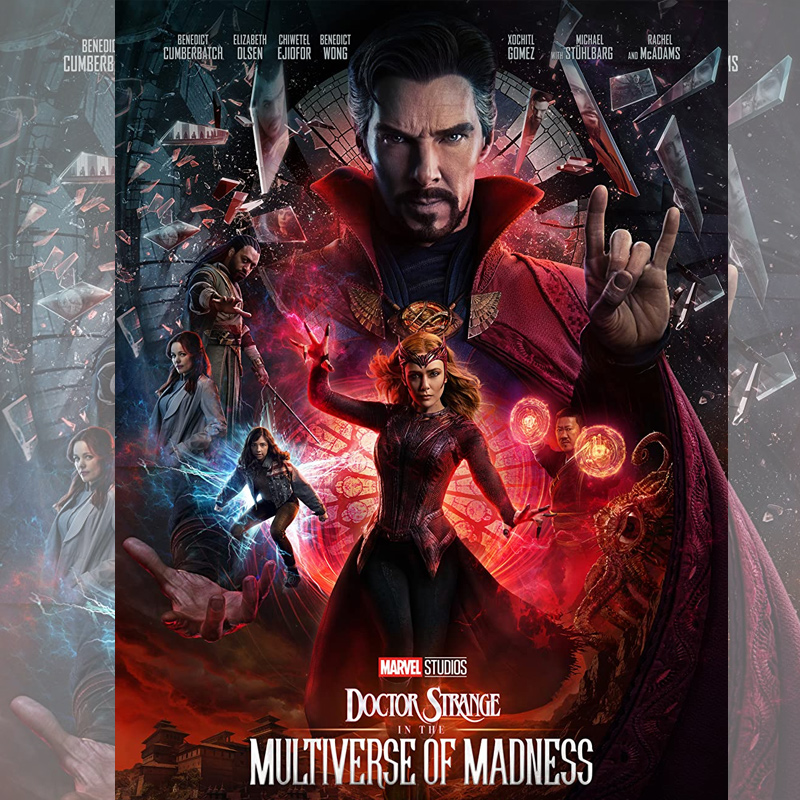
Mumbai: The summer movie season soared to a magical start thanks to “Doctor Strange and the Multiverse of Madness.” The superhero action extravaganza grossed an estimated $185 million in ticket sales in its first weekend in US and Canadian theaters, the Walt Disney Co. said on Sunday.
Not only did it more than double the opening of the first “Doctor Strange”, which opened to $85 million in 2016, but it’s also the biggest opener of the year, ahead of “The Batman’s” $134 million; the second biggest of the pandemic, behind “Spider-Man: Far From Home’s” $260.1 million; and the sixth biggest of all time globally.
International markets are holding fast and setting new records. Friday added five more hubs to take the total to 49. India debuted the Sam Raimi-directed pic at $4.3 million for No. 1 and the fourth-highest Hollywood launch day of all time. Spain’s No. 1 start of $2.5 million is the best opening day of the pandemic and Turkey’s $700K set a benchmark for the top opening Friday in history. In total, “Doctor Strange and Multiverse of Madness” have already made a commanding $450 million.
Produced by Marvel Studios and distributed by Walt Disney Studios Motion Pictures, it is the sequel to “Doctor Strange” (2016) and the 28th film in the Marvel Cinematic Universe (MCU). The film was directed by Sam Raimi, written by Michael Waldron, and stars Benedict Cumberbatch as Stephen Strange, alongside Elizabeth Olsen, Chiwetel Ejiofor, Benedict Wong, Xochitl Gomez, Michael Stuhlbarg, and Rachel McAdams. In the film, Strange protects America Chavez (Gomez), a teenager capable of travelling the multiverse, from the villainous, Wanda Maximoff (Olsen).
“Doctor Strange in the Multiverse of Madness” premiered at the Dolby Theatre in Hollywood on 2 May, and was released in the United States on 6 May, as part of phase four of the MCU. The film received generally positive reviews from critics, who praised Raimi’s direction, the visual effects, musical score, and performances of the cast (particularly Cumberbatch, Olsen, and Gomez), although the pacing received some criticism. The film currently sits at 75 percent of fresh critics’ reviews on Rotten Tomatoes.
Spider-Man is at least partially to thank for the massive debut of “Doctor Strange and the Multiverse of Madness”: Benedict Cumberbatch’s powerful sorcerer appeared prominently in “Spider-Man: No Way Home”, which has become the third biggest movie of all time since opening in December. Additionally, Elizabeth Olsen’s Wanda Maximoff is seen as a plus in regards to attracting a potentially younger female demo than usual for an MCU title.
Fanbase favourite, Sam Raimi stepped up to direct “Doctor Strange in the Multiverse of Madness”, which reportedly cost around $200 million to make — though that number doesn’t account for the many more millions spent on marketing and promotion.
The film also has a gigantic footprint. It’s playing in 4,534 theaters in the US and Canada alone, which according to Disney is the seventh widest opening ever. Premium format screens, including IMAX and 3D, accounted for 36 percent of the overall box office.
“This is a total win for the industry for whom the last two summers almost didn’t exist in terms of box office,” said Paul Dergarabedian, the senior media analyst for Comscore. “Marvel has been kicking off summers for over a decade. This is a return to normalcy.”
The success of “Doctor Strange and the Multiverse of Madness” only helps build momentum for the big summer movies on the way, like “Top Gun: Maverick” on 27 May. “We’ve got a real summer movie season on our hands, something we couldn’t have imagined two years ago,” Dergarabedian said. “It’s been a long time coming.”
There was little left for other movies playing in theaters. Part of that is due to the fact that many multiplexes chose to pack their theaters with wall-to-wall “Doctor Strange” screenings.
Universal and DreamWorks Animation’s “The Bad Guys” fell to second place in its third weekend with an estimated $9.8 million, while “Sonic the Hedgehog 2”, from Paramount, landed in third with $6.2 million.
“Fantastic Beasts: The Secrets of Dumbledore” took fourth with $3.9 million, bringing its domestic total to $86 million. And in fifth place was another multiverse-themed film, “Everything Everywhere All At Once.” It had a slight dip in its seventh weekend but is still speeding along with an additional $3.3 million from 1,542 screens in its seventh weekend in theaters. The A24 film has grossed $41.6 million in total.