MAM
Bajaj Electricals elevates Anuj Poddar to the role of managing director and CEO

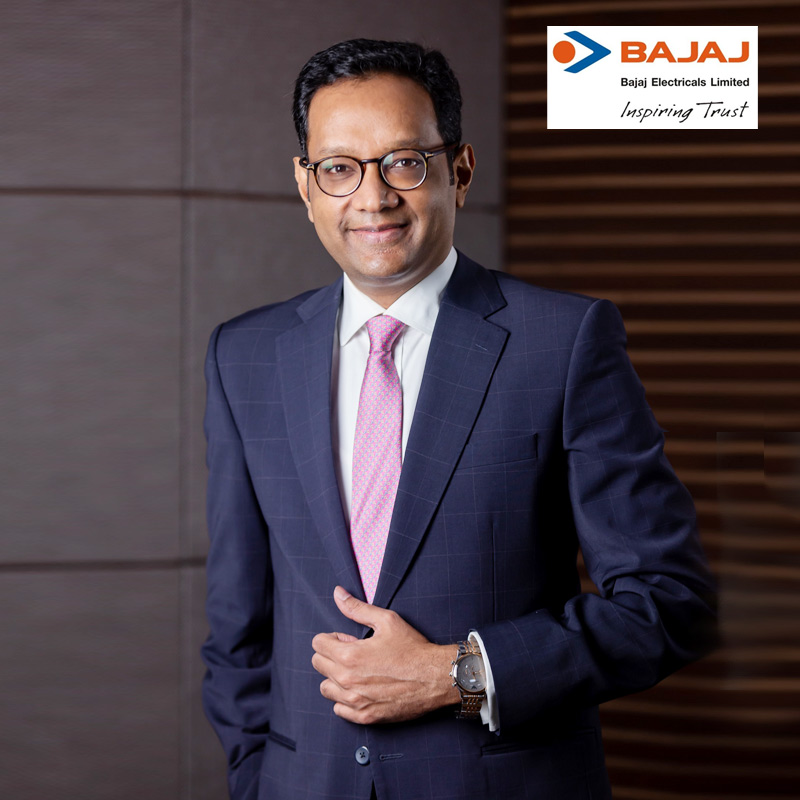
Mumbai: Homegrown consumer durables company Bajaj Electricals announced on Tuesday the elevation of Anuj Poddar to the roles of managing director (MD) and chief executive officer (CEO). Shekhar Bajaj will continue as executive chairman of the company.
Anuj Poddar joined the company in late 2018 as its executive director.
This announcement comes on the back of the ongoing and significant transformation journey and keeps in mind the company’s long-term strategy. The separation of the chairman and managing director positions is a continuation of the professionalisation of the management of the company and marks the company’s commitment to strong corporate governance standards, said the company in a statement.

Bajaj Electricals chairman Shekhar Bajaj said, “Over the last few years, we have embarked upon a significant transformation journey at Bajaj Electricals – involving many changes on the business as well as organisational front. In continuation of that, I believe this will provide further impetus to the achievement of our strategic goals and demonstrate our commitment to strong corporate governance. Anuj Poddar has demonstrated exceptionally visionary leadership, executional ability, and passion in driving this transformation journey, and I am confident that in his elevated role he will continue to drive our company forward and add value to all stakeholders.”
Anuj Poddar said, “I am thankful to the chairman and our board for entrusting me with this elevated responsibility. I am truly excited about what lies ahead of us at Bajaj Electricals – we have a clear vision and roadmap for building this future, and together with our entire team, we are committed to being a best-in-class organisation that delivers superior performance and value creation.”
Over the last three years, Bajaj Electricals has undertaken multiple initiatives, including strengthening of the leadership, streamlining of its corporate structure, a turnaround of its performance and balance sheet, and the planned demerger of the EPC business.
Further, the company achieved a key strategic milestone of becoming net-debt-free on 31 March 2022 – a first for the company in over four decades. Having achieved these milestones, Bajaj Electricals is preparing for aggressive growth across its businesses in a focused manner.
The company posted its Q1 FY 22-23 results. For the first quarter of 2022-23, the company achieved revenue from operations of Rs 1,229 crore as against Rs 857 crore, a growth of 43 per cent over the first quarter of the previous year. For the quarter, the company made profit before tax and profit after tax of Rs 57 crore and Rs 41 crore, respectively, as against a loss before tax and loss after tax of Rs 31 crore and Rs 25 crore, respectively, in the corresponding first quarter of the previous year. For the quarter ended 30 June 2022, the company generated positive cash flow from operations of Rs 165 crore in cash equivalents and surplus investments of Rs 254 crore.





Brands
Maharashtra panel orders Lodha to refund Rs 5 crore to homebuyers
Consumer court flags unfair practices in long-running property dispute case

MUMBAI: In a sharp rebuke to one of India’s biggest real estate players, the Maharashtra State Consumer Disputes Redressal Commission has directed Macrotech Developers to refund nearly Rs 5 crore to a senior citizen couple, Uttam and Anindita Chatterjee. The ruling, delivered on March 13, 2026, calls out the developer for “deficiency in service” and “unfair trade practices”, bringing closure to a dispute that has stretched over a decade.
The case traces back to 2015, when the couple booked a 3-BHK flat at World Towers in Lower Parel for Rs 12.22 crore, with possession promised within a year. What followed was a series of changes that complicated matters. After deciding to exit the project, they were persuaded to shift to a 4-BHK in another development priced at Rs 8 crore, with delivery scheduled for 2018. However, within months, the price was allegedly increased to Rs 10 crore. After demonetisation reshaped the market, similar flats were reportedly being offered at lower prices, but the couple were not given the benefit.
Despite paying over Rs 2.83 crore, the couple neither received possession nor clarity. Instead, in 2018, the developer unilaterally cancelled the booking, retained part of the amount as earnest money, and argued that the buyers were investors rather than consumers. The commission rejected this claim, observing that casual references to “investment” do not take away consumer rights when the purchase intent is residential.
The bench also held that the developer could not penalise buyers for payment delays while failing to meet its own delivery commitments. It noted the lack of formal documentation for revised terms and termed the prolonged retention of funds without delivering a home as exploitative.
As part of its order, the commission directed the developer to refund Rs 2.83 crore paid by the couple, along with interest at 10 per cent per annum, amounting to around Rs 2.12 crore. In addition, Rs 1 lakh has been awarded for mental agony and Rs 50,000 towards litigation costs, taking the total payout to over Rs 5 crore. The developer has been asked to comply within two months.
For now, the ruling serves as a reminder that in real estate, shifting terms and delayed promises can carry a significant cost.