MAM
Tata Tele to expand its cloud communication suite Smartflo with WhatsApp Business Platform


Mumbai: Connectivity and communication solutions for businesses Tata Tele Business Services (TTBS) has announced the strategic integration of WhatsApp Business Platform into its cloud communication suite, Smartflo. This is an advanced move in the digital era to offer an enhanced business communication experience, thus accelerating user engagement, boosting CX, and ensuring impactful customer interactions.
WhatsApp Business Platform is a simple and trusted solution for businesses to better manage customer discussions and inquiries around the world. Its superior UX, further enhances business communications, enabling seamless, rich, and impactful interactions in the way customers want to engage in today’s business ecosystem.
Tata Tele Business Services, in its endeavour to transform digital experiences with technology, brings to the table in-depth knowledge of enterprise customer needs and requirements, as well as trust and service assurance. This integration will assist businesses in mapping customer operational needs across multiple channels, while also improving customer experience through unified hyper-personalised interactions and multi-touch attributions.

Sharing his views on the enhanced cloud communication suite, Tata Teleservices Ltd SVP & head of product, marketing, and commercial Vishal Rally said, “We are excited to offer WhatsApp Business Platform through our Smartflo business suite, thereby, allowing businesses to adapt to new challenges and provide exceptional assistance to their customers on the messaging platform. Customers today expect communication to be efficient, simple, and genuine, which is enabled by WhatsApp Business. It connects our customers to their target audiences in the way they like to be assisted. As a WhatsApp Business solution provider, we at TTBS guarantee a superior user experience based on trust to our valued customers.”
“We are excited that WhatsApp Business Platform is being leveraged for customer engagement by Tata Tele Business Services for its (CPaaS) suite,” he added.
Businesses across sectors use the WhatsApp Business Platform to build a variety of customised, scaled solutions. It helps advance customer convenience and enable richer customer engagement. We look forward to continuing to build partnerships with businesses to help them unlock avenues of access to new audience cohorts who use WhatsApp extensively every day,” added WhatsApp India director of business messaging Ravi Garg.
Smartflo, in collaboration with WhatsApp Business Platform, offers an integrated omnichannel solution experience that incorporates various channels and methods of connecting with and integrating customers. It unifies the customer experience (CX) across different channels such as websites, mobile apps, social media, and phone calls, as a single-point system to optimise the collective interaction experience.
Smartflo makes business communication easy and rich, with a host of features such as single customer view, workflow automation, AI-enabled chatbots, chat interfaces, advanced analytics, hyper-personalisation, one-click integration, and an easy-to-integrate API platform.
Counted among the country’s leaders in smart digital solutions, Tata Tele Business Services, not only provides the digital highways on which companies, big and small, run their businesses but also acts as the technology catalyst for their growth by offering a comprehensive portfolio of digital solutions in the domain of security, collaboration, marketing, the cloud, and SaaS.
Smartflo, SmartOffice, SD-WAN iFLX, Microsoft 365, Google Workplace, Zoom Communications, EZ Cloud Connect, Customer Experience Platform for Businesses, Ultra-Lola, and Smart Internet leased line are among the company’s enterprise-grade solutions.






MAM
BLS International launches #VisaReady campaign to guide applicants
Initiative targets visa myths, delays and rejections with practical guidance
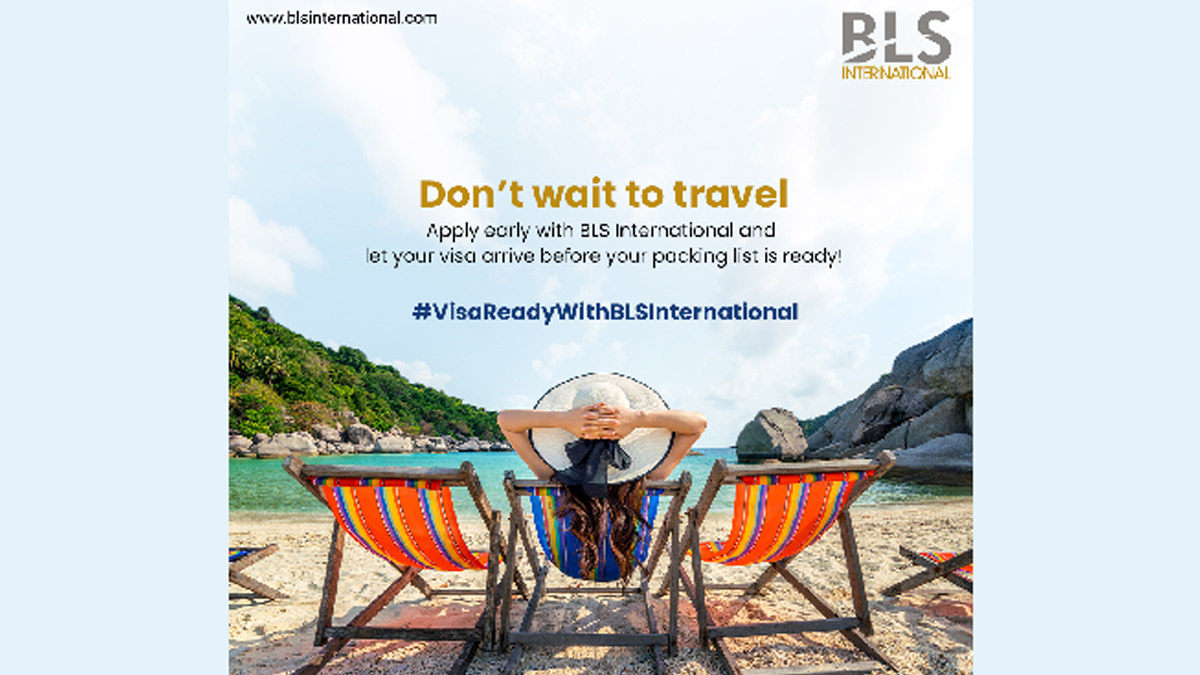
MUMBAI: Visa woes may soon meet their match because paperwork, it seems, is finally getting a user manual. BLS International has rolled out a new awareness drive, #VisaReadyWithBLSInternational, aimed at simplifying the often confusing visa application process and reducing delays caused by misinformation and incomplete documentation. The campaign, led across social media platforms, zeroes in on a long-standing pain point for travellers: lack of clarity around procedures, timelines and requirements. By offering step-by-step guidance, documentation checklists and clear Dos and Don’ts, the initiative attempts to turn what is typically a stressful process into a more predictable one.
At its core, the campaign also seeks to bust common myths that frequently derail applications issues that often lead to avoidable rejections or last-minute complications. The idea is to equip applicants with practical, actionable insights so they can plan better and submit stronger applications within expected timelines.
The push will not remain limited to digital channels. BLS International plans to extend the initiative across its Visa Application Centres globally, reinforcing awareness at key touchpoints where applicants engage with the process.
BLS International joint managing director Shikhar Aggarwal framed the campaign as more than a communication exercise, emphasising the company’s attempt to embed guidance and preparedness into every stage of the applicant journey.
Operating in over 70 countries and working with more than 46 client governments including embassies, consulates and diplomatic missions, the company has built a sizeable footprint in visa and consular services. With this campaign, it is now leaning into education as much as execution, signalling that in the world of visas, clarity might just be the new currency.