Ad Campaigns
Don’t order, ‘make’ with love: Philips’ #TasteOfLove campaign

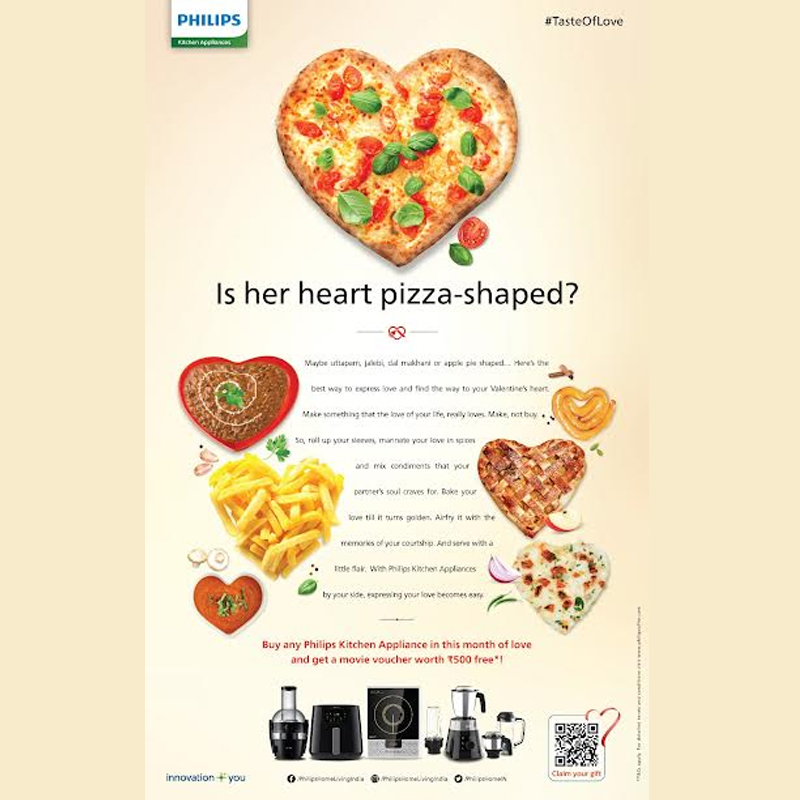
MUMBAI : Valentine’s Day, the day of love, gets lots of people to express their love in myriad ways. Understanding this, Philips Domestic Appliances India recently released a print campaign, #TasteOfLove, which caught the eyes of many for more reasons than one, but most importantly the very fact that print advertising, too, can be creative – even today.
Kreativ Street is the agency behind this stirring campaign. In a confab with Indiantelevision.com, the creative minds behind this campaign Kreativ Street chief creative officer Ajoy Bhan and Kreativ Street executive creative director Sujit Das discuss the conceptualisation of the campaign, and Philips Domestic Appliances India marketing head Pooja Baid speaks about why such a campaign and much more. I also spoke to a few industry minds who had contrasting views about the campaign.
Talking about the campaign, the ad’s headline reads, “Is her heart pizza-shaped?” catching the reader’s attention, and the body copy puts up an adorable narrative urging people to put in that extra effort and cook something for their valentine, in an inclusive way. “Make, not buy. Roll your sleeves up and marinate your love in spices and mix condiments that your partner’s soul craves for.” said a line from the ad.
Kreativ Street founder and CEO Neeraj Sancheti said, “Philips is one of the world’s most trusted brands, and we wanted to do something that adds further to its immense brand love. While the idea was simple and visually compelling, it also ensured inclusiveness and stayed away from any kind of stereotypes around cooking or gender-roles.”
Donning the creative hat
Bhan points out that the client brief provided to them was to do a campaign for Valentine’s Day, that will run through the month, where the key thought would be how for Indians, food is like a first love. Then take it forward and see how the brand can connect food to relationships in the context of Valentine’s Day.
He further explains that the creative thought was to take a leap forward and go beyond the love of food. The idea was to challenge the stereotype that women cook (the cliche of the way to man’s heart is through his stomach etc) and ask questions about how well you know what she likes. And then a carefully crafted stimulus that suggests that a man should roll up his sleeves and make something that touches her heart and soul.
“One of the key thoughts we wanted to leave behind was ‘make, not buy’. And, how the best way to celebrate Valentine’s Day and every other day is by making something yourself, rather than ordering from outside. When a couple starts cooking together, they not only share the load, but find a common interest, that with a little help from candles, flowers and potpourri, can add romance to everyday life. For me, this is work with a little head, and a lot of heart,” Bhan exclaims.
Apart from making all art and graphics in the shape of a heart for the occasion of Valentine’s Day, what was the reason behind putting together such art/visual representations for this particular campaign? Das, who has worked on the art for this campaign, elucidates, “The beauty in this communication lies in its simplicity. While the copy spoke about what her heart longs for, we decided to create a heart-shaped visual metaphor for food. While food shots being inviting is a basic in advertising, when we show it in a heart shape, it becomes metaphoric. With this device, we also create a visual language that is owned by Philips and helps the work stand out in the sea of food shots that you will find in any advertising related to food.”
Understanding the brand perspective
On going ahead with a campaign such as this, Baid of Philips says, “Our thought really stemmed from the fact that Valentine’s Day is about love and in India particularly, food is the best way to express love. I mean, think about how your mom feeds you when you meet her after a long time, or what first comes to your mind when you want to plan something really special for a loved one – whatever the occasion, the relationship, the moment, food is integral to it. However, over the last couple years, especially with the younger audience, there is this huge propensity to order in or outsource this. With this campaign, we wanted to re-ignite India’s original way to express love – by making something for the one you love.”
But the question is that we hardly see advertising for domestic appliances on an occasion like Valentine’s Day. So, why did Philips choose to do so? “At Philips Domestic Appliances, we always think consumer-first and understand their needs and preferences. That’s why we understand the strong connection between love and food in India. With Valentine’s Day around the corner, we are excited to launch our #TasteOfLove campaign which inspires people to use cooking as an expression of love and encourages them to put in that extra effort and cook something special for their beloved. The idea is to step away from the norms and prepare dishes that will touch your loved ones’ heart. A simple, personalized gesture can go a long way and we hope that this campaign and Philips range of kitchen appliances allows our consumers to make this day and month of love, even more special,” Baid states.
Also, when everybody is turning to digital, and so has Philips with this campaign too, but then why did the brand choose print as part of the media mix? Baid explains, “Our products cater to a vast consumer group that is spread across demographics and channels. Therefore, we didn’t want to limit our campaign just to digital – we took a multi-channel approach so that our message of love reaches more people this Valentine’s Day. We created multiple touchpoints for our consumers with the focus of engaging and building a stronger relationship with them. While we started with a print campaign with a pizza-only full-page ad across major publications, this week also some customisation in dishes to appeal to our audience in other markets such as Chennai and Hyderabad. The digital, social and e-commerce activities are also in full swing, the key highlight being a heart-warming Instagram video by our ambassador, celebrity chef Ranveer.”
What the industry thinks?
Print advertising has been considered boring and is discussed mostly as catalogue advertising nowadays. From that perspective, what do advertising specialists think about this creative?
Bang In The Middle (BITM) co-founder & managing partner Naresh Gupta is of the opinion that the ad is clever. “It does what any good ad should do. Draw you in and make you engage with the brand. Clever headline, nice visuals and in your face brand integration are all well done. In the crowd of sameness that Valentine’s Day sees, this is different.
Enormous Brands planning head Soumitra Patnekar likes the creative, however, holds a different view. “While I like the creative, I don’t think print is the right medium for the same. The idea of actually making something for your partner rather than just buying gifts is a smart one. Yet I feel the medium does a disservice to the creative. Especially when online is the place, where he is actually searching for avenues/hacks to impress his better half. If it was a sale/ Diwali ad which usually is the time for a considered purchase, print would have worked.”
Gupta has seen the evolution of print advertising. Shedding light on whether print works or not anymore, he reveals, “I have always believed that press ads work. People do read what matters to them. To everyone that says that press ads don’t work or they don’t read ads, the social media content is almost like mini press ads. People read. The brand defines specific roles for the media and often the role assigned to the press is to give info. Then the ads end up giving info. When the brief is to engage and generate interest, print does it well.”
Patnekar begs to differ, “The sheer context of it – reminding him to roll up his sleeves and make something marks out a moment, while the purchase of the appliance is seldom an impulse buy but a planned one. So, digital would work out way better for this, undoubtedly.”
The brand has rolled out this print campaign across major publications to promote the heart-warming message of urging people to cook for their valentine. It has also been activated on digital, social & e-commerce platforms as well as brought to life at the shop front through point-of-sales material.






