Hindi
Curiosity matters more than cameras, says Sanjeev Sivan at MIFF 2026 masterclass
Veteran filmmaker urges storytellers to prioritise people, trust and observation

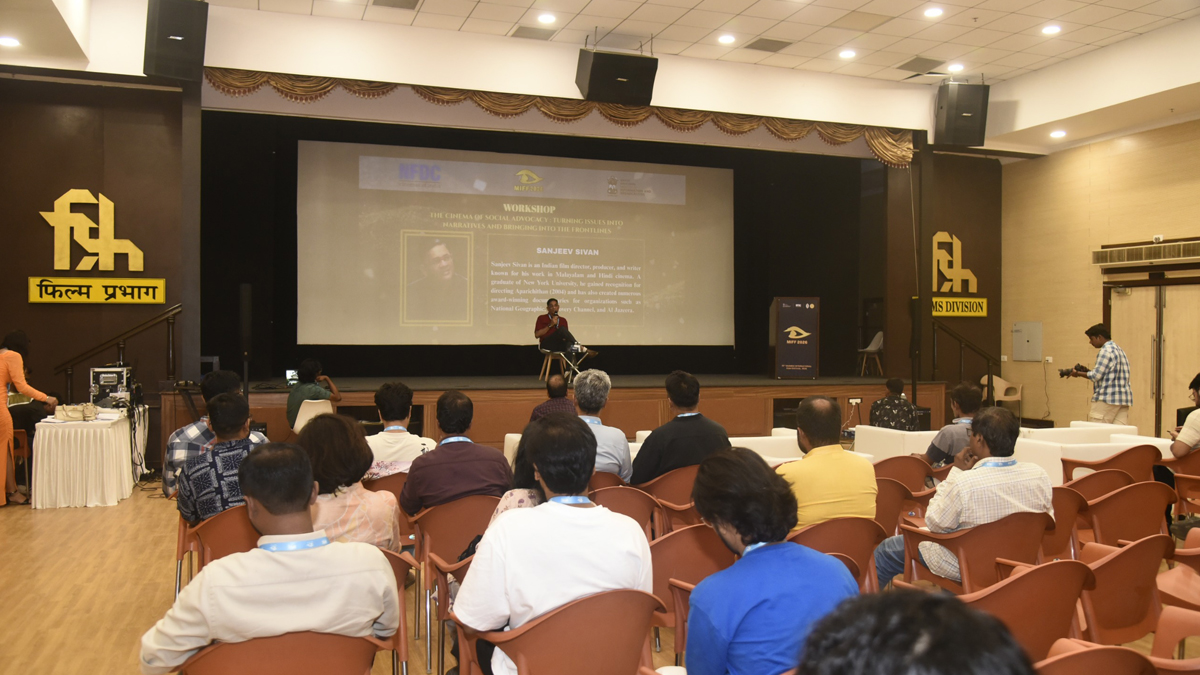
MUMBAI: In an era obsessed with cameras, lenses and production gear, veteran filmmaker Sanjeev Sivan had a simpler message for aspiring storytellers at the 19th Mumbai International Film Festival: curiosity is still the most powerful filmmaking tool.
Delivering a masterclass titled “The Cinema of Social Advocacy: Turning Issues into Narratives and Bringing Them to the Frontlines”, the National Award-winning filmmaker urged participants to focus less on technology and more on understanding people, asking questions and observing the world around them.
Drawing from a career that spans more than 75 documentaries, over 30 short films and several feature films, Sivan offered a candid look at how real-life issues can be transformed into compelling cinematic stories.
“I think the most important instrument you should have is curiosity, not cameras,” he said, arguing that strong narratives emerge from research, observation and meaningful human connections rather than expensive equipment.
The filmmaker illustrated this philosophy with stories from his own career. One such example was a chance encounter with an Ouija board in the United States, which sparked an idea that evolved from a short documentary into the Malayalam feature film Aparichithan, starring Mammootty.
“The movie was first a documentary but later became a feature film,” Sivan explained, highlighting how a single spark of curiosity can travel across formats and genres.
A recurring theme throughout the session was that documentaries are fundamentally about people rather than topics. According to Sivan, filmmakers often make the mistake of focusing on subjects while overlooking the human stories at their core.
“If you’re making a documentary on fishermen, the story is not about fishing. It is about survival. If you’re making a film on a village, it is not about geography but identity,” he said.
He also stressed the importance of patience and trust-building in documentary filmmaking, noting that authentic stories only emerge when people feel comfortable enough to share their experiences.
“People need to be comfortable before they open up. That can take days, months or even years,” he said.
Addressing the ethical challenges of nonfiction storytelling, Sivan warned young filmmakers against prioritising drama over truth.
“When you are doing a documentary, there is a responsibility. You cannot show or narrate wrong things just to make it dramatic,” he said.
During the session, Sivan discussed several projects from his extensive body of work, including Little Women, which explored the lives of women rebuilding their futures after trafficking and prostitution, and Decoding Shankar, a biographical documentary on musician Shankar Mahadevan. He also spoke about documentary assignments undertaken for the Indian Navy.
Sivan further revealed how his documentary After Life eventually inspired the award-winning Malayalam feature Venalodungathe, demonstrating how observations gathered through documentary work can become the foundation for fictional storytelling.
Reflecting on the changing media landscape, the filmmaker encouraged emerging creators to take advantage of digital technology, streaming platforms and OTT services, which have lowered barriers to entry for independent storytellers.
“You don’t need a large crew. You should have good live sound. Beyond that, you don’t need more than three people to shoot a film,” he said.
As the session drew to a close, Sivan returned to the idea that has shaped his career for decades: stories are everywhere for those willing to look closely enough.
“There is a story everywhere, in every person you meet. Make your story and strategically showcase them at reputed international film festivals to enhance visibility and secure distribution opportunities,” he said.
His message resonated as both practical advice and a reminder that, even in a rapidly evolving industry, great filmmaking still begins with curiosity, empathy and the willingness to listen.