Brands
NVIDIA and LG Group join forces to build AI factory for robotics and mobility
Partnership targets physical AI, autonomous driving and next-generation data centres

SEOUL: Building intelligence is no longer just about software. For technology giants, it is increasingly about building the factories that create it. In a major strategic partnership, NVIDIA and LG Group have announced plans to develop a next-generation AI factory designed to power advancements in robotics, autonomous driving, AI infrastructure and cloud services.
The initiative will provide LG Group with the accelerated computing infrastructure needed to train, simulate, validate and deploy AI applications across multiple businesses, creating a unified ecosystem that connects AI model development, robot training, digital twins and edge deployment.
The collaboration combines NVIDIA’s end-to-end AI factory platform with LG’s expertise across consumer electronics, mobility, smart spaces, robotics and data centre technologies. Together, the companies aim to create a foundation for what is increasingly being called “physical AI”, where intelligent systems interact with and understand the physical world.
A key focus area will be manufacturing. By combining operational data and production expertise from LG’s global manufacturing network with NVIDIA’s AI infrastructure and digital twin technologies, the companies plan to develop a highly autonomous manufacturing ecosystem. The vision is to connect procurement, production, logistics and customer delivery through real-time data and AI, creating a new benchmark for smart factories.
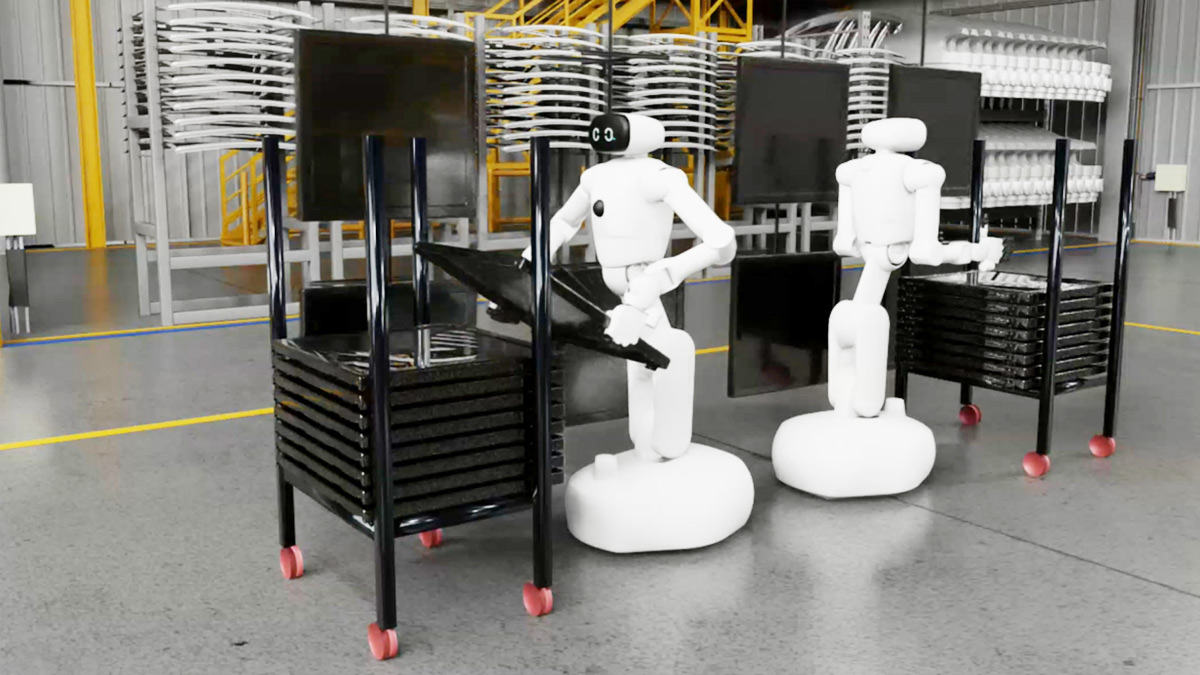
Within robotics, LG Electronics is expanding its development of home robots, including the CLoiD platform. The company plans to leverage NVIDIA Isaac Sim and NVIDIA Isaac Lab to simulate, train and test robots in virtual environments before deployment in real-world settings.
LG is also exploring the use of NVIDIA Isaac GR00T, a robotics foundation model designed to give machines more advanced reasoning and task-execution capabilities. The two companies additionally plan to collaborate on reference robot development, bringing LG’s robotic systems into NVIDIA’s growing robotics ecosystem.
To tackle one of robotics’ biggest challenges, access to large-scale training data, LG Electronics is building a dedicated physical AI data factory. Using NVIDIA Cosmos, the facility will generate synthetic training data aimed at accelerating robotics and industrial AI development for Korean and international companies.
Elsewhere in the group, LG CNS is integrating NVIDIA’s robotics and AI technologies into its PhysicalWorks industrial robot platform to support automation in manufacturing and logistics environments. Meanwhile, LG Innotek plans to develop sensing and robotics components optimised for NVIDIA-powered systems.
The partnership extends beyond robotics into the rapidly expanding AI infrastructure sector. The companies will collaborate on AI factory technologies aligned with NVIDIA’s DSX architecture, including advanced cooling systems, prefabricated modular designs and liquid-cooled data centre technologies designed to support increasingly powerful AI workloads.
Several LG businesses are expected to play a role. LG Uplus intends to develop large-scale AI data centres capable of hosting the latest NVIDIA GPUs, while LG Energy Solution is exploring next-generation energy solutions for AI infrastructure. LG CNS will also build scalable AI factories powered by NVIDIA GPUs.
The alliance is equally significant in mobility. LG Electronics is strengthening its collaboration with NVIDIA around advanced driver-assistance systems and software-defined vehicles. Future vehicle technologies will be aligned with the NVIDIA DRIVE ecosystem, including NVIDIA DRIVE Hyperion and NVIDIA DRIVE AGX, supporting autonomous driving, intelligent cockpits and edge AI processing.
The companies are also deepening their work in sovereign AI. LG AI Research and NVIDIA are collaborating on EXAONE, one of South Korea’s leading AI models. The model’s development has utilised technologies including NVIDIA Blackwell, NVIDIA NeMo, NVIDIA Nemotron and TensorRT-LLM.
The broader goal is to expand the use of EXAONE and agentic AI across LG’s businesses through tools such as ChatEXAONE, helping automate operations and improve productivity across the group’s portfolio.
As the race to build AI infrastructure intensifies globally, the NVIDIA-LG alliance signals a shift from simply developing AI models to constructing the industrial foundations that power them. From robots and autonomous vehicles to data centres and digital factories, the partnership places both companies at the centre of the next chapter of the AI economy.