MAM
The Maruti Swift’s Pre-Owned Legacy: Why Each Generation Holds Its Value Differently

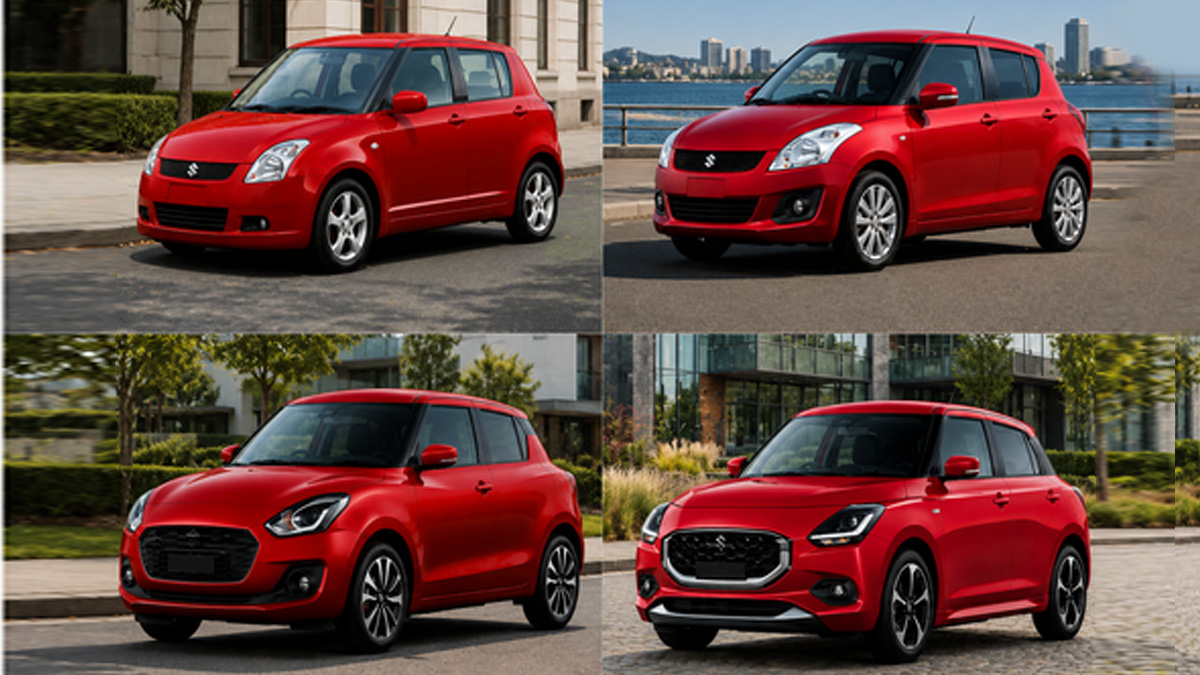
If there is one car that has shaped the Indian used hatchback market more than any other over the last two decades, it is the Maruti Swift. Since its debut in 2005, the Swift has sold in volumes that have made it a constant presence across every price band in the pre-owned market, from ₹1.5 lakh for first-gen examples with very high mileage, all the way to ₹8-9 lakh for near-new fourth-generation cars. Understanding how each generation holds its value, and why, gives any prospective buyer a useful framework for deciding where in the Swift timeline to place their money. Whether you are searching for a Second hand Swift at a specific budget or comparing it against other used Maruti cars in the same segment, the generation context makes all the difference in knowing what you’re actually getting.
First Generation (2005-2011)
The first-gen Swift introduced India to a new idea: a compact, sporty-looking hatchback that was genuinely fun to drive, at a time when the market was dominated by the rounder, more utilitarian Alto and Santro. The K12 and K10 petrol engines in these cars are now very high-mileage in most surviving examples, and the body panels have aged with varying degrees of care depending on ownership history.
In the used market today, first-gen Swifts have largely left the mainstream used car segment, they sit in the ₹1-3 lakh range for running examples, primarily for buyers who want minimal transport at minimum outlay. Valuation here is almost entirely condition-driven rather than variant-driven.
Second Generation (2011-2018)
This is where the used Swift story gets genuinely interesting. The second-gen Swift brought a stiffer body, a better suspension setup, and the same K12B engine that powers so many Maruti products so reliably. These cars are now priced between ₹3 and ₹6 lakh depending on year, variant, and condition, and represent some of the best value in the segment. A 2015-2017 Swift VXI or ZXI in good condition with complete records is a near-perfect budget sports hatchback proposition.
Third Generation (2018-2024)
The third-gen Swift was a more refined, more feature-complete package. It retained the K12M engine initially, added an AMT option, and offered a touchscreen infotainment system in higher trims. These are the cars most buyers actively search for in the ₹5-8 lakh used market, and they hold value well because demand remains high relative to supply.
Fourth Generation (2024+)
The 2024 Swift brought the K12N DualJet engine, dual airbags as standard, a redesigned interior, and, importantly, a claimed fuel efficiency improvement to around 24 km/l. These are essentially new cars in the used market currently, priced close to new car levels.
For used car buyers, each generation requires a slightly different mindset. Second hand Swift searches across generations surface the full spectrum, but the second and third-gen cars are where the best value currently lives, because they’re established, well-supported, and priced at a point where the Swift’s well-known strengths (fun to drive, economical, low running costs) can be accessed without the new-car premium.
The Swift’s generational story in the used market is a rare thing: consistent, predictable value retention driven by genuine buyer demand. It rewards knowledge of which generation suits your needs.
The mechanical difference between generations is worth understanding at more than a surface level. The K12B engine used in second-gen Swifts was already a significant improvement over the earlier K10, better NVH isolation, improved thermal efficiency, and a more linear power delivery. The K12M in the third generation brought idle start-stop technology and a further refinement in smoothness. The K12N DualJet in the fourth generation adds dual fuel injection and marginally better fuel efficiency figures.
Among the full range of used Maruti cars, the Swift competes with the Baleno for buyer attention at the higher end of the used Maruti hatchback spectrum. The choice between them usually comes down to whether you want a sportier, lower-slung character (Swift) or more features and rear passenger space (Baleno).
What this means practically is that a third-gen Swift from 2019-2021 with complete service records is not far behind the fourth-gen in terms of the daily ownership experience, while being available at a price that’s ₹2-3 lakh below a new fourth-gen. For most buyers, that gap is where the Swift’s used car value story is clearest.
The Swift’s driving character is also consistent across generations in one important way: the car has always been biased toward an engaging, direct feel. Compared to the Alto or the Wagon R, the Swift has always felt more like a car that rewards active driving. This character is present in every generation, the second-gen has it, the third-gen has it, and the fourth-gen refines it further without losing it. It’s a distinguishing trait that buyers who’ve experienced it rarely want to give up.