TCHxVAM2026
Streaming into culture: Prime Video India’s Nikhil Madhok talks scale and substance at TCH x VAM 2026
Nikhil Madhok reveals how authentic storytelling rewires minds, not just viewing habits

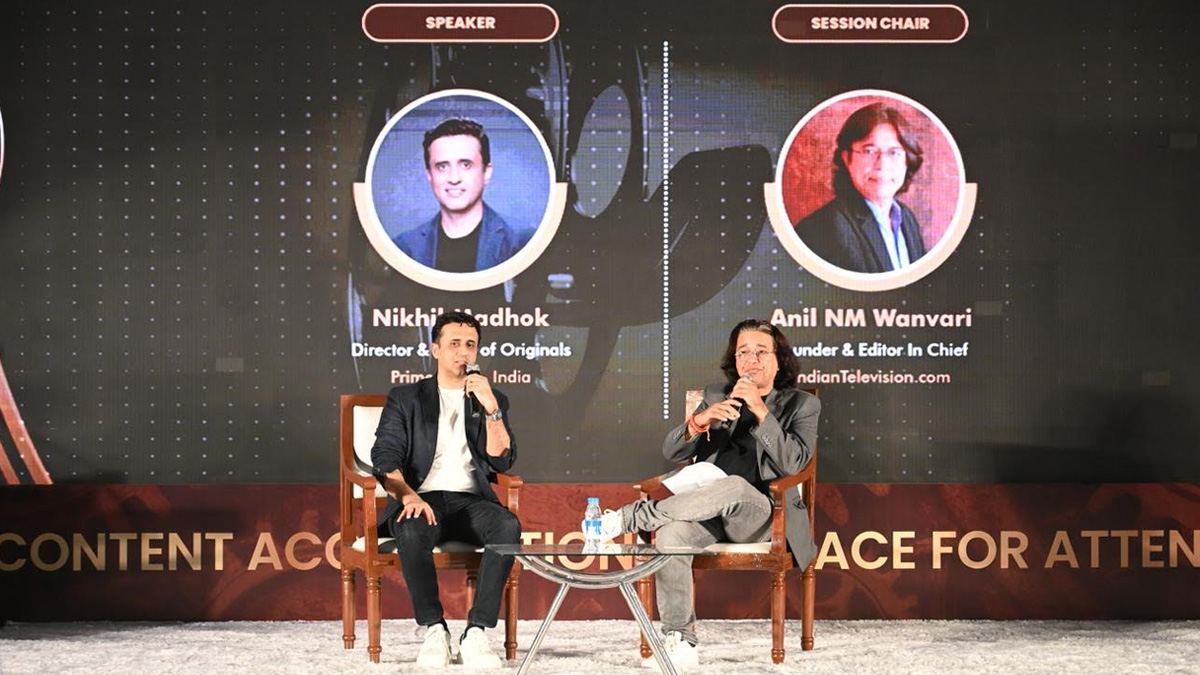
MUMBAI: In the battle for eyeballs, Prime Video is betting that culture, not just clicks, will decide the winners. At The Content Hub x VFX & More Summit 2026 in Mumbai, Prime Video director and head of originals Nikhil Madhok sat down with Indiantelevision.com founder and editor-in-chief Anil Wanvari for a wide-ranging conversation on how streaming is doing far more than fill screen time. It is, Madhok argues, quietly reshaping the way India thinks.
“Culture is a shared set of values and beliefs,” said Nikhil Madhok, “and stories are really the bedrock of that.” The observation may sound textbook, but the man behind some of India’s most talked-about originals is anything but theoretical. From the battered idealism of Hathiram Chaudhary in Paatal Lok to the small-town grit of Brij Bhatti in Matka King, Madhok’s thesis is rooted in something disarmingly simple: make it real, and audiences will follow.
Madhok distilled his creative philosophy into three pillars: authenticity, theme over plot, and the power of a perfectly placed line of dialogue. On authenticity, he pointed to characters that feel lived in rather than written up. “You look at Hathiram Chaudhary and you’re reminded of a Haryanvi cop you’ve seen somewhere in life,” he said. “He’s instantly relatable.”
On theme, he used Dupahiya, Prime Video’s comedy about a stolen motorcycle in a supposedly crime-free village, as a masterclass in layered storytelling. The twist: the bike was demanded as dowry. “How truly crime-free is that village?” Madhok asked, letting the irony speak for itself.
And on dialogue, he was almost reverent. A single line from Mirzapur, “Shuru majboori mein kiye the, ab maza aa raha hai,” he noted, became so culturally embedded that it leapt from the screen into everyday conversation. “The idea is that if those dialogues really land powerfully, your show has a much better chance of breaking into zeitgeist.” Scripts at Prime Video India, he added, go through six to ten months of development before a single frame is shot.
Wanvari, never one to sidestep the awkward, pressed Madhok on the initial scepticism around casting Vijay Verma as the lead in Matka King. Madhok did not flinch. “His audition was fantastic,” he said, before noting that a second season was greenlit within three weeks of the first season’s launch. “Huge kudos to Vijay for performing that role with so much sincerity. No tantrums, I’ll be there.” In the streaming business, it seems, commitment counts as much as craft.
When Wanvari asked the room how many felt fewer shows were being produced today, roughly ten hands went up, including his own. Madhok’s response was to reach for the numbers. Prime Video’s March 2026 slate announcement, he said, outlined the largest volume of Hindi originals, unscripted content, South Indian productions, and original films the platform has ever commissioned in its nine-year history in India. “For us, there’s no slowdown at all. We’re absolutely open for business.”
He did acknowledge that consolidation among platforms may have created the perception of a thinning market. But he was unambiguous about Prime Video’s own trajectory: it is, he said, only ramping up.
For aspiring creators, Madhok had practical advice. Prime Video’s submission portal is not, he insisted, a black hole. The platform operates a 90-day turnaround on all ideas received, and first-time creators have broken through. He cited Dupahiya, developed after its creators reached out cold through the portal, and Khauf, which marked writer Smita Singh’s debut as a showrunner.
His tip on what to submit was characteristically direct: send as much material as possible. “The more written material to respond to, the better,” he said, warning that a one-line pitch risks being interpreted in entirely the wrong direction.
Zooming out, Madhok was candid about India’s standing on the global content map. Around 25 per cent of Prime Video India’s viewership already comes from outside the country, and not exclusively from the Indian diaspora. But he said, with characteristic honesty, that India has yet to produce its equivalent of anime or K-drama: a genre-defining moment that rewires global audiences into expecting more from a single country’s output. “We need one or two disruptive pieces of content that just change the lens,” he said.
When asked what is keeping him excited, Madhok name-dropped with the enthusiasm of someone who has genuinely watched everything on his own list. Crime thriller Rhaak (“a fantastically made show, one of my favourites”), the sweeping independence-era drama The Revolutionaries from director Nikhil Advani with a young cast including Bhuvan Bam and Rohit Saraf, the family comedy Adarsh Baal Vidyalaya, a second season and a Telugu adaptation of reality hit The Traitors, and Don’t Be Shy, a young adult romantic comedy produced by Alia Bhatt’s company Eternal Sunshine. The platform’s theatrical push also includes five films heading to cinemas, with Raftaar and Vibe among the first to arrive.
For a man who admits travel has lost its lustre, the content calendar appears to be more than adequate compensation. Prime Video India is not just in the business of telling stories. It is, by Madhok’s account, in the business of telling the ones that outlast the scroll.