Brands
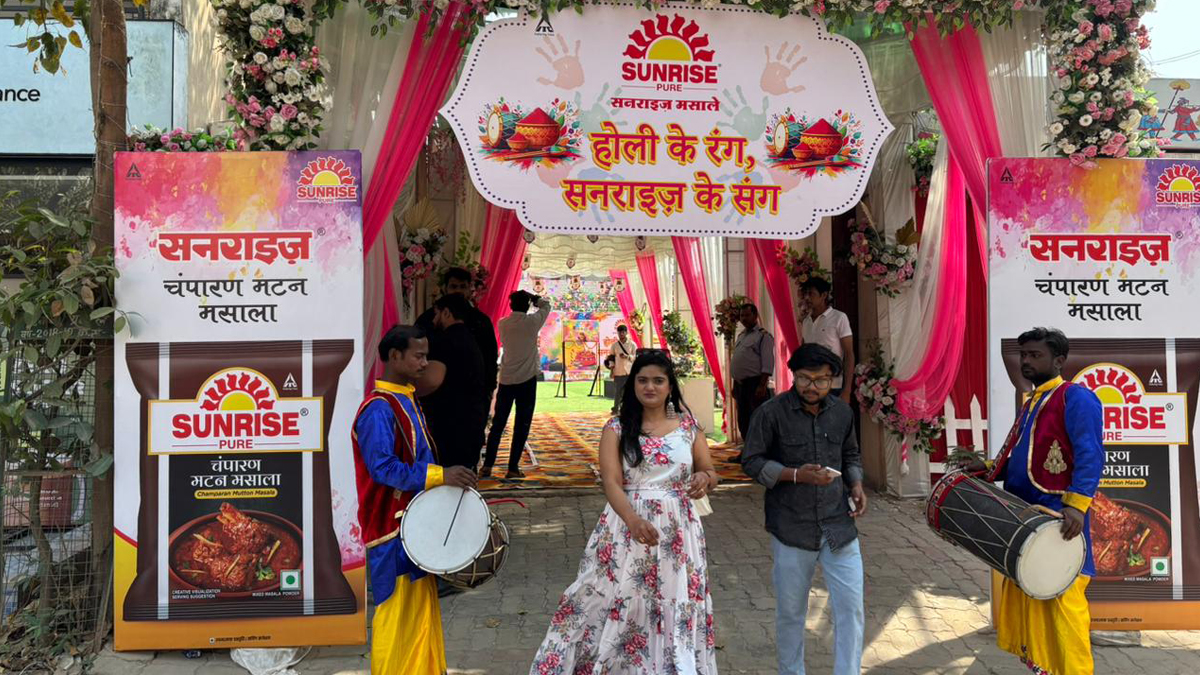
Sunrise Spices launches Champaran Mutton Masala for Holi
New Rs 20 blend brings Bihar’s iconic dish to kitchens across state and Jharkhand.
MUMBAI: Sunrise Spices just turned up the heat for Holi because nothing says “festival of colours” like a handi of slow-cooked mutton stealing the show. ITC Ltd.’s Sunrise Spices unveiled Champaran Mutton Masala at a lively pre-Holi celebration in Patna, paying tribute to Bihar’s signature slow-cooked mutton dish that’s as essential to the festival as gulal and gujiya. The new spice blend, priced at Rs 20, is crafted to deliver the authentic flavour profile of Champaran mutton eliminating guesswork while keeping the rich, earthy taste intact for home cooks.
The launch event transformed the venue into a traditional Bihari courtyard with earthy mud tones, wooden textures, and community-style seating. At the centre stood the symbolic “Holi Ki Handi,” a live, sealed slow-cooking demonstration using the new masala. Guests watched the process from spice mixing to dough-sealed cooking, then savoured the freshly unveiled dish in a communal feast.
ITC Ltd. business head for Sunrise Spices Piyush Mishra said, “At ITC Sunrise Spices, we believe food is deeply woven into cultural celebrations. Launching Champaran Mutton Masala amid a vibrant Holi celebration allowed us to showcase not just the product, but the emotion and tradition it represents.”
The celebration also featured spice-led activities, a hands-on handi-sealing ritual, and a cultural corner where guests shared Holi food memories. The evening wrapped with the community feast hot mutton straight from the handi, traces of gulal still on smiling faces capturing the warm, togetherness-filled spirit of a Bihari Holi.
Now available across key retail outlets in Bihar and Jharkhand, the launch positions Sunrise as a champion of regional cuisines made accessible for modern kitchens. In a season of colour and feasting, Sunrise isn’t just selling masala, it’s serving up a taste of home, one fragrant handi at a time.

Brands
Kwality Wall’s reports standalone losses following strategic HUL demerger
Ice cream major faces Rs 64 crore Ebitda loss amid commodity inflation and muted Q3 sales
MUMBAI: Kwality Wall’s (India) Limited (KWIL) has released its first set of financial results as a standalone entity, revealing a challenging start to its independent journey. Following its successful demerger from Hindustan Unilever Limited (HUL) on 1st December 2025 and its subsequent listing on 16th February 2026, the company is navigating a transition period marked by structural changes and high input costs.
For the quarter ended 31st December 2025, the company reported revenue of Rs 222 crores. Despite the revenue base, the bottom line was impacted by several factors, resulting in an Ebitda loss of Rs 64.2 crores. When calculated on a Pre-IND AS 116 basis, the Ebitda loss stood at Rs 83.8 crores.
Organic Sales Growth (OSG) declined by 6.5 per cent year-on-year during the quarter. Volume growth, however, saw a marginal increase of 1.2 per cent. The company reported a gross margin of 41.5 per cent. Additionally, exceptional expenses amounting to Rs 94 crores were recorded, primarily linked to non-recurring costs during the transition phase.
Performance across portfolios and channels was mixed. Within the impulse portfolio, brands such as Magnum and Cornetto recorded mid-single digit volume growth, indicating steady demand in on-the-go consumption. However, the in-home portfolio, which includes take-home packs, experienced muted consumption. The company is planning a relaunch of this category with improved offerings ahead of the 2026 season.
Quick commerce (Q-Com) continued to emerge as a strong growth driver, delivering robust double-digit growth during the quarter. Meanwhile, the company also expanded its physical distribution network by increasing the number of company-owned cabinets across markets.
Margin pressure during the quarter was driven by a combination of one-off factors and broader cost inflation. Gross margins were impacted by around 600 basis points due to trade investments made for stock liquidation. Additionally, cocoa price inflation contributed to another 400 basis points of pressure on margins.
Deputy managing director Chitrank Goel attributed the muted performance partly to prolonged monsoons and transitional challenges linked to the GST framework. Operating expenses also increased as the company invested in establishing its standalone supply chain, operational systems and corporate infrastructure following the demerger.
Looking ahead, the management remains focused on a volume-driven growth strategy. To restore profitability, the company has initiated a cost productivity programme aimed at reducing non-consumer-facing costs. It is also working on building regional manufacturing networks to optimise logistics expenses and improve operational efficiency.
The commodity outlook for the near term remains mixed. Dairy prices are expected to remain firm due to tight supply conditions and rising fodder costs. Sugar prices may also move higher following increases in the Minimum Selling Price (MSP). While cocoa prices have moderated recently, currency depreciation has offset some of the potential cost relief for the company.