Digital
Urgent: Protecting our kids from predators demands immediate awareness


Mumbai: In the digital age, the rapid expansion of technology has brought about both unprecedented opportunities and disturbing challenges. One such disconcerting challenge is the emergence of child predators, individuals who exploit the innocence and vulnerability of children for their own sinister motives. Child predators exploit various platforms, from social media networks to online gaming communities, to manipulate and groom young victims into engaging in harmful activities.
As a society, it is imperative that we confront this grave issue head-on, understanding the methods predators employ and taking collective action to protect our most vulnerable members – our children. In this discussion, we will delve into the unsettling world of child predators, examining their tactics, the impacts on victims and families, and the measures that can be taken to prevent and combat their activities.
Qissé Films in partnership with MISSING, an NGO working on child trafficking prevention, has released a PSA (Public Service Announcement) that aims to create awareness and drive conversations around child online safety.

Conceptualized by Qissé Films and MISSING, the film features the narrative of two young children from different backgrounds and how they get exploited by strangers who pose as friends on social media. It showcases how easily they fall prey to online traffickers even from the perceived safety of their homes. The film ends with a cautionary message of introspecting who you are really talking to online. It shockingly reveals that these predators target children as young as nine years and shares a WhatsApp number that can be reached out for anyone seeking help.
The PSA is supported by NCPCR (National Commission for Protection of Child Rights) and Cyber Peace. It is playing across PVR theatres in the country.
Indira Aditi Rawat, the director of the film, says, “Having worked with non-profits focused on children for many years, I was clear that the film should avoid sensationalism or melodrama and maintain authenticity. The narrative journey should be simple and show how ordinary conversations can lead to distressing situations for children who are isolated from their parents when spending time on their devices.”
Luv Kalla and Richa Maheshwari, Founders of Qisse Films, say, “We’ve all had worried conversations about our children spending more and more unsupervised time online. To make the online space safer for our kids, we need to get these conversations out of the living rooms and to the public forums. We at Qissé are glad to be able to create a film and aid MISSING, who are doggedly working to raise awareness, educate and push for policy initiatives to create a safe online environment for our children.”
Leena Kejriwal, Founder Missing Link Trust and strident advocate for anti-child trafficking and child safety, says “Our children in India face the highest risk of online abuse in the world, with a child being either abused or going missing every 10 minutes. Films play a powerful role in building public awareness, which is the first step in prevention. Qissé’s impactful film will help us prevent online abuse by building awareness about the alarming statistics and beginning a dialogue about the issue with parents, children, schools and the community at large. There is an urgent need for the public to get involved and help build a safer online world for our children.”
The helpline WhatsApp chat number is 60030 60040, and it aims to provide 24/7 information and assistance to parents and children grappling with this issue.
Indiantelevision.com in conversation with Leena Kejriwal, Founder – Missing Link Trust on the research done by them, the messaging and much more…..
On why this messaging is important now
India unfortunately leads the world in child abuse statistics. Every 10 minutes an Indian child either goes missing or is abused. From 2017-2020, 24 lakh CSAM cases were reported from India. This number increased to 56 lakhs in 2022, registering a six per cent increase from 2021.
The restrictions of movement and social distancing measures during COVID-19 pushed the whole world and their children online. The children came online way faster than we expected and there was no basic education or systems of digital hygiene and cyber civic sense in place. A study conducted by McAfee reported that children in India are among the youngest to reach mobile maturity and report the highest exposure to online risks. Children in India aged 10 to 14 appear to adopt mobile more quickly than nearly all their peers worldwide.
Sex abuse and exploitation have now been recognized as a social issue and then a criminal justice issue. The pandemic caused a further escalation by shifting the abuse from offline to online spaces and left our children vulnerable in their very homes. The need for awareness about the issue amongst the children, parents and society at large is becoming critical, to keep our children safe. MISSING is continuously working to raise awareness to address this alarming social issue of child sexual abuse & exploitation. We have taken up the mission of online child safety, through the public service announcement (PSA). The PSA aims to raise awareness about the perils of child trafficking and educate the public on its prevention. These PSA films will enable us to create a dialogue and to reach our target audience directly.
The CTA of this film is our Online Child Safety Desk which is a WhatsApp chatbot available at 6003060040, which is created by us for children and parents.
On Missing garnering info on missing children
Our founder Leena Kejriwal was drawn to the issue as early as 2000 and for over a decade she worked with friends and NGOs in the red-light district like Urmi Basu of New Light in Kalighat, Srabani Roy of South Kolkata Humari Muskaan in Bowbazar and others. It was years of engagement that made her realize the importance of public engagement. The public which is the most important stakeholder in the issue, was far away from most of the anti-trafficking conversations. Since then, she has been working with experts- educationists, cyber security experts and child rights experts who understand the depth of the issue and its nuances.
Since we started the Missing Awareness and Safety School program (MASSp) in 2018, we have had direct conversations with students, parents, teachers and caregivers and realized that we have garnered many insights from our interactions and research with them. Our M&E gives us deep insights into the choices children make and what drives them to risqué behaviour.
On the PVR collaboration
Missing started as a public art campaign and public advocacy has been a crucial agenda for all our work. We created our first PSA in 2016. We have an award-winning game and comics, and we are constantly looking at reaching our target audiences through our multiple assets. PVR collaboration is the next most natural direction for engaging the public because anybody from a 10-year-old to an 80-year-old is PVR INOX’s target audience, including children, young adults, parents, caregivers, guardians and every member of society. Hence a PVR cinema space is a powerful space for raising mass awareness. PVR INOX Cinemas with its 17000 halls and access to 20 million viewers will help in taking the PSA to its target beneficiaries – the public.
On the film being screened on all PVR screens and the message reaching to larger audience
Stop Online Stalkers (#SOS) needs all the help it can get to be prompted on every screen and in conversation. There is no issue more urgent as our children’s online safety needs to be prioritized. This cannot be done by just one section of the community. It has to be a collective effort of multiple stakeholders who have access to the public screen. Parents, schools, cyber safety officials, policymakers, the government and most important of all, the public. You and me. We need to join hands on child safety and the #SOS campaign.
On Missing talking to schools and parents to educate them on how to ensure the safety of their children in cyberspace
Our motto is why wait for a child to be trafficked to save them. We work on prevention. The first step to prevention is education and awareness. We have been conducting our Missing Awareness and Safety School program (MASSp) since 2017. We conduct it for adolescents from the age group of 13-18 and the entire program is one of its kind, audio visual, geography agnostic and all our assets are embedded within it. We talk about cybersafety within our program.
Within our #SOS campaign too, we have the #SOS Forum which is ongoing right now in cities across the country, where students are engaging in dialogues with us, other issue experts, policy makers, cyber safety officials and government agencies. Concerned parents are invited to join #SOSMums and raise their awareness as well as their voices on this issue on social media.





Digital
RBI proposes Rs 25,000 compensation cap for small digital fraud losses
RBI, customer bank and beneficiary bank will share payouts
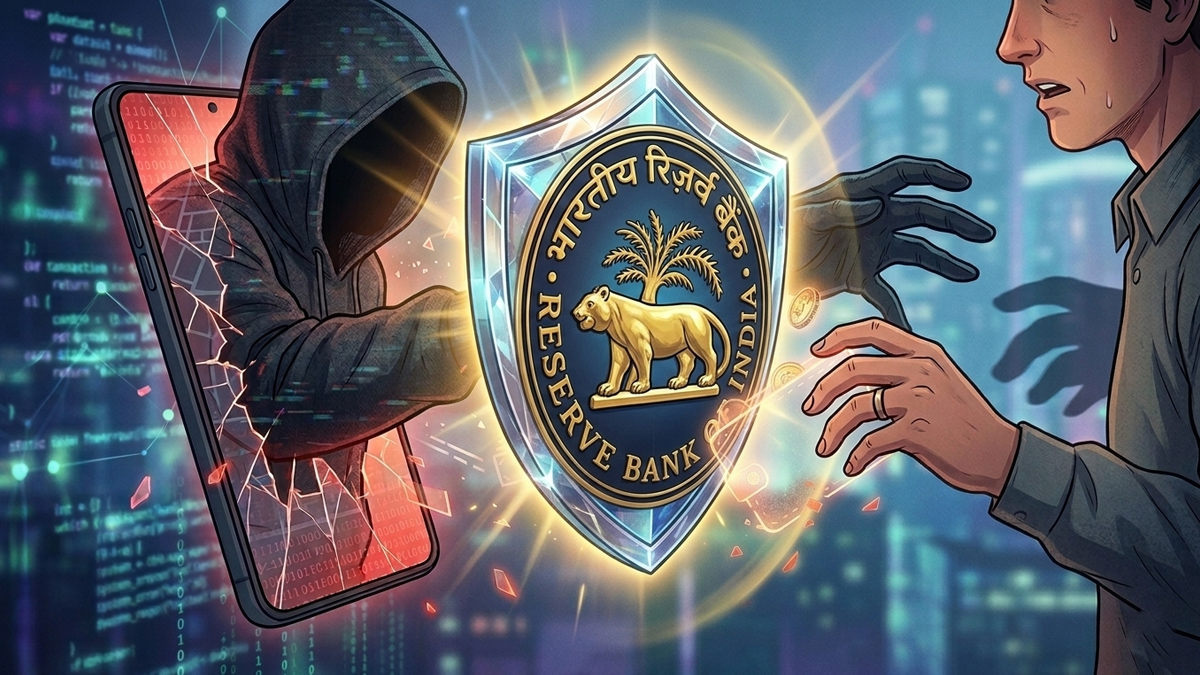
NATIONAL: The Reserve Bank of India has proposed a new compensation framework for small-value fraudulent electronic banking transactions, requiring the central bank, the customer’s bank and the beneficiary’s bank to share payouts to affected customers.
Under draft rules released on Friday, compensation will be capped at the lower of 85 per cent of the net loss amount or Rs 25,000 in cases where the gross loss from a fraudulent electronic transaction is up to Rs 50,000.
The proposal comes as regulators step up efforts to strengthen customer protection amid a rise in digital banking frauds.
RBI governor Sanjay Malhotra had indicated during last month’s monetary policy announcement that the central bank planned to introduce a compensation framework for small-value digital frauds, allowing affected customers to claim relief once during their lifetime.
According to the draft guidelines, when the loss is below Rs 29,412, compensation of 85 per cent of the loss will be paid. Of this amount, 65 per cent will be borne by the RBI, while the customer’s bank and the beneficiary bank will contribute 10 per cent each.
For losses of Rs 29,412 or more but up to Rs 50,000, the compensation will be capped at Rs 25,000. In such cases, the RBI will contribute Rs 19,118, while the customer’s bank and the beneficiary bank will each contribute Rs 2,941.
If funds are later recovered after compensation has been paid, the customer’s bank must recalculate the payout based on the revised net loss and adjust the recovered amount accordingly.
Customers will be eligible for compensation only if they report the fraudulent transaction within five calendar days of its occurrence.
Complaints must be lodged both with the bank and through the National Cyber Crime reporting portal or the National Cyber Crime helpline. Banks must also confirm that the loss is bona fide under their internal processes.
Once a complaint is received, banks must compensate the customer within five calendar days, the draft rules state.
In joint accounts, only one account holder may submit a compensation claim.
The central bank has also proposed tightening transaction alerts by mandating instant SMS notifications for all electronic banking transactions above Rs 500. For transactions of up to Rs 500, banks may decide whether to send alerts based on internal policies.
Banks will not be allowed to charge customers for SMS messages sent to meet regulatory requirements or those used for promotional, marketing or customer awareness purposes.
The draft framework also calls for stronger oversight by requiring banks to periodically report complaints related to fraudulent electronic transactions to their boards or board-level committees. These reports must detail the number and value of cases across categories including card-present transactions, card-not-present transactions, internet banking, mobile banking and ATM transactions.
The RBI has invited public comments on the draft guidelines until 6 April, 2026. The rules are expected to take effect on 1 July, 2026 once finalised.
Banking officials say the proposed sharing of compensation between the RBI, the customer’s bank and the beneficiary bank is intended to increase vigilance across the digital payments ecosystem.