Connect with us

Digital

Eight-year-old coder steals the show at India AI Impact Summit 2026

Ranvir Sachdeva meets Sundar Pichai and Sam Altman, links ancient philosophy to modern AI

Published

on

DELHI: Amid a sea of global tech chiefs and policy heavyweights, the loudest buzz at Bharat Mandapam this week came from a boy barely tall enough to see over the lectern.

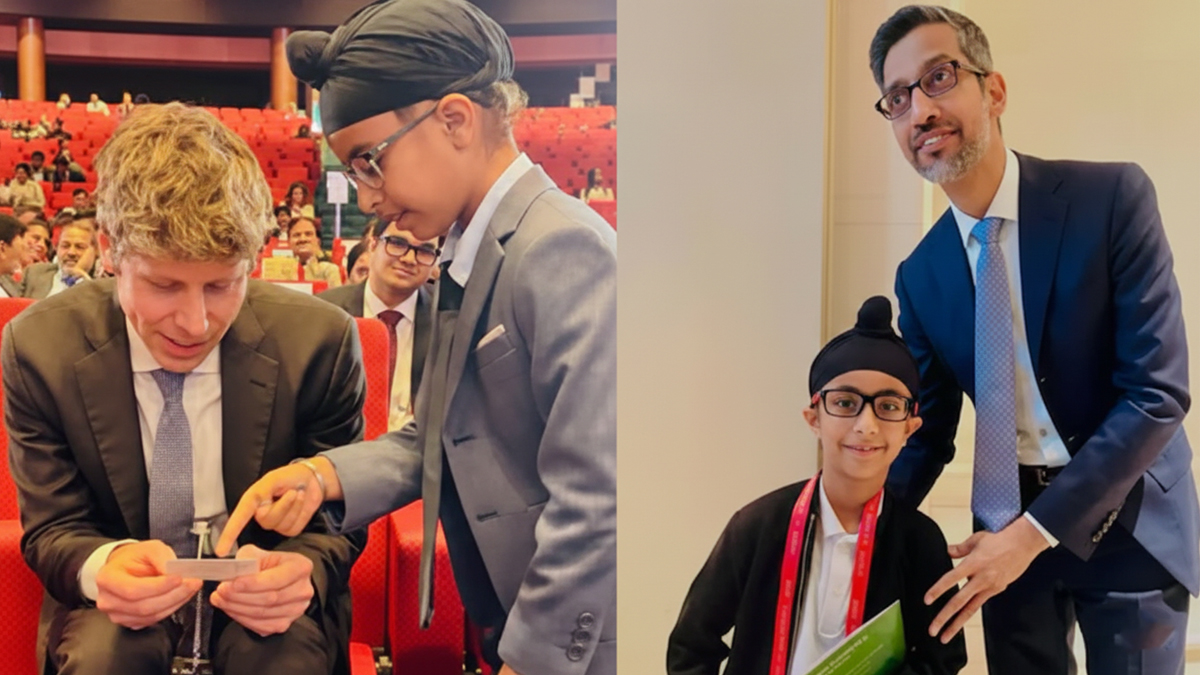
Ranvir Sachdeva, eight, became the youngest keynote speaker at the India AI Impact Summit 2026 in New Delhi, elbowing his way into a line-up dominated by chief executives, founders and ministers. Calm, bespectacled and fiercely articulate, he declared himself a technologist — and spoke like one.

“I’m here as the youngest keynote speaker at the India AI Impact Summit. I’m talking about how I’m linking ancient Indian philosophies to modern-day technologies. I’m also covering the different approaches which the rest of the nations are building AI,” he told news agency ANI.

Advertisement

He added: “I’m talking about how India is building AI with. I’m sharing my own use case of an Indian AI model just released and how I’m contributing to India’s GDP and driving AI literacy with it.”

The summit, held from February 16 to 21 in New Delhi, has drawn global names. Ranvir met Google chief executive Sundar Pichai and OpenAI chief executive Sam Altman on the sidelines, sharing photographs of the encounters. He has previously met Salesforce chief executive Marc Benioff and Doreen Bogdan-Martin, secretary-general of the International Telecommunication Union, at the AI for Good Global Summit in Geneva.

In 2024, he met António Guterres, United Nations secretary-general.

Advertisement

His most high-profile brush with corporate royalty came earlier. In 2023, during the opening of Apple’s Delhi store, Ranvir demonstrated his Swift coding skills to Apple chief executive Tim Cook in a one-on-one session. Cook later posted: “What an incredible reception, Delhi, thank you! We’re delighted to welcome our customers to our newest store—Apple Saket!”

Ranvir replied publicly: “Thank you so much, @tim_cook! It was great meeting you today and showcasing my Apple Swift coding skills! You are an inspiration and I so want to meet you at #WWDC2023!”

The invitation followed. Cook extended a personal call for Ranvir to attend the Worldwide Developers Conference 2023 at Apple Park in Cupertino.

Advertisement

This is not Ranvir’s first turn on the global stage. In 2025, aged seven, he addressed the United Nations’ AI for Good Global Summit in Geneva as its youngest keynote speaker. He spoke for 20 minutes on “Agents of Change: A 7-Year-Old’s Lens on Generation AI for Good”, in front of more than 10,000 attendees from over 180 countries and 53 UN partner organisations.

He shared the broader stage with Geoffrey Hinton, Nobel laureate and Turing Award winner, alongside senior figures from Amazon, Meta and Salesforce. According to a LinkedIn post by the Ardee School, Ranvir argued that “Generation AI are the true changemakers”, highlighting healthcare breakthroughs from bionic solutions and exoskeletons to assistive devices for ALS patients. He called for the democratisation of such tools to bridge the digital divide.

The precocity runs deep. At six, he became the world’s youngest TEDx speaker, speaking on technology and innovation. At five, he won a gold medal as a “Super Presenter” in the 2022 Global Reading Challenge. Media reports say that in 2021 he built a prototype rocket aimed at supporting NASA’s Mars exploration, earning recognition from the Jet Propulsion Laboratory.

Advertisement

In 2023, he became the youngest recipient of a robotics and AI certification from IIT Delhi after a summer workshop at the I-HUB Foundation for Robotics.

He began coding at three.

At an event otherwise obsessed with trillion-dollar valuations, sovereign AI stacks and regulatory guardrails, it was a small voice that cut through. Linking Sanskrit thought to silicon chips, GDP to generative models, Ranvir Sachdeva did more than make history. He made the grown-ups listen.

Advertisement
Click to comment

Leave a Reply

Your email address will not be published. Required fields are marked *

Digital

Google partners with Adani and Airtel to build India’s largest AI data centre

The three-campus complex, built with Adani and Airtel, is India’s largest-ever technology infrastructure investment

Published

on

Visakhapatnam: Google has broken ground on what it is billing as India’s largest-ever technology infrastructure project: a gigawatt-scale artificial intelligence hub in Visakhapatnam, Andhra Pradesh, built in partnership with AdaniConneX and Nxtra by Airtel. The ceremony at Tarluvada on 28th April marked the start of construction on a three-campus data centre complex that sits at the heart of a $15 billion investment Google has committed to deploying across India between 2026 and 2030.

The numbers are staggering by any measure. Nearly 1 gigawatt of compute capacity at a single location, three data centre campuses, a fibre-optic expansion under the America-India Connect initiative, and a long-term clean energy strategy designed to feed new renewable supply into the national grid. Google says the project will help India hit its target of 500 gigawatts of non-fossil fuel capacity by 2030 while delivering the high-performance, low-latency infrastructure that businesses need to build and scale AI-powered services.

The groundbreaking drew a formidable gathering of political and corporate India. Union minister for information technology Ashwini Vaishnaw, Andhra Pradesh chief minister N. Chandrababu Naidu and state IT minister Nara Lokesh attended alongside Google Cloud chief executive Thomas Kurian, Adani Group directors Karan Adani and Jeet Adani, and Bharti Enterprises vice chairman Rakesh Mittal.

Advertisement

Vaishnaw framed the project in terms of national ambition. “The India AI hub and three subsea cables landing in Visakhapatnam will become very important infrastructure for the country’s journey forward,” he said, adding his thanks to Google for its “continued trust in India.” Naidu was equally bullish, describing Andhra Pradesh as “India’s premier investment destination” and the Vizag hub as a cornerstone of the state’s technology corridor. “Our vision goes beyond attracting investment,” he said. “We want local talent, startups, and enterprises to become active partners in this technology-driven growth story.”

Kurian called the groundbreaking “a powerful realization of our shared vision with the Indian government, and an inflection point for the country’s AI-native future.” Jeet Adani was characteristically direct: “When energy becomes more affordable and increasingly powered by clean sources, intelligence becomes more accessible, and that is how India will lead the next phase of digital growth.” Gopal Vittal, executive vice chairman of Bharti Airtel, said the full stack of data centres, green power, pan-India fibre and a next-generation cable landing station would enable “large-scale, world-class AI infrastructure in Vizag.”

The project was first announced in October 2025. AdaniConneX and Nxtra by Airtel will lead construction of the data centre buildings and connecting infrastructure, with Google deploying its AI capabilities on top.

Advertisement

Beyond the hardware, Google has announced a substantial package of community programmes. On water, it is partnering with Sponge Collaborative on a watershed management plan linking coastal ecosystem restoration with clean drinking water systems, including reverse osmosis plants and Water ATMs, for local residents. On livelihoods, a tie-up with the Sambhav Foundation will equip more than 1,000 fisherfolk with GPS navigation, weather-forecasting tools, cold-chain management training and UPI-based financial literacy. The Google Udaan India Fund, run through ChangeX, will provide direct grants to local schools and social enterprises for AI skilling labs and digital literacy programmes. The NARI Shakti programme, developed with the Learning Links Foundation, will support more than 10,000 women entrepreneurs from low-income backgrounds in building micro-enterprises. The Skills Trade and Readiness programme will prepare more than 1,000 local workers for construction, welding and facility operations roles, while a parallel tie-up with ICT Academy will train more than 1,200 students and educators in cloud computing and generative AI.

The groundbreaking was accompanied by the Bharat AI Shakti Conclave, a conference organised with the Andhra Pradesh government and Nara Lokesh, bringing together suppliers, industry partners and infrastructure firms to map how Google’s anchor investment can be turned into a broader economic value chain for the region. The conclave’s central theme was building an AI industrial corridor, with a local-first procurement approach and the integration of regional small and medium enterprises into Google’s global operational frameworks.

Every major technology company in the world has been courting India. What sets Vizag apart is the sheer scale of the commitment and the deliberate effort to build an industrial ecosystem around it rather than simply plant servers in a field. Google is not just betting on India’s digital future; it is trying to build the factory floor on which that future gets made. Whether the $15 billion translates into genuine local opportunity, or merely into an impressive data centre humming quietly on the Andhra Pradesh coast, will depend on whether those community programmes prove as durable as the hardware. The groundbreaking, as ever, is the easy part.

Advertisement
Continue Reading

Advertisement News18
Advertisement
Advertisement
Advertisement
Advertisement Whtasapp
Advertisement Year Enders

Indian Television Dot Com Pvt Ltd

Signup for news and special offers!

Copyright © 2026 Indian Television Dot Com PVT LTD