Hollywood
Bonded by Boom Christopher Corbould lifts the lid on cinema’s loudest secrets

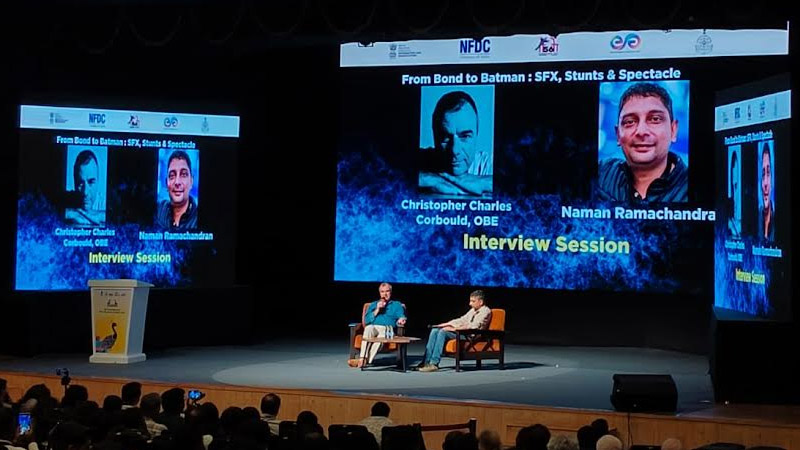
MUMBAI: If movie magic had a mailing address, Christopher Charles Corbould OBE would probably receive half the post. After all, not many people can casually say they’ve blown up a Guinness-record-breaking desert, flipped a truck for Christopher Nolan and dropped a tube train through the ceiling in Skyfall, all before lunch. So when the Oscar-winning special-effects legend took the stage at the 56th International Film Festival of India in Goa for a masterclass titled From Bond to Batman: SFX, Stunts & Spectacle, the room’s energy crackled almost as loudly as one of his detonators.
Corbould, the man behind Hollywood’s most heart-stopping practical sequences, began with a line that quietly summed up his philosophy: filmmaking is a battlefield, but a beautifully choreographed one. “We are all soldiers,” he said stunt teams, art departments, digital units each pitching ideas, each building a cog that keeps the cinematic machine from falling apart. Strip out one department and the spectacle collapses. And he means this literally; no Bond chase, no Batmobile roar, no galactic explosion exists without a thousand hands hidden in the shadows.
But among all those hands, one rule towers above the rest: safety is non-negotiable. Designing a stunt vehicle rig, Corbould explained, begins with protecting the stunt driver’s life. Roll cages must be disguised beneath upholstery, fire-suppression systems tucked into interiors, fuel tanks reduced to minimise impact. Meanwhile, the stunt crew will gleefully attempt to “destroy the car” in rehearsals, which, he admits with a sigh, breaks his heart every single time.

Still, spectacular cinema demands sacrifice sometimes of the sheet metal variety. In No Time to Die, the team shot in Matera, the ancient Italian city carved from stone more than 5,000 years ago. Protecting its history meant disguising modern safety blocks as centuries-old architecture. Bond films, he noted, pride themselves on leaving locations exactly as they found them “or better”.
How, then, does a film team navigate the tug-of-war between departments with competing priorities, stunts, VFX, art, camera, all convinced their needs matter most? Corbould’s answer is disarmingly simple: you talk. “Information is integral,” he said. Before every major sequence, the entire crew circles up for a ritual briefing. Every action, every explosion, every fall, every spark is articulated aloud by each team, ensuring no surprises sneak up, because in his world surprises are where danger lives.
And yet even the best-laid plans wobble when the blast button is involved. Corbould has staged explosions for decades, including the world’s largest cinematic explosion in Spectre, a detonation comprising around 300 separate blasts, choreographed via a cutting-edge computerised triggering system. Instead of running hundreds of wires across the Moroccan desert, the team programmed each detonator to fire at precisely the right millisecond. The only catch? A three-second delay between pressing the button and the boom. Which is how Corbould ended up warning Daniel Craig “No pressure, but I’ll have to press three seconds before you finish your line” and receiving a look that suggested Bond would rather defuse a nuclear device.
If Nolan films require mathematical precision, they also demand unlimited imagination. Corbould recalls Christopher Nolan arriving on Batman Begins without the usual action-film safety net of a second-unit director. Instead, Nolan personally shot the Batmobile chase shot for shot, no multiple-angles safety coverage wasting nothing, capturing only what he needed. It changed Corbould’s understanding of how lean action filmmaking could be, so much so that the “no second unit” approach ended up more cost-efficient than traditional methods.
But Nolan isn’t just efficient; he’s exacting. Corbould described him as the director who pushes him furthest out of his comfort zone—in the best way. Their partnership sometimes involves tough conversations, including the day Corbould had to politely refuse Nolan’s request to have actors inside a plane fuselage as it plummeted during the opening of The Dark Knight Rises. “Chris, I don’t think this is safe,” he said, and Nolan backed down immediately. That mutual respect, he insists, is what keeps ambitious films grounded.
Not all directors speak “machine, metal and mayhem” fluently. Some need guidance, others need negotiation, and a few he names Sam Mendes, Martin Campbell and Marc Forster stretch his creativity in unexpected directions. Campbell, he says, reinvented Bond twice with GoldenEye and Casino Royale; Mendes taught him the art of marrying spectacle with character; Nolan forced him to rethink the physics of the possible.
Of course, every titan has bad days. Catastrophic failures, he joked, rarely involve 300-blast mega-explosions. They usually involve tiny rigs, a stubborn mechanism the size of a fist that refuses to fire after 25 takes while an entire crew stares in silent judgement. “Those are the embarrassing ones,” he laughed.
But the triumphs? There are plenty, though his favourite might just be the jaw-dropping London Underground set-piece in Skyfall. Mendes wanted “one jaw-dropping moment” to cap a foot chase. Corbould suggested a tube train crashing through the ceiling. His crew blinked. “Tube trains weigh 70 tonnes,” they reminded him. His solution was charmingly Corbouldian: “Well, we’ll build two.” And so they did, an 80-foot, life-size replica, constructed from scratch, then dropped through a set like a full-fat wrecking ball. The result became one of the most thrilling Bond moments ever filmed made entirely with practical effects.
His résumé also includes a detour through galaxies far, far away. Though not a lifelong Star Wars devotee, he reinvented the franchise’s effects style in The Force Awakens and returned for The Last Jedi, drawn in by Rian Johnson’s gentleness and clarity of vision.
But what of the future? What of AI, virtual productions, LED stages and the death of “real” spectacle? Corbould is cautiously optimistic. AI, he believes, is useful, but the true intelligence still lives in the human mind. Digital effects once threatened his job too, but instead they expanded his crew from 40 technicians on GoldenEye to over 120 on later Bond films, enabling bolder and more imaginative sequences. LED stages help actors, he admits, but never replace the adrenaline of responding to a real explosion. He cites a scene in John Carter where swapping a shouted cue for an actual off-camera blast transformed performances instantly.
So no, cinema hasn’t reached its limit. Safety isn’t the ceiling; imagination is. “If you did an explosion twice the size of the Spectre one,” he shrugged, “it’s just another explosion.” Original ideas, not louder bangs, are the future.
He praises Indian filmmakers too, calling RRR “fantastic, beautifully shot, and full of great action.” With Rajamouli’s next projects under way including an “insane” production in Varanasi Corbould believes India is now firmly in the global spectacle league.
And finally, what does the master look for in the next generation? Not perfection. Not technical prowess. Just three ingredients: keenness, politeness and respect. The rest lathe work, welding, drawing, rigging can be taught. “Every day is a learning day,” he says, describing junior crew who joined him at 16 and remain with him four decades later.
By the end of the masterclass, one thing was clear: behind cinema’s biggest bangs lies a man who speaks softly, plans obsessively and worries constantly until the moment the director calls “action”. For audiences, it’s over in seconds. For Christopher Corbould, it’s a lifetime of careful chaos.
And as long as filmmakers keep dreaming dangerously, he’ll be there, one quiet button-press away from spectacle.