Digital
Webinar unpacks how influencers turn attention into action


MUMBAI: MRSI’s November edition of its Wednesday Webinar series dug deep into one question that defines modern marketing: how do influencers turn scrolling into shopping? Titled “Attention to Action”, the session brought together experts who unpacked the fast-growing creator economy and its widening role across India’s consumer landscape.
The panel featured KlugKlug co-founder and CEO Kalyan Kumar, GroupM WPP and Goat Agency India’s business head Kunal Sawant, and Hansa Research Group’s vice president for quantitative research Pramod Pawar, with Sunder moderating the discussion.
The conversation began with a simple question: who exactly is an influencer? Kalyan described them as creators who build communities through content. Pramod defined them as people who sway decisions through digital platforms. Kunal added that anyone with the power to shift opinions or purchases through social media qualifies.

Kunal highlighted how influencer marketing has become a strategic priority across major sectors including FMCG, BFSI, manufacturing, and utilities. A GroupM study showed that 71 per cent of brands now favour an always-on model instead of campaign bursts. Analysing 60,000 influencers and posts from 52 brands, the study emphasised that content quality and engagement matter far more than follower count. Long-term relationships are rising too, with 72 per cent of brands and an impressive 95 per cent of manufacturing companies preferring sustained partnerships.
Discovery remains a hurdle, especially in regulated categories like BFSI. Engagement rate has become the core metric, while impressions and views continue to fade in importance. Although conversion stands at 23 per cent today, it is expected to climb as brands sharpen their influencer strategies.
Pramod presented a sweeping view of the ecosystem through Hansa’s Brand Endorser study. With over 500 respondents across 36 cities evaluating more than 350 celebrities and influencers, the study showed influencer recognition has grown nearly 50 per cent in recent years. The rise is strongest in the West, with regional creators dominating in the South and East. Though often seen as a Gen Z phenomenon, influencer impact is rising sharply among millennials too.
Relatability remains the biggest pull, with 82 per cent of consumers finding influencers more relatable than traditional celebrities. Preferences vary by category: polished creators work best for apparel; practical voices for finance; warm personalities for food; and regional creators for smaller towns. Comedy and entertainment lead growth, while food content is booming beyond metros. Podcasts are gaining traction among younger men, and tech continues to hold a niche but highly trusted space.
In a segment on B2B influence, Kalyan explained that while the dynamics differ sharply from B2C, influencer-like behaviour has long existed through subject experts. LinkedIn remains the most effective space, though credibility makes endorsements rare.
He also highlighted the scale of the industry. Influencer-led content today forms a Rs 10,000 crore market, with brands spending upwards of Rs 20 crore annually. More than 14,000 Amazon brands rely on creator-driven content to move market share. Beauty categories see up to 5 times earned media value multipliers, while home and kitchen categories reach as high as 7 times. Yet challenges remain; audience misalignment is common and multiple intermediaries often dilute budgets before they reach creators.
Kalyan called for brands to move beyond swipe-ups and link-in-bio tracking, which capture barely a fraction of true influence. With Gen Z and millennials forming 67 per cent of India’s internet users, social-first content now commands seven times higher brand recall compared to traditional media. Authenticity, agility, and relevance have become the new currency of marketing.
The webinar closed on a clear note: influencer-led discovery, trust, and purchase influence are no longer optional. They are reshaping the consumer journey, redefining marketing playbooks, and opening a massive opportunity for brands that bring data, creativity, and authenticity together.






Digital
Google partners with Adani and Airtel to build India’s largest AI data centre
The three-campus complex, built with Adani and Airtel, is India’s largest-ever technology infrastructure investment
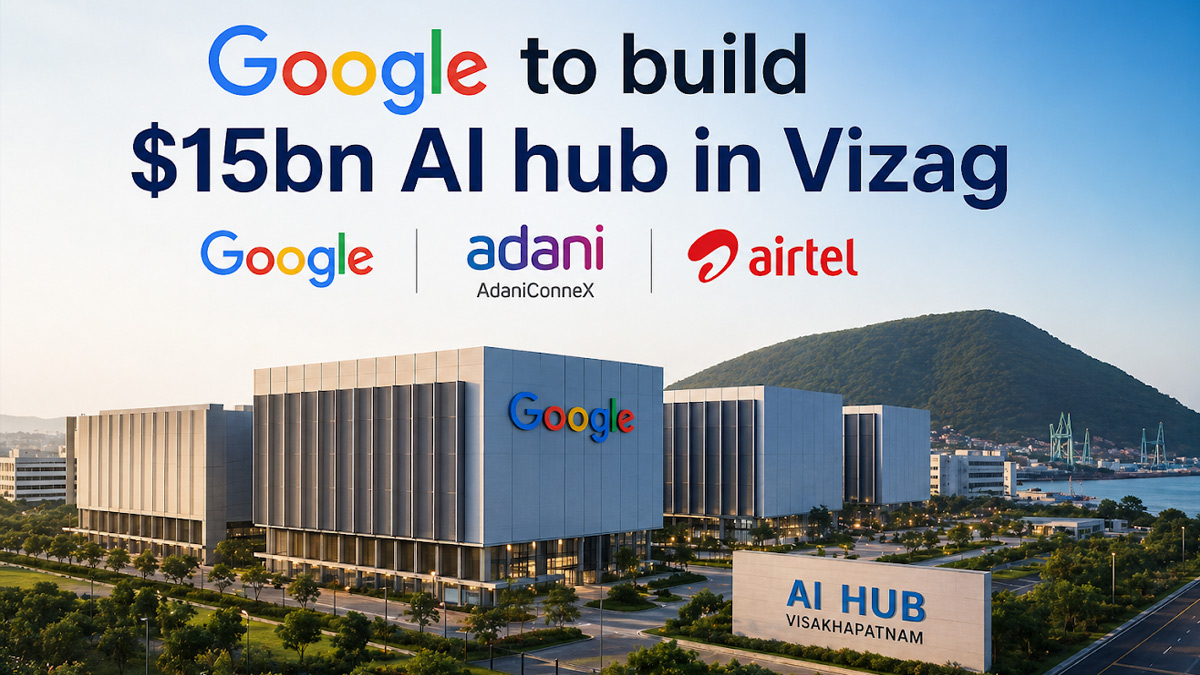
Visakhapatnam: Google has broken ground on what it is billing as India’s largest-ever technology infrastructure project: a gigawatt-scale artificial intelligence hub in Visakhapatnam, Andhra Pradesh, built in partnership with AdaniConneX and Nxtra by Airtel. The ceremony at Tarluvada on 28th April marked the start of construction on a three-campus data centre complex that sits at the heart of a $15 billion investment Google has committed to deploying across India between 2026 and 2030.
The numbers are staggering by any measure. Nearly 1 gigawatt of compute capacity at a single location, three data centre campuses, a fibre-optic expansion under the America-India Connect initiative, and a long-term clean energy strategy designed to feed new renewable supply into the national grid. Google says the project will help India hit its target of 500 gigawatts of non-fossil fuel capacity by 2030 while delivering the high-performance, low-latency infrastructure that businesses need to build and scale AI-powered services.
The groundbreaking drew a formidable gathering of political and corporate India. Union minister for information technology Ashwini Vaishnaw, Andhra Pradesh chief minister N. Chandrababu Naidu and state IT minister Nara Lokesh attended alongside Google Cloud chief executive Thomas Kurian, Adani Group directors Karan Adani and Jeet Adani, and Bharti Enterprises vice chairman Rakesh Mittal.
Vaishnaw framed the project in terms of national ambition. “The India AI hub and three subsea cables landing in Visakhapatnam will become very important infrastructure for the country’s journey forward,” he said, adding his thanks to Google for its “continued trust in India.” Naidu was equally bullish, describing Andhra Pradesh as “India’s premier investment destination” and the Vizag hub as a cornerstone of the state’s technology corridor. “Our vision goes beyond attracting investment,” he said. “We want local talent, startups, and enterprises to become active partners in this technology-driven growth story.”
Kurian called the groundbreaking “a powerful realization of our shared vision with the Indian government, and an inflection point for the country’s AI-native future.” Jeet Adani was characteristically direct: “When energy becomes more affordable and increasingly powered by clean sources, intelligence becomes more accessible, and that is how India will lead the next phase of digital growth.” Gopal Vittal, executive vice chairman of Bharti Airtel, said the full stack of data centres, green power, pan-India fibre and a next-generation cable landing station would enable “large-scale, world-class AI infrastructure in Vizag.”
The project was first announced in October 2025. AdaniConneX and Nxtra by Airtel will lead construction of the data centre buildings and connecting infrastructure, with Google deploying its AI capabilities on top.
Beyond the hardware, Google has announced a substantial package of community programmes. On water, it is partnering with Sponge Collaborative on a watershed management plan linking coastal ecosystem restoration with clean drinking water systems, including reverse osmosis plants and Water ATMs, for local residents. On livelihoods, a tie-up with the Sambhav Foundation will equip more than 1,000 fisherfolk with GPS navigation, weather-forecasting tools, cold-chain management training and UPI-based financial literacy. The Google Udaan India Fund, run through ChangeX, will provide direct grants to local schools and social enterprises for AI skilling labs and digital literacy programmes. The NARI Shakti programme, developed with the Learning Links Foundation, will support more than 10,000 women entrepreneurs from low-income backgrounds in building micro-enterprises. The Skills Trade and Readiness programme will prepare more than 1,000 local workers for construction, welding and facility operations roles, while a parallel tie-up with ICT Academy will train more than 1,200 students and educators in cloud computing and generative AI.
The groundbreaking was accompanied by the Bharat AI Shakti Conclave, a conference organised with the Andhra Pradesh government and Nara Lokesh, bringing together suppliers, industry partners and infrastructure firms to map how Google’s anchor investment can be turned into a broader economic value chain for the region. The conclave’s central theme was building an AI industrial corridor, with a local-first procurement approach and the integration of regional small and medium enterprises into Google’s global operational frameworks.
Every major technology company in the world has been courting India. What sets Vizag apart is the sheer scale of the commitment and the deliberate effort to build an industrial ecosystem around it rather than simply plant servers in a field. Google is not just betting on India’s digital future; it is trying to build the factory floor on which that future gets made. Whether the $15 billion translates into genuine local opportunity, or merely into an impressive data centre humming quietly on the Andhra Pradesh coast, will depend on whether those community programmes prove as durable as the hardware. The groundbreaking, as ever, is the easy part.