Hindi
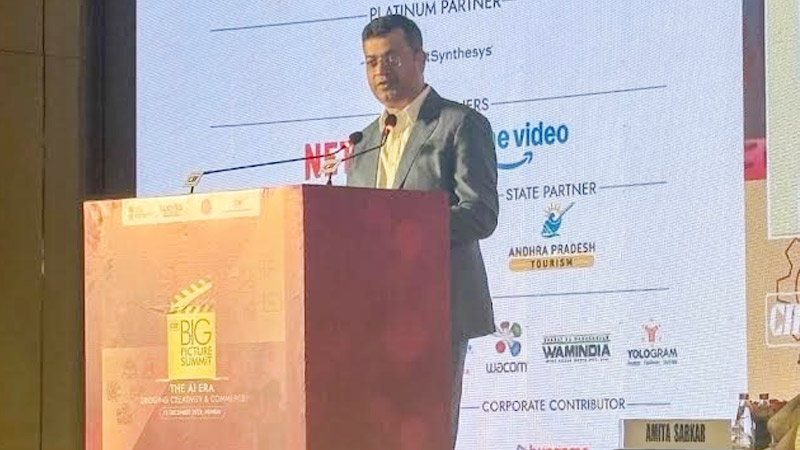
Gaurav Banerjee opens Big Picture Summit with call for global creative ambition
MUMBAI: Lights, camera… recalibration! At the CII Big Picture Summit 2025 in Mumbai, Sony Pictures Networks India MD & CEO and CII National Council on Media & Entertainment chairman Gaurav Banerjee served up a stirring call for India’s creative economy to stop thinking local and start playing on the world stage.
Speaking at the JW Marriott Juhu, Banerjee said India’s Media & Entertainment sector stood at “a moment of profound transformation”, with talent, technology and cultural confidence finally aligning. The global industry is racing towards $3.5 trillion by 2030, and though India currently accounts for just 2 per cent of that value, he framed this not as a constraint but a “phenomenal headroom to grow”.
He argued that India’s long-standing comfort with its vast domestic market has, ironically, limited its global ambition. Drawing a sharp parallel with South Korea’s deliberate creation of the Hallyu wave, from K-dramas to Parasite and Squid Game, Banerjee asked why India shouldn’t aim for similar worldwide cultural impact.
He pointed to India’s creative hits already making waves, from chart-topping music to globally streamed series, and even cited Mahavtar Narasimha as an example of audiences welcoming bolder, fresher formats. “The real constraint isn’t the market,” he said. “It’s the ambition we place on ourselves.”
To unlock India’s next leap, Banerjee called for an “IPL of Creativity”: specialised creative institutions, stronger industry–academia partnerships, regional creative hubs, and rapid public–private collaboration—capacity-building engines that have powered global creative economies.
On the role of AI, he struck a reassuring note. Creativity, he insisted, would remain human at its core. “AI will not define creativity. Human imagination will.”
Wrapping up, Banerjee urged the industry to stop measuring success merely by domestic scale. “India must define success by global influence,” he concluded. “If we raise our ambition, build institutions, nurture creators and think boldly, not just about the India we are, but the India we can be, then India will not just grow. India will lead.”

Hindi
Remembering Gyan Sahay, the lens behind film, television and advertising
From a puppet rabbit selling poppadums to Hindi cinema, he framed it all.
MUMBAI: There are careers, and then there are canvases. Gyan Sahay, the veteran cinematographer, director, and producer who passed away on 10 March 2026 in Mumbai, had one of the latter. Over several decades in the Indian film and television industry, he turned lenses, lights, and the occasional puppet rabbit into something approaching art.
A graduate of the Film and Television Institute of India (FTII) in Pune, Sahay built his reputation as a director of photography across a career that stretched from the early 1970s all the way to the digital age. He was the kind of craftsman who understood that a well-composed shot is not merely a technical achievement but a quiet act of storytelling.
For most Indians of a certain age, however, Sahay will forever be the man behind the rabbit. His direction of the iconic long-running television commercial for Lijjat Papad, featuring its now-legendary puppet bunny, gave the country one of its most cheerfully persistent advertising images. It was the sort of work that sneaks into the national subconscious and takes up permanent residence.
His big-screen credits as cinematographer include Anokhi Pehchan (1972), Pagli (1974), Pas de Deux (1981), and Hum Farishte Nahin (1988). In 1999, he stepped behind a different kind of camera altogether, making his directorial debut with Sar Ankhon Par, a drama that featured Vikas Bhalla and Shruti Ulfat, with a cameo by Shah Rukh Khan for good measure.
On television, Sahay was particularly prized for his command of multi-camera production setups, a skill that made him a go-to technician for large-scale shows and reality programmes. In an industry that has never been especially patient with complexity, he was the calm hand on the rig.
In later life, Sahay turned teacher. He participated regularly in masterclasses and Digi-Talks, often hosted by organisations such as Bharatiya Chitra Sadhna, sharing hard-won wisdom on cinematography, the comedy of timing in a shot, and the sweeping changes brought by the shift from celluloid to digital. He was also said to have been involved in a project concerning a biographical film on Infosys co-founder N.R. Narayana Murthy.
Tributes from the film industry poured in following the news of his passing, with colleagues remembering him as a senior cameraman who served as a rare bridge between two entirely different eras of Indian cinema. That is, perhaps, the finest thing one can say of any craftsman: he kept up, and he brought others along with him.