Connect with us

MAM

Rajasthan taps into change as Watershed Mahotsav pours spotlight on revival

Published

on

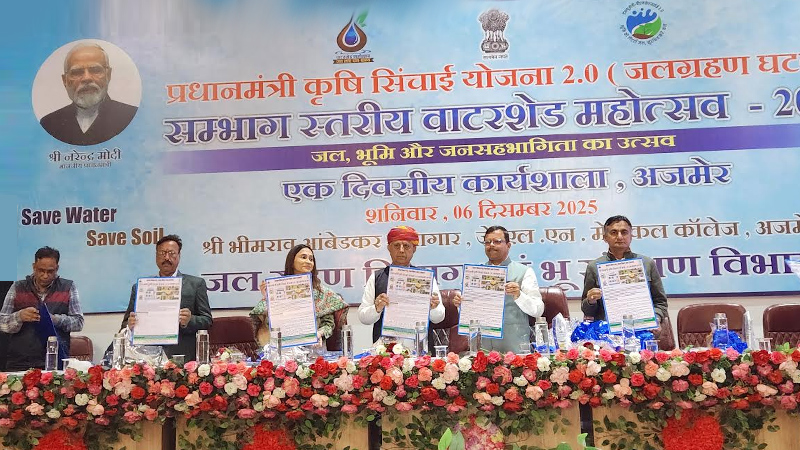
MUMBAI: Rajasthan is gearing up for a celebration that’s less about pomp and more about ponds as the Watershed Mahotsav flows into Ajmer on 6 December, spotlighting how community-led action is rewriting the state’s water story. Hosted at the JLN Medical College Auditorium, the Mahotsav brings together government teams, village leaders and partner organisations to reflect on one question that has quietly transformed the desert state, what happens when people take charge of their own water security?

The event will put the achievements of the Mukhya Mantri Jal Swalamban Abhiyan (MJSA) and the Pradhan Mantri Krishi Sinchay Yojana (PMKSY) under the lens, with teams from five districts presenting real on-ground shifts. Panchayati Raj members, local leadership and community representatives will share how watershed interventions have reshaped agriculture, storage and daily life. Senior dignitaries, including MP Bhagirath Choudhary and six MLAs from Ajmer, are slated to attend, underscoring the importance of the moment.

Piramal Foundation, a partner to the Watershed and Soil Conservation Department, is anchoring the Mahotsav to reinforce the power of Jan Bhagidari, a belief that durable water security emerges when communities co-create solutions. A short film by the Foundation, developed with the A.T.E. Chandra Foundation (ATECF), will be screened to show how desilting can measurably expand storage capacity and be funded through Finance Commission allocations. The film makes a compelling case for a low-cost, replicable rejuvenation model built on collective ownership rather than dependence.

Advertisement

The scale of progress already paints a vivid picture. In the past three years, ATECF and its partner organisations have rejuvenated nearly 1,180 waterbodies across 12 districts. Backed by FFC funding and implemented with the Piramal Foundation, the effort has been particularly effective in underserved areas 14 per cent of the rejuvenation has taken place in NITI Aayog’s Aspirational Districts and Blocks. The results are formidable: 1,191 crore litres of additional storage created, equivalent to over 10 lakh tanker trips, impacting an estimated 1.7 million people across roughly 1,700 villages.

Data from WRIS maps the road ahead. Rajasthan has approximately 82,000 waterbodies, of which nearly 49,000 are viable for revival. Aligning large-scale rejuvenation with MJSA could unlock water security for 26,000 villages, generate an estimated 33,210 crore litres of potential storage and save nearly Rs 9,963 crore in tanker expenditure. For a state living on the edge of the monsoon, the numbers speak louder than any speech.

The sentiment was echoed by Piramal Foundation lead of school of climate & sustainability Sangeeta Mamgain who said the organisation is adapting its Gandhi Fellowship model to strengthen natural resource management. “Through our collaboration with the Directorate of Watershed Development & Soil Conservation under MJSA in Ajmer, we aim to support machine-led rejuvenation of water bodies and contribute to a more climate-resilient Rajasthan.”

Advertisement

ATECF COO Amrtha Kasturi Rangan added, “Restoration accelerates when people, institutions and systems work together rather than apart. Watershed Mahotsav is a moment to acknowledge that shared effort. We remain committed to approaches that place people at the front and protect ecosystems.”

Offering a forward-looking view, Watershed Development and Soil Conservation IAS and director Muhammad Junaid P. P.  said, “The journey ahead remains significant. By collaboratively shaping a clear action pathway, we can strengthen long-term engagement and secure durable outcomes for communities across Rajasthan.”

With stakeholders from across sectors gathering in a single room, the Watershed Mahotsav aims to be more than an event, it aims to be a turning point. A place where stories from the field meet policy, where numbers meet lived experience, and where Rajasthan’s long-term vision for water security gathers momentum one revived waterbody at a time.


Advertisement
Click to comment

Leave a Reply

Your email address will not be published. Required fields are marked *

Brands

Microsoft faces worst quarter since 2008 financial crisis

Cloud giant battles soaring AI costs and fierce competition from nimble startups.

Published

on

MUMBAI: When the tech titan starts looking a little wobbly, even the Magnificent Seven can feel the tremors because Microsoft is currently starring in its own sequel, “Clouds and Doubts.” Microsoft is on track for its worst quarterly performance since the 2008 global financial crisis, according to Bloomberg, as investors grow increasingly uneasy about rising capital expenditure and intensifying competition from nimble AI firms. The company has been pouring money into AI infrastructure, yet markets are questioning when these hefty investments will finally deliver stronger revenue growth.

At the same time, investors are shifting away from traditional software stocks amid fears that AI startups such as Anthropic and OpenAI are developing autonomous agents capable of replacing established products, including those from Microsoft. Jonathan Cofsky, portfolio manager at Janus Henderson Investors, noted growing concern that customers may bypass Microsoft and deal directly with AI vendors, potentially disrupting its core business and putting pressure on pricing and margins.

Microsoft’s stock has tumbled 25 per cent in the first quarter, putting it on course for its largest drop since a 27 per cent fall in the fourth quarter of 2008. It has also emerged as the weakest performer among the so-called Magnificent Seven technology stocks, while a broader index tracking the group has fallen 14 per cent over the same period. The shares slipped a further 1.7 per cent after markets opened on Friday, marking a potential fourth consecutive session of declines.

Advertisement

Cofsky pointed out that Microsoft has become more capital intensive and that improved investor confidence will hinge on assurances that software growth will not slow materially. Despite the sell-off, the stock is now trading at less than 20 times projected earnings over the next 12 months, its lowest valuation level since June 2016. Its valuation remains slightly above that of the S&P 500 Index, although it has recently traded at a discount to the broader benchmark for the first time since 2015.

Bloomberg data shows Microsoft’s capital expenditure, including leases, is expected to surge to $146 billion in fiscal 2026, up around 66 per cent from $88 billion in fiscal 2025. Spending is projected to climb further to $170 billion in fiscal 2027 and $191 billion in fiscal 2028, based on average estimates. Investors are growing cautious about such levels of spending without clearer signs of stronger growth.

Microsoft’s Azure cloud division has reported a slight slowdown in growth compared with the previous quarter, while its Copilot AI product has seen limited user traction, prompting internal changes aimed at improving performance. Ben Reitzes, an analyst at Melius Research, warned in a March note that Microsoft’s upside in Azure could be constrained as the company works to address challenges related to its AI models and Copilot offering, adding that these issues are unlikely to be resolved in the short term.

Advertisement

Of the 67 analysts covering Microsoft, 63 maintain buy ratings, three hold ratings and one a sell rating. The average 12-month price target of $592 implies a potential upside of more than 64 per cent, the highest on record based on data going back to 2009. The stock is also trading below its 200-day moving average by the widest margin since 2009.

Reitzes suggested the dominance of buy ratings may indicate complacency among analysts, while highlighting risks in Microsoft’s productivity and business processes segment as well as its More Personal Computing division. In contrast, Tal Liani of Bank of America reinstated coverage with a buy rating, citing durable multi-year growth prospects across cloud and AI. Jake Seltz, portfolio manager at Allspring Global Investments, maintained that Microsoft retains strong long-term value and that its AI strategy is likely to be validated over time, viewing near-term concerns as a potential opportunity for longer-term investors.

The report highlights a growing divergence in market sentiment, with optimism around long-term AI potential weighed against immediate execution risks and investor uncertainty. In the world of big tech, even the mightiest clouds can have silver linings but right now, Microsoft’s investors are scanning the horizon for clearer skies.

Advertisement
Continue Reading

Advertisement News18
Advertisement All three Media
Advertisement Whtasapp
Advertisement Year Enders

Indian Television Dot Com Pvt Ltd

Signup for news and special offers!

Copyright © 2026 Indian Television Dot Com PVT LTD