Legal and Policies
India’s Right to Disconnect Bill: Switching off for sanity

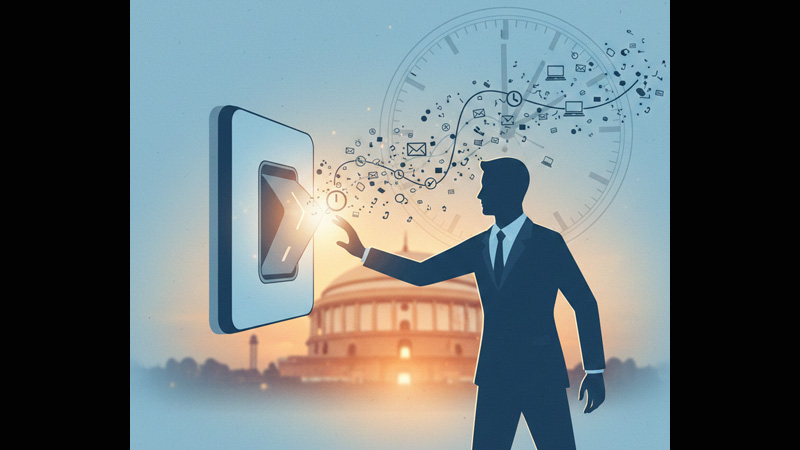
NEW DELHI: Indian workers could soon enjoy something revolutionary: the legal right to ignore their boss after clocking off. The Right to Disconnect Bill, 2025, a private member’s bill introduced in the Lok Sabha by NCP MP Supriya Sule during the Winter Session, proposes freeing employees from the digital leash that keeps them tethered to office communications beyond working hours.
The legislation tackles what many have experienced firsthand: the relentless ping of work emails at dinner time, late-night calls about tomorrow’s meeting, and the Sunday morning message asking for “just one quick thing.” Sule’s bill proposes the creation of an Employees’ Welfare Authority, which would ensure that workers face no repercussions for switching their phones to silent after deciding their workday has ended.
Companies with more than 10 employees would be required to negotiate clear after-hours communication norms with unions or employee representatives. If work beyond fixed hours becomes unavoidable, employers must compensate employees at normal wage rates. Firms that fail to comply with the rules could face a proposed penalty amounting to 1% of their total employee remuneration.
A complementary proposal came from MP Shashi Tharoor, who introduced an amendment bill seeking stronger safeguards against overwork. In Parliament, Tharoor referenced the death of Anna Sebastian Perayil, a 26-year-old EY professional whose case reignited public debate on exploitative working hours, arguing that unchecked overwork undermines both physical and mental health.
The Bill goes beyond boundary-setting. It calls for access to counselling services and the establishment of digital detox centres to address rising workplace afflictions such as “telepressure,” the compulsion to respond instantly, and “info-obesity,” a state of constant message monitoring. Comparable protections already exist in France (law introduced in 2016), Portugal (implemented January 2022), and Australia (right-to-disconnect amendments passed in 2024 with staged rollout).
However, as a private member’s bill, its path ahead is steep. Parliament rarely passes such bills; in fact, none have become law since 1970. Most are withdrawn after the government responds or stall without debate. Still, the introduction of Sule’s bill has sparked necessary conversations about workplace well-being in an increasingly hyper-connected economy.
For now, the proposal remains just that, a proposal. But its very presence on the floor of Parliament signals a growing recognition of a simple truth: genuine rest requires genuine disconnection. Whether lawmakers choose to act on that truth remains to be seen.