MAM
Kartik Aaryan episode raises questions on Indian cinema’s crisis management modus operandi

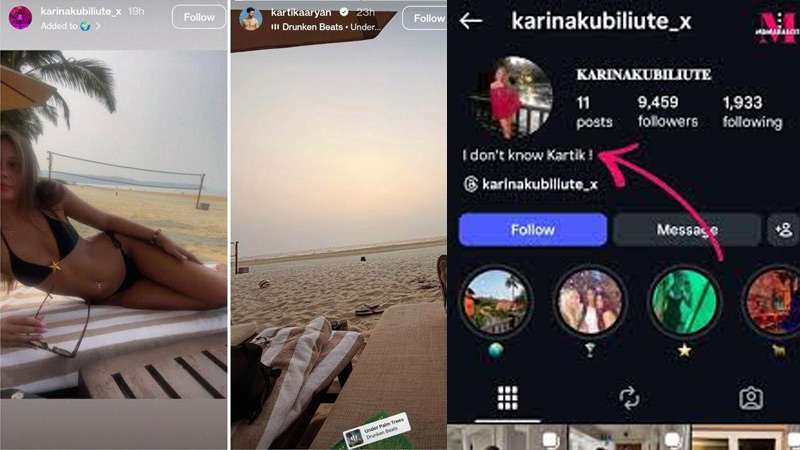
MUMBAI: One holiday photo, one Instagram trail and suddenly the industry was back in crisis mode. What began as a few sun-soaked images from Goa has now spiralled into a full-blown online storm complete with rumours, denials, timelines, talking points and a PR defence that many feel has only poured petrol on the fire.
Thespark came in late October, when vacation pictures of Kartik Aaryan began circulating online. Social media users quickly noticed that a young woman, identified online as Karina Kubiliute, had posted from similar beach locations around the same time. Screenshots travelled faster than clarifications, and speculation about whether the two were holidaying together took hold.
Within days, the conversation took a sharper turn. Users began sharing old birthday posts attributed to the woman’s family, suggesting she may be under 18. Based on those screenshots, many online inferred that she could be 17 at the time, though no official documents were made public and no legal confirmation followed. Still, the optics alone were enough to set social media alight.
As the noise grew, Karina Kubiliute stepped in. She publicly denied any romantic association, briefly adding “I don’t know Kartik” to her Instagram bio before removing it and switching off comments, a move widely read as an attempt to escape the sudden spotlight. Kartik Aaryan, meanwhile, made no public statement, leaving the discussion to play out online.
That silence created space and into it rushed a response seen often in the past from the Indian cinema community.
Within hours, a familiar chorus took over social media timelines. Trade voices, film journalists and influential fan accounts appeared to echo strikingly similar talking points framing the actor as an “outsider under attack”, warning of a “smear campaign”, and recasting criticism as yet another chapter in the film industry’s long history of bullying stars not having an Indian cinema pedigree. Whether coordinated or coincidental, the uniformity was impossible to miss and it quickly became the story.
The outsider narrative has, in the past, worked in Aaryan’s favour. His rise without filmi lineage is real, and his his non-conforming with the industry establishment is well-documented.. But critics argue that recycling the same victimhood script in this controversy felt deeply misplaced.
What unsettled many observers was not defence itself, but the choice of defence. This wasn’t a box-office rivalry or an industry feud. It was a rumour involving age sensitivity and optics. Reaching for the well-worn “outsider victim” narrative felt, to some, like a mismatch, a familiar script applied to an unfamiliar situation.
The reaction intensified when parts of the online discourse began invoking Sushant Singh Rajput, drawing parallels between past industry bullying and the current backlash. While no official statement made such a comparison, the association gained traction in fan-led spaces and that’s where the mood shifted. For many, bringing an unrelated tragedy into a dating rumour felt excessive, even uncomfortable.
Instead of cooling the conversation, the defence seemed to stretch it. Questions were reframed as attacks, scepticism as persecution. Critics pushed back, not just on the rumours, but on the response itself. The focus drifted from what happened in Goa to how loudly and uniformly the defence was being mounted.
Meanwhile, the controversy continued to grow without new facts. The actor’s professional life rolled on, with multiple films in the pipeline and releases lined up for 2026. Online, however, the story had already moved beyond holiday photos. It had become a talking point about Indian cinema’s increasingly visible PR machinery and whether it knows when to step back.
What this episode has shown is less about guilt or innocence and more about timing, tone and tactics. In the age of hyper-aware audiences and screenshot journalism, old-school damage control doesn’t always land the way it used to. Sometimes, the defence becomes louder than the allegation and that’s when curiosity turns into criticism.
For now, the controversy remains rooted in speculation, not verified findings. But as Indian cinema has learned repeatedly, in the social media era it’s not just what happens that shapes a story, it’s how quickly, and how noisily, it’s handled.
And in this case, the noise may have done more talking than the truth ever did.