AD Agencies
Arijit De joins Adfactors PR as director


MUMBAI: Arijit De has taken up a new role as director at Adfactors PR, marking his return to frontline consulting after nearly three decades at the sharp end of communications, media and corporate affairs.
De joins India’s largest communications consulting firm following a four-and-a-half-year stint at Burson, where he served as chief client officer and was part of the India management team, advising top-tier multinational and Indian companies on positioning, narrative, issues and crisis management.
A senior strategic communications professional, De brings deep experience across financial services, conglomerates and global institutions. His career spans leadership roles at Standard Chartered, where he headed corporate communications for India and South Asia and earlier led group media relations in London; Bank of America Merrill Lynch, where he was India head of marketing and corporate affairs; and Reliance Capital, where he served as chief communications officer.

Before moving into corporate communications, De built a strong editorial career. As Mumbai bureau chief at Business Standard, he rebuilt the paper’s newsroom and covered India’s largest conglomerates, including the Tata group and the Aditya Birla group. He began his career as a reporter in the mid-1990s, covering sectors from telecoms and energy to FMCG and automobiles.
At Adfactors PR, which advises clients across more than 25 industries in 40 cities and was named one of PRovoke Media’s global “Agencies of the Decade”, De is expected to strengthen senior counsel and leadership across complex mandates.
From newsroom to boardroom and back to advisory, De’s move signals a familiar truth in Indian communications: when reputations are on the line, experience still talks loudest.







AD Agencies
Fevicol releases its last ad campaign by the late Piyush Pandey
The adhesive brand’s last campaign by the late advertising legend Piyush Pandey turns an everyday Indian obsession into a quietly powerful metaphor
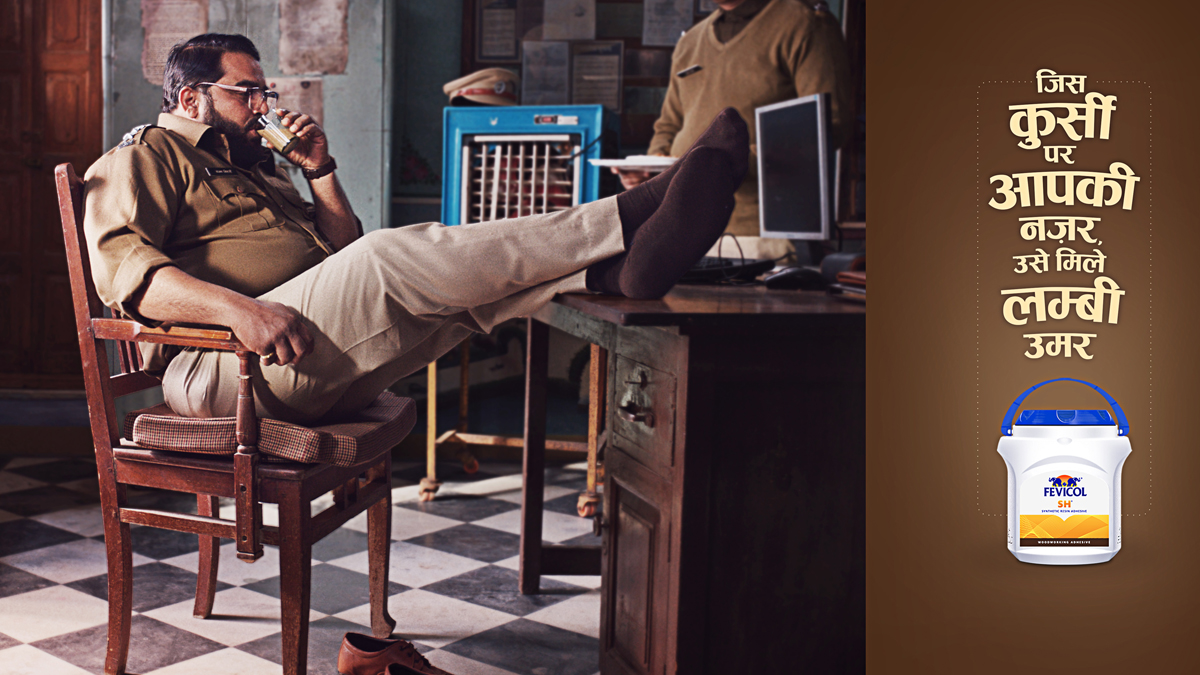
MUMBAI: Fevicol has never needed much of a plot. A sticky bond, a wry observation, a truth that every Indian instantly recognises — that has always been enough. “Kursi Pe Nazar,” the brand’s latest television commercial, is no different. And yet it carries a weight that no previous Fevicol film has had to bear: it is the last one its creator, the advertising legend Piyush Pandey, will ever make.
The film, released on Tuesday by Pidilite Industries, fixes its gaze on the kursi — the chair — and what it means in Indian life. Not just as a piece of furniture, but as a currency of ambition, a vessel of authority, and a source of quiet social drama that plays out in every home, office and institution across the country. Who sits in the chair, who waits for it, and who eyes it hungrily from across the room: the film transforms this sharply observed cultural truth into a narrative that is, in the best Fevicol tradition, funny, warm and instantly familiar.
The campaign was Pandey’s idea. He discussed it in detail with the team before his death, but did not live to see it shot. Prasoon Pandey, director at Corcoise Films who helmed the commercial, said the team needed five months to find its footing before they felt ready to shoot. “This was the toughest film ever for all of us,” he said. “It was Piyush’s idea, magical as always.”
The emotional weight of that responsibility was not lost on the team at Ogilvy India, which created the campaign. Kainaz Karmakar and Harshad Rajadhyaksha, group chief creative officers at Ogilvy India, described the process as “a pilgrimage of sorts, on the path that Piyush created not just for Ogilvy, but for our entire profession.”
Sudhanshu Vats, managing director of Pidilite Industries, said the film was rooted in a distinctly Indian insight. “The ‘kursi’ symbolises aspiration, transition, and ambition,” he said. “Piyush Pandey had an extraordinary ability to elevate such everyday observations into iconic storytelling for Fevicol. This film carries that legacy forward.”
That legacy is considerable. Over several decades, Pandey’s partnership with Fevicol produced some of the most beloved advertising in Indian history, building the brand into something rare: a household name that people actively enjoy watching sell to them.
“Kursi Pe Nazar” does not try to be a tribute. It simply tries to be a great Fevicol film. By most measures, it succeeds — which is, in the end, the most fitting send-off of all.